
 Search


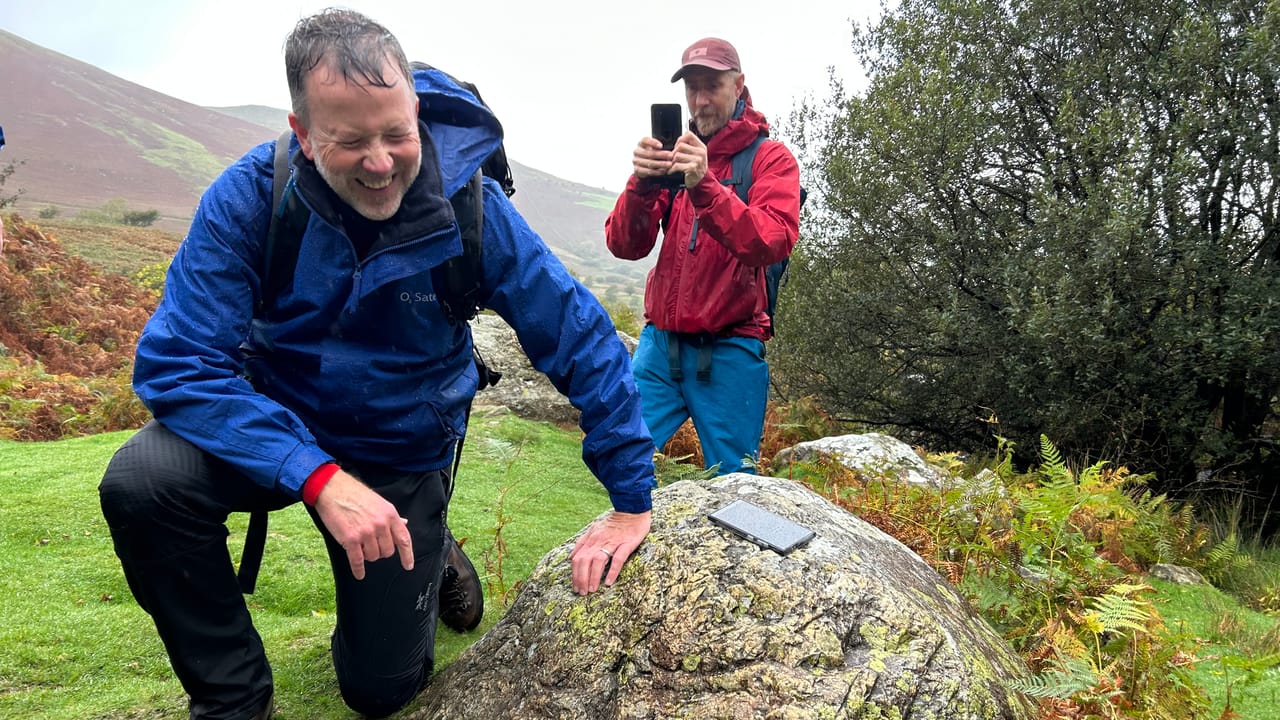
Virgin Media O2's Rob Joyce sees the fun side of using Starlink to establish a mobile connection in rural Wales.(Source: Iain Morris/Light Reading)
Mountainous Snowdonia in northern Wales is honeycombed with "not-spots," the geographical zones of a country still untouched by a standard mobile signal delivered by Earth-bound towers. That made it an ideal place for Virgin Media O2 (VMO2), one of the UK's three mobile operators, to demonstrate the satellite backup service it launched earlier this year to a privileged group of analysts and reporters.
For an extra monthly fee of just £3 (US$4), any VMO2 customer with a modern smartphone who is beyond the reach of a tower can use O2 Satellite instead. It follows an agreement the operator struck this time last year with Starlink, the satellite offshoot of Elon Musk's SpaceX business. Using a technology called direct-to-device (D2D) or direct-to-cellular (D2C), a signal is beamed to the smartphone not from a local basestation but straight from space – specifically from a Starlink satellite orbiting the planet at an altitude of about 350km and a speed of around 17,500mph.
On a blustery, drizzly and mist-filled day in the gorgeous town of Caernarfon, the initial challenge for the intrepid team of satellite explorers was finding a not-spot. In most ways, that was a nice problem for VMO2 to have. The rival terrestrial mobile service provided by BT-owned EE was largely unavailable while VMO2's stubbornly refused to vanish, like a nuisance guest at a party. Until it did, the default settings meant the satellite could not be used.
But a suitable not-spot was eventually found after a mud-squelching hike to Aber Falls, where thin ribbons of mist clung to the frizzy braids of white water streaming down the cliffside. Off the trail later in the day, following some initial frustrations that may have been weather-related, VMO2's Rob Joyce managed to establish satellite connectivity, validated on a device screen by the appearance of the letters "SAT" where a customer would normally see "4G" or "5G" in the presence of cellular. Texts were sent. An Internet-based voice call was made.
'Reassurance of coverage'
The ability to do this halfway up a Welsh mountain should not be underestimated. At one time, satellite technology required users to carry brick-sized phones with antennas that resembled fencing foils. The ongoing D2D/D2C revolution, combined with the investments Musk and others have made in newer low-Earth orbit (LEO) satellites, allow iPhone and Android phone users to remain contactable for the price of an ice cream in some of the remotest areas. Only the most churlish would argue it is not worth the money.
Yet the demo also showed the current limitations of satellite. Only about 650 Starlink satellites today support the D2D service, according to Joyce, the director of mobile access engineering for VMO2. Orbital paths meant there was not always a satellite directly overhead in north Wales, leading to gaps in coverage.
Any hiker expecting to catch up with the latest episode of The Traitors at the bottom of Aber Falls would also be disappointed. That is certainly not how VMO2 markets O2 Satellite, but Starlink is for now restricted to supporting basic data services. Text messages and even Internet-based voice calls work. Ordinary voice calls do not, and video streaming would be ambitious. "It doesn't do native voice calling yet, so it's a pure data service," Joyce said during a presentation before the trek. "Obviously, it's not meant yet for doing high-bandwidth applications. It's there for reassurance of coverage beyond the current cellular footprint."
To support the service, VMO2 is sharing a 5MHz sliver of spectrum in the 1800MHz band between cellular and satellite to provide 4G connectivity via Starlink. Joyce reckons customers should be able to enjoy speeds of about 4 Mbit/s. "We estimate 4 Mbit/s per spot beam, and these satellites have about 50 spot beams," he said, explaining that a spot beam has a diameter of about 50km. "It's 4 Mbit/s of capacity in a 50km diameter. So, depending on how many O2 Satellite subscribers we have, they share that value." Were they all to attempt a streaming of the World Cup, there would be a problem, he acknowledged.
The intention, of course, is to boost landmass coverage. Thanks to a UK initiative with other telcos called the Shared Rural Network, VMO2 can already boast availability of about 89% on its nationwide terrestrial network. The Starlink deal lifts this to 95%, with those six percentage points equivalent to about two thirds the area of Wales.
Starlink's technology roadmap should also lead to improvements for VMO2. That includes Musk's recent 14MHz acquisition of 800MHz spectrum in the US. "If they are going to build satellites that do 800MHz, when they fly across Europe, we can use that 800MHz," said Joyce, noting that VMO2 has its own 10MHz allocation in that range as well as spectrum in adjacent bands.
Today's service also works on Starlink's first generation of D2D technology with its relatively small constellation of 650 satellites. The launch of a newer generation and a substantial increase to about 15,000 satellites will furnish VMO2 and other customers with "a lot more bandwidth," said Joyce. "It's 20 times or it's 100 times the capacity, depending on how much spectrum we deploy." Suddenly, people clambering up hills outside the cellular footprint will be able to stream movies and make voice calls, he said.
No cellular replacement
For all the optimism about what satellite will be able to deliver in rural areas by the late 2020s, Joyce is adamant that it will never be a full replacement for cellular. "The reason is quite simple – from 10km away it's quite hard to get a signal into this room, and that's coming through the windows and through plasterboard walls," said Joyce, speaking from a dining room in Caernarfon's Celtic Royal Hotel. "If you're 350km away, and you're coming through tile roofs, aluminium reflective foil and then three stories, there is no way you're going to get a signal indoors."
Generation-two Starlink satellites will increase the number of spot beams and shrink the diameter of a spot beam to around 25km. But this would still leave it short of the capacity and coverage needed to provide service deep indoors, according to Joyce. "Is Elon going to challenge the cellular operators?" he said. "No, he can't."
Can't, that is, through satellites or the construction of small cells, a US plan aired by Starlink executives earlier this year and subsequently criticized by numerous experts. None of that rules out Musk's future signing of a mobile virtual network operator agreement, allowing him to piggyback on the macro cells already built by terrestrial operators. Whatever technology it uses, a Starlink-branded service could be a formidable competitor in the US.
Even so, Joyce does think VMO2 might be able to avoid building out new terrestrial sites in rural areas and rely on Starlink as a more economical alternative. By the late 2020s, more people will have satellite-capable phones and VMO2 will be turning off its old 2G network. Replacing that with terrestrial 4G could look costlier than beaming a more advanced satellite service to customers in those areas.
"It's one small text for man, it's one giant leap for the O2 network," Joyce messaged his boss – VMO2 chief technology officer Jeanie York – in November last year when he first began testing the Starlink service. For all the current limitations, it works as what could be a lifesaving fallback in certain scenarios. And it looks due to get a lot better.

-
 C114 Communication Network
-
 Communication Home
