
 Search

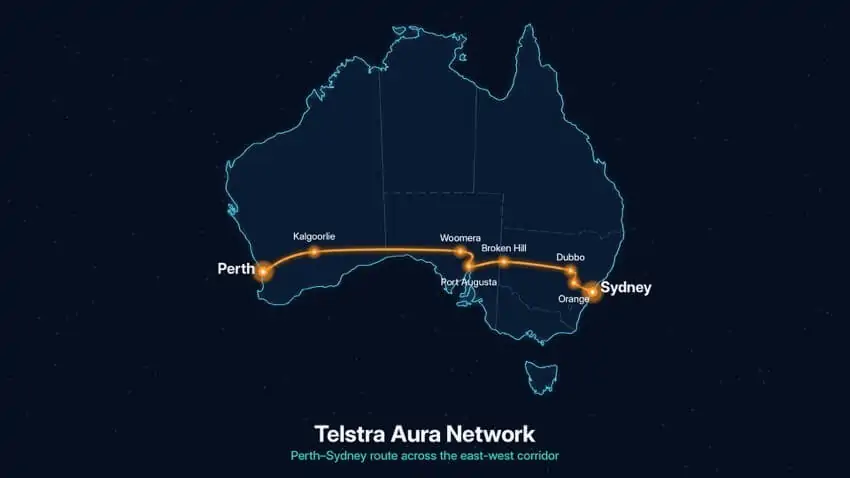
Telstra has activated the Perth-to-Sydney route of its Aura Network, completing the longest segment yet of its new national intercity fiber system and establishing a high-capacity terrestrial path spanning Australia from west to east. The route starts in Perth and passes through Kalgoorlie, Woomera, Port Augusta, Broken Hill, Dubbo and Orange before reaching Sydney. Telstra says more than 9,000 kilometers of Aura fiber have now been built, with six routes ready for service.
The Perth-Sydney activation significantly expands the geographic reach of an infrastructure program that began delivering commercial routes in 2025. Aura, originally known as Telstra’s Intercity Fibre Network, is being constructed as an approximately 14,000-kilometer national backbone linking Australia’s mainland capital cities and regional locations. The network supports three commercial models: dark fiber for customers seeking control of the underlying optical infrastructure, Direct Spectrum offering 3.8 to 15.2 Tbps of scalable spectrum capacity, and managed wavelength services at 100 Gbps and 400 Gbps. Telstra has previously said dark-fiber customers can support capacity of up to 83.6 Tbps between capitals.
The new route also strengthens the terrestrial infrastructure connecting Western Australia with cloud regions, data centers and international cable gateways on Australia’s east and west coasts. That role has become more significant as hyperscalers secure capacity on Aura: Microsoft is a foundation partner, while Google announced an agreement in June to obtain intercity dark fiber capacity as part of a broader arrangement combining Telstra’s terrestrial network with Google’s Pacific subsea systems. Telstra reported in August that it also has long-term infrastructure contracts with AWS and Australian AI infrastructure provider Firmus.
| Telstra Aura Network — Perth-Sydney Route | |
| Status | Live / Ready for Service |
| Route | Perth → Kalgoorlie → Woomera → Port Augusta → Broken Hill → Dubbo → Orange → Sydney |
| Network Build | 9,000+ km of Aura fiber built |
| Routes Ready | Six routes ready for service |
| Dark Fiber | Customer-managed fiber supporting up to 83.6 Tbps between capitals |
| Direct Spectrum | 3.8–15.2 Tbps with customer equipment flexibility |
| Wavelength | 100G / 400G managed point-to-point connectivity |
| Target Infrastructure | Data Centers • Cloud Regions • AI Infrastructure • Subsea Gateways |
Steven Worrall, CEO of Telstra Digital Infrastructure, said: “AI may capture the headlines, but AI is not just a software story. It’s an infrastructure story.”
Analysis
The significance of the Perth-Sydney activation is less about introducing a new optical service than about extending Aura into a genuinely national-scale infrastructure platform. The first Intercity Fibre Network route announced in May 2025 connected Sydney and Canberra, when Telstra had deployed more than 4,000 kilometers of fiber. Aura has now passed 9,000 kilometers, providing a new high-capacity terrestrial path across the Australian continent.
The route also creates another layer in Australia’s emerging AI and cloud connectivity architecture. Western Australia is an important landing region for international subsea systems, while Sydney is Australia’s largest cloud and data-center market. Connecting those ecosystems with new terrestrial infrastructure provides customers with additional choices for capacity and route diversity. Google’s agreement to take Aura dark fiber illustrates how hyperscalers can combine dedicated terrestrial fiber with their own international subsea assets rather than treating those networks as separate infrastructure domains.
Aura is also evolving technically beyond the initial 100G/400G managed-service proposition. In September, Telstra and Ciena demonstrated four 400GbE client services over a single 1.6 Tbps wavelength across approximately 1,100 kilometers between Melbourne and Sydney using WaveLogic 6 Extreme and L-band spectrum on the live Aura Network. That does not mean 1.6 Tbps is currently a standard Aura wavelength service, but it demonstrates the optical headroom Telstra is testing as traffic requirements move beyond today’s commercial 400G services.
| Telstra — Company Profile | |
| Company | Telstra Group Limited |
| Market | ASX: TLS |
| CEO | Vicki Brady, CEO and Managing Director |
| Digital Infrastructure | Steven Worrall, CEO, Telstra Digital Infrastructure |
| Headquarters | Melbourne, Victoria, Australia |
| Strategic Focus | Australian and international digital infrastructure spanning terrestrial fiber, subsea connectivity, data centers, mobile networks and associated infrastructure services. |

-
 C114 Communication Network
 -
 Communication Home
