
 Search

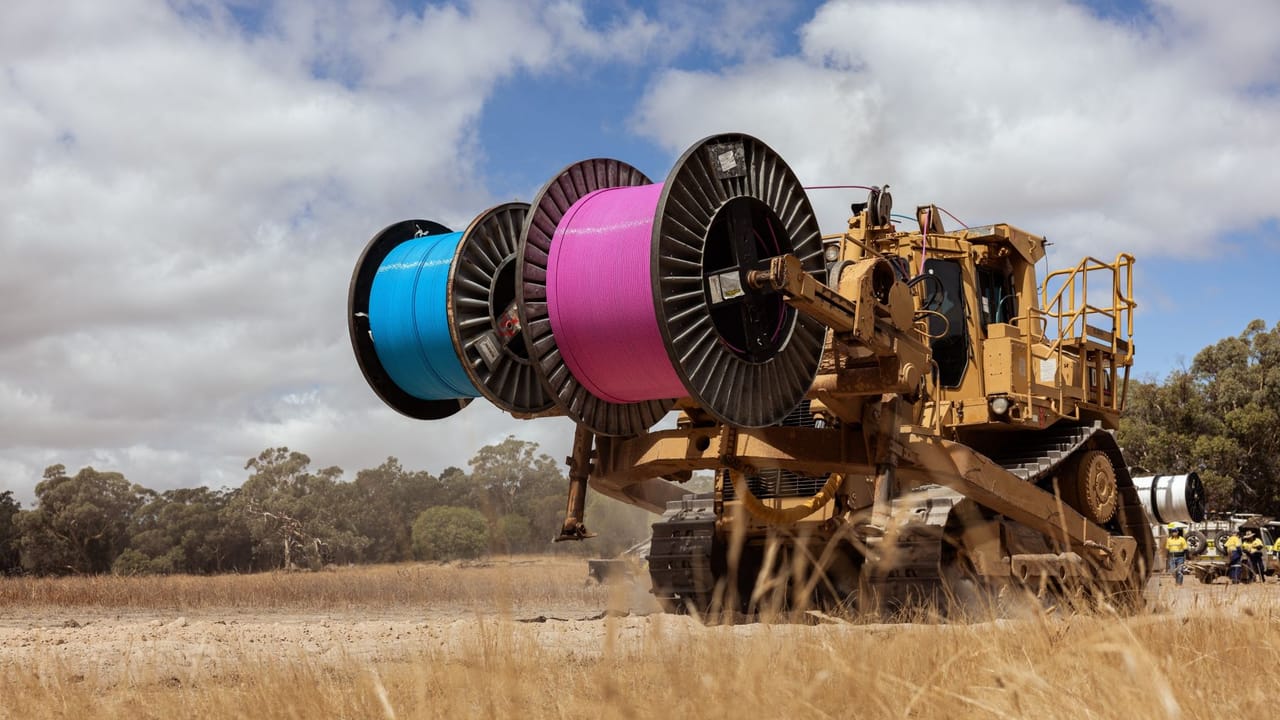
(Source: Telstra)
Telstra has reached a milestone in the development of its terrestrial Aura Network by activating the Perth–Sydney route, bringing the 10-route inter-city fiber project closer to completion by fiscal year 2028.
The company has now laid 9,000km of the planned 14,000km fiber-optic network, with active routes now in place across the major Australian cities of Sydney, Melbourne, Canberra and Perth.
To date, six routes have been built, accounting for around 65% of the Aura Network. These are the Sydney-Canberra Coastal, Sydney-Canberra Central, Melbourne-Canberra Central, Sydney-Perth Direct and Adelaide-Wilmington Direct routes.
"Our next committed milestones are Adelaide-Melbourne, the coastal Perth-Adelaide route, Sydney-Brisbane and Darwin-Glendambo, which are planned for completion by FY28," Roary Stasko, Telstra's Digital Infrastructure's chief customer and growth officer, told Light Reading.
East-West digital corridor
As the longest route within the Aura Network, the Perth-Sydney connection strengthens the link between Western Australia and the eastern states of the country. It establishes a digital pipeline connecting major cloud hubs and data centers in the eastern states directly to Perth. From there, it also links to global subsea cable networks, significantly improving international data flow.
"Perth is an important landing point for subsea cables connecting Australia with global markets," Stasko pointed out. "The Aura Network provides the high-capacity terrestrial backbone that can carry those international data flows beyond the cable landing point, connecting Western Australia’s global gateways with data centers, cloud regions, major cities and industry across the country."
Designed as the next-generation "digital superhighway," the Aura Network provides up to 35 times more fiber capacity per path, meeting the ever-increasing demand for bandwidth amid the AI boom.
"In practical terms, where a conventional fibre path provides one lane of capacity, the Aura Network is engineered to provide up to 35 lanes, giving customers substantially more room to scale as AI, cloud and data center traffic grows," Stasko said.
"Customers can choose from managed wavelength, direct spectrum, and dark fiber options, depending on the capacity and level of network control they require. The Aura Network’s two-path architecture also combines an express intercity route with regional connection points," he added.
Economic opportunities
New research by Oxford Economics, commissioned by Telstra, states that the Aura Network will play a crucial role in boosting Western Australia's digital economy.
"The largest opportunities lie at the intersection of digital capability and WA’s existing industrial strengths," the study said. "In mining, higher-capacity connectivity can support autonomous fleets, remote operations, industrial AI, digital twins and predictive maintenance. The state’s aspirations to develop internationally recognized manufacturing will require hosting advanced robotics and the surrounding technology ecosystem to enable it."
As Western Australia evolves rapidly into a strategic defense hub in the Indo-Pacific, the study noted that the new Perth–Sydney route can expect sustained demand for secure communications, cyber capability, simulation, digital engineering and data-intensive asset management.
"The Aura Network can support these agendas by strengthening the connectivity platform for AI, cloud services, automation, secure data exchange and regional service delivery," the research stated. "In doing so, it helps position WA as a competitive and attractive location in the Southern Hemisphere to build, power and operate the digital and AI infrastructure of the future."
Oxford Economics estimated that Western Australia's digital economy could grow from $16.8 billion Australian dollars (US$11.67 billion) in fiscal year 2025 to approximately AU$89.1 billion ($61.91 billion) by fiscal year 2040 under an accelerated digital adoption scenario.
From subsea to terrestrial
While subsea cables have historically dominated Australia's connectivity investments – expanding capacity and linking the country to global networks – the strategic focus has now rebalanced toward terrestrial fiber. These on-land networks now require urgent upgrades to handle the exponential demands of AI and cloud workloads.
"This is about more than adding fiber. AI, cloud and data center expansions are changing where capacity is required and creating demand for networks with diverse, resilient routes that can withstand outages, congestion and other disruptions," Brendan Swan, senior analyst at GlobalData wrote in a recent blog.
Telstra has a significant headstart with its Aura Network (formerly known as the Intercity Fibre Network), which was unveiled in 2022. The multi-year AU$1.8 billion ($1.25 billion) project aims to build a brand new ultra-high-capacity intercity fiber network linking major hubs like Adelaide, Perth, Sydney and Melbourne.
In May 2025, the company announced that the Sydney-Canberra route, the first official segment of the network, was finalized and ready for commercial service. The critical Sydney-Melbourne coastal route was activated in October of the same year.
The network is already meeting demand from cloud, AI and digital infrastructure providers. Technology giants Microsoft and Google have secured capacity on the Aura Network to help meet the growing need for connectivity.
In an article posted on the Telstra website on Wednesday to mark the launch of the Perth-Sydney route, Telstra Digital Infrastructure CEO Steven Worrall observed that all customer conversations ultimately come back to infrastructure.
"AI may capture the headlines, but AI is not just a software story. It's an infrastructure story. Every AI application depends on data moving between people, systems, data centres and clouds quickly, securely and reliably. As AI adoption accelerates, demand for that infrastructure is accelerating too," he wrote.
"That's why we made the decision to invest ahead of demand," he added.
Meanwhile, Stasko told Light Reading that looking beyond the committed build of the Aura Network, Telstra has also completed designs for potential routes between Perth and Darwin, and between Brisbane and Darwin.
"Any investment decisions on those routes will be subject to customer demand," he said.
Telstra is not the only company building Australia's next-generation terrestrial networks.
In July, fiber specialist Vocus announced plans to construct the country's first ducted long-haul fiber route between Sydney and Melbourne at a cost of AU$500 million ($347.4 million). The project is expected to be completed by 2029.
The company is also set to build its second long-haul fiber route with ducted technology. Spanning 4,000km, the route will connect Brisbane, Townsville and Darwin in northern Australia, with an expected completion date of 2030.
The two projects are part of the company's Australian Digital Infrastructure Platform (ADIP), a multi-year initiative launched by Vocus to address the country's growing fiber capacity gap amid the AI boom.

-
 C114 Communication Network
 -
 Communication Home
