
 Search

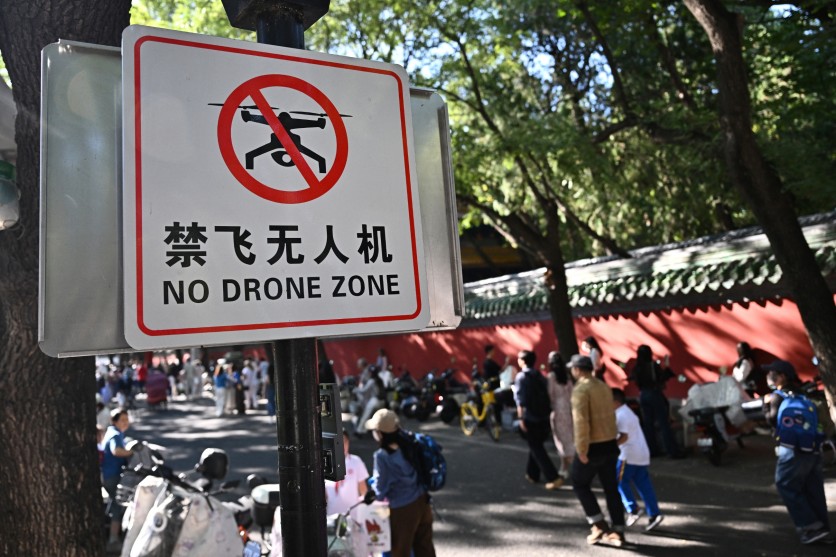
People walk past a sign reading "No drone zone" in an alley in Beijing on September 14, 2026. Beijing will ban the possession of drones within city limits under new rules from November, further tightening regulations that already prohibited the sale of the devices. Pedro PARDO/AFP via Getty Images
Beijing drone owners have roughly two months to get rid of their equipment — or lose it to authorities without appeal. Revised regulations announced Sunday by Beijing authorities will ban the possession or storage of any unmanned aerial vehicle or core component anywhere within the Chinese capital's city limits, effective November 15. Authorities can confiscate drones from owners who do not comply and can impose fines on both individuals and companies.
The new rules extend a crackdown that began in May, when Beijing became the first Chinese city to ban drone sales outright. That earlier ban stopped Beijing residents from buying or importing drones but allowed existing registered owners to keep up to three devices at a single address inside the sixth ring road. The possession ban eliminates that limited protection entirely, requiring all registered owners in a city of roughly 22 million to dispose of their property before the deadline.
From Sales Ban to Property Prohibition: What Changed This Summer
Beijing's drone regulations tightened in three distinct stages over the course of 2026. The city's legislature approved sweeping rules in March; they took effect May 1. Under the initial framework, drones and 17 designated core components could not be sold, leased, or brought into the city without explicit permission from public security authorities. Existing owners who completed real-name police registration by April 30 were allowed to keep their registered devices, though storage was capped at three drones or ten core components per address within the sixth ring road.
The second-stage rules did not arise from a gradual regulatory review. They arose from a crash.
On June 26, 2026, a pilot died when his small aircraft struck Beijing's tallest building — the 528-meter (1,732-foot) CITIC Tower, also known as China Zun — while the building was occupied during regular business hours. Thirteen others were injured. The aircraft was a Sunward SA60L Aurora, a domestically produced two-seat light-sport plane. Flight data from Flightradar24 showed it took off 50 kilometers east of Beijing and flew west across the city before striking the building.
The CITIC Tower sits in Beijing's Central Business District, in close proximity to Zhongnanhai — the walled compound that houses the offices of the Communist Party's senior leadership. Chinese authorities did not issue an official statement on the crash, and social media footage was scrubbed from domestic platforms. Witnesses reported deleting their own recordings.
The crash exposed something Beijing's regulators could not ignore: even the city's existing, unusually strict airspace controls — which already required advance authorization for any outdoor flight and designated the entire administrative area as controlled airspace — failed to prevent a registered, transponder-equipped aircraft from penetrating central Beijing airspace. The possession ban is, in part, an acknowledgment that the prior enforcement architecture was insufficient. Removing devices from the city entirely is the only approach that eliminates the enforcement gap.
What Beijing Drone Owners Must Do Before November 15
Under the revised regulations released Sunday, owners have three options before the deadline.
Beijing authorities are offering subsidies for existing owners to sell their devices at designated buyback locations, according to the state-owned newspaper Beijing Daily. Owners may also scrap or recycle their drones for a smaller subsidy. The third option is to ship devices outside Beijing before the November 15 deadline — drone use is still permitted in other Chinese provinces, though real-name registration requirements apply everywhere.
The logistics are significant. Bringing registered equipment in or out of Beijing requires prior notification to authorities. Drones sent outside the city for repair must be collected in person rather than delivered back. Repairs within Beijing are prohibited entirely. For owners whose devices break before November 15, replacement is not possible under existing rules.
Tourists are not exempt. Bringing drones into Beijing from outside the city was already prohibited under the May rules; the possession ban reinforces that.
Narrow exemptions exist for counter-terrorism, emergency rescue, agriculture, and education and research purposes — each requiring explicit governmental authorization beforehand. No exemption exists for recreational or commercial creative use.
Can You Still Fly Drones Anywhere in China?
Yes, though the regulatory environment has tightened significantly across the country. Beijing's restrictions are the most severe, but national rules require real-name registration for all drone operators. Approval for outdoor flights is required even outside the capital, and the permit system has grown increasingly difficult to navigate in practice.
Steven Wang, a university student and drone enthusiast interviewed by CNN, described the situation before the possession ban was announced: "I have to apply for permission for each flight, which is very inconvenient. And starting this year, the wait time is getting longer, and the reasons for rejection are becoming more vague." Wang's account was reported in CNN's Beijing coverage.
In northern China, one drone owner described to the New York Times submitting three dozen flight applications before the May rules took effect. Two were approved, both limited to flights below roughly 9 meters (30 feet) and within line of sight.
DJI Squeezed on Two Fronts Simultaneously
For DJI, headquartered in Shenzhen and holding roughly 70 percent of the global consumer drone market, the Beijing possession ban lands on top of the worst regulatory crisis in the company's history.
In the United States, the Federal Communications Commission placed DJI on its Covered List on December 22, 2025, effectively blocking new DJI models from receiving equipment authorization and entering the American market. DJI filed a petition with the U.S. Court of Appeals for the Ninth Circuit on February 20, 2026, arguing the FCC decision carelessly restricts DJI's US business and denies US customers access to its latest technology. In an April 15, 2026 filing in the same case, DJI told the court that the FCC action had blocked 14 DJI products outright, frozen 25 planned 2026 product launches, and is projected to cost the company approximately $1.56 billion in lost revenue this calendar year alone.
DJI cleared its Beijing retail shelves ahead of the May 1 sales ban. The company did not respond to press inquiries regarding the September possession ban announcement. The combination of Beijing's domestic crackdown and Washington's import restrictions has placed the world's largest drone manufacturer under simultaneous pressure in its two most important markets.
The broader Chinese drone industry, however, is not uniformly disadvantaged. Commercial, industrial, and state-approved drone operations can continue in Beijing with appropriate authorizations. What is disappearing is consumer drone ownership — not the commercial drone economy the government is actively cultivating.
Beijing as Template: The Low-Altitude Economy Paradox
Beijing's action is unfolding against the backdrop of China's stated ambition to build the world's dominant commercial drone economy. The government has designated what it calls the "low-altitude economy" — encompassing commercial drone delivery, air taxis, agricultural applications, infrastructure maintenance, and building inspection — as a strategic priority in its 15th Five-Year Plan (2026-2030). The sector is projected to generate ¥3.5 trillion by 2035 (approximately $486 billion), according to Civil Aviation Administration of China estimates. China had more than 3 million registered drones by the end of 2025 — a 50 percent increase from the prior year.
The possession ban does not contradict that ambition. Analysts who have examined the Beijing restrictions argue the municipal government is effectively nationalizing low-altitude airspace — clearing amateur and consumer traffic from the sky to make room for a state-managed commercial drone infrastructure. The exceptions carved into the regulations reinforce that reading: state-sanctioned enterprises can apply for authorization; private hobbyists and creative professionals cannot.
Regulators in other densely populated cities across Asia, Europe, and the Middle East have been monitoring Beijing's model as they develop their own low-altitude airspace frameworks. No other major city of comparable size — Beijing's administrative jurisdiction covers approximately 16,410 square kilometers (6,336 square miles), larger than the state of Connecticut — has moved from a sales ban to a possession ban on this timeline.
Lizzi C. Lee, a fellow on the Chinese economy at the Asia Society Policy Institute's Center for China Analysis, described the Beijing approach as experimenting with a comprehensive front-end approach to drone management. The November deadline will test whether that approach can be enforced at city scale — and whether other governments watching closely will follow.
Frequently Asked Questions
What happens to Beijing drone owners who don't comply by November 15?
Under the revised regulations, authorities are empowered to confiscate drones and their key components from anyone who still possesses them within Beijing's city limits after November 15, 2026. Fines can also be imposed on both individuals and companies. Owners have until that date to sell devices at official buyback locations, scrap or recycle them for a subsidy, or physically transport them outside Beijing's administrative boundaries.
Why did Beijing ban drone possession — not just sales and flights?
The May 2026 sales and flight restrictions were Beijing's initial attempt at airspace control. But the June 26, 2026 crash of a light aircraft into the CITIC Tower — killing the pilot and injuring 13 people inside the building — demonstrated that existing controls, including mandatory flight authorizations and real-name registration, could not prevent unauthorized aircraft from penetrating Beijing's most politically sensitive airspace. A possession ban is the enforcement endgame: when you cannot reliably police who is flying, you remove the ability to fly at all by eliminating the devices from the city entirely.
Does the ban affect travelers visiting Beijing?
Yes. Bringing a drone into Beijing from outside the city was already prohibited under the May 2026 rules, and the revised regulations reinforce this prohibition. Tourists, business travelers, and transit passengers with drones in their luggage are prohibited from bringing those devices into Beijing. The ban applies to the city's full administrative jurisdiction — not just the urban core — covering an area of approximately 16,410 square kilometers (6,336 square miles).
What does Beijing's possession ban mean for China's commercial drone industry?
The ban applies specifically to individual consumer ownership and is not intended to halt commercial drone operations. State-authorized enterprises can still apply for permission to operate drones commercially in Beijing for approved purposes including delivery, infrastructure maintenance, agriculture, and emergency services. Analysts describe the possession ban as part of a broader effort to "nationalize" low-altitude airspace — reserving it for regulated commercial operators while eliminating uncontrolled private use — in support of China's ¥3.5 trillion (approximately $486 billion) low-altitude economy target by 2035.

-
 C114 Communication Network
 -
 Communication Home
