
 Search

Spaceforce.mil
Space Systems Command's July 24 notice asked commercial satellite operators for access to commercially owned and operated narrowband satellites in medium-Earth orbit — the clearest signal yet that the U.S. Space Force is treating its dependence on five aging geostationary satellites as a strategic vulnerability it cannot afford to leave unaddressed. The service wants capability available "immediately or as soon as possible." It already spent $2 billion on a stopgap.
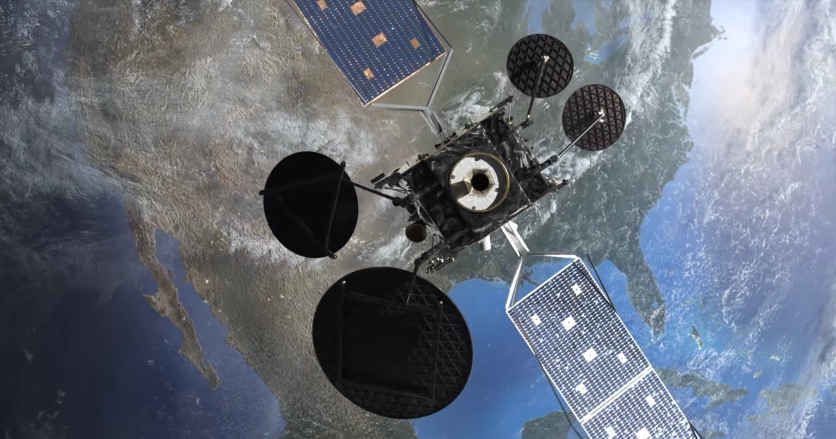
The stopgap is a pair of new satellites Boeing will build under the Mobile User Objective System Service Life Extension program, awarded June 24, 2026. Those spacecraft — Space Vehicles 6 and 7 on Boeing's active 702MP production line — will launch in fiscal years 2031 and 2032 and are designed to keep the current MUOS fleet operational through 2035. They buy the Space Force time. What the July 24 commercial MEO notice signals is that the Space Force intends to use that time to build something fundamentally different.
Why Five GEO Satellites Are Not Enough Anymore
The current narrowband constellation — four operational MUOS satellites plus one on-orbit spare — sits at roughly 22,000 miles (35,406 km) above Earth in geostationary orbit, where each spacecraft appears stationary relative to the ground. That stability is a feature: it lets warfighters use simple, fixed-pointing antennas. It is also a liability. A geostationary satellite is easy to locate, difficult to maneuver, and exquisitely expensive to replace. Five satellites provide global coverage precisely because each one watches over a continent-sized slice of Earth from that altitude — but lose even one and that slice goes dark.
U.S. defense threat assessments have found that China probably intends to field anti-satellite weapons capable of reaching geostationary orbit. In April 2026, U.S. Space Force threat documents confirmed that Russia is developing a satellite-borne nuclear anti-satellite weapon. Neither threat is distant: the CSIS Space Threat Assessment 2025 documents that China demonstrated direct-ascent ASAT capability against its own satellite as recently as 2007 and has continued developing the underlying system. The Space Force has spent years explaining in budget documents that it must "preserve its asymmetrical advantage given a contested, degraded, and operationally limited space environment." Five satellites in a single orbital regime are not an asymmetrical advantage. They are a target list.
Medium Earth orbit — spanning roughly 1,200 to 22,000 miles (1,931 to 35,406 km) above sea level — changes that calculus. An adversary who destroys one satellite in a proliferated MEO constellation of dozens degrades coverage for a fraction of users, not all of them. The geometry of MEO also provides something GEO cannot: multiple look-angles from different orbital tracks, which helps close coverage gaps at high latitudes where GEO satellites have poor elevation angles, and reduces the effectiveness of ground-based jamming systems targeting a specific satellite. MEO is also far less congested than low-Earth orbit — fewer than 200 satellites currently operate in MEO, compared with tens of thousands in LEO. The Space Force sees that relative emptiness as a window it wants to occupy before it closes.
How MUOS Actually Works — and Why Moving It to MEO Is Hard
To understand why the July 24 notice matters technically, it helps to know what the current system actually does.
MUOS operates in the ultra-high-frequency band — specifically the 240–315 MHz range used for military satellite operations. UHF signals have physical properties that make them uniquely valuable for tactical military communications: rainfall attenuates them by less than 0.1 decibels per kilometer even in heavy downpours, giving the system link availability exceeding 99.5 percent in most weather conditions. They penetrate buildings, dense foliage, and mountainous terrain where higher frequencies fail. They are significantly harder to jam than Ka-band or Ku-band signals operating at much shorter wavelengths. That combination — weather immunity, terrain penetration, jam resistance — is why every combatant command relies on MUOS for the voice and low-data-rate communications that keep troops connected when every other link has failed.
The modern MUOS payload does not simply relay UHF radio signals the way a telephone exchange used to route calls through a switchboard. It employs Wideband Code Division Multiple Access — WCDMA — a technology derived directly from commercial 3G cellular networks. Multiple users share the same spectrum simultaneously through code-based spread-spectrum techniques, organized across spot beams that function like cell towers in space. Users roam between beams automatically, with call handoffs occurring seamlessly. The result is approximately ten times the communications capacity of the legacy UHF Follow-On system MUOS replaced, at data rates up to 384 kilobits per second — narrowband by design, not by accident.
The Engineering Problem Lurking Behind Every Terminal
Moving a WCDMA-based narrowband system from geostationary orbit to medium-Earth orbit is not architecturally straightforward, and the technical challenge the Space Force has been most careful to acknowledge in its notices is also the one it has been most careful not to overstate: what happens to the terminals.
Geostationary satellites appear fixed in the sky. A ground terminal — whether mounted on a Humvee, strapped to a soldier's backpack, or installed in the communications mast of a destroyer — points at a GEO satellite the same way a satellite dish points at a television broadcast satellite: once aligned, it stays aligned. MEO satellites are not stationary. They move across the sky with orbital periods ranging from two to twenty-four hours, depending on altitude. A user terminal watching a MEO satellite watches it rise, arc overhead, and set — and must track it throughout that pass, continuously reacquiring signal as the geometry changes.
Solving that tracking problem has three broad approaches. Electronically steerable phased-array antennas can redirect their beam without any mechanical movement, but they are significantly more expensive and complex than fixed-point antennas. Mechanically steered dishes with motorized tracking mounts work but add weight, power requirements, and failure modes. Software-defined approaches — updating the radio firmware to handle Doppler compensation and changing satellite elevation angles without hardware changes — are cheapest, but require every legacy terminal to pass through a qualification process. The Defense Department has more than 17,000 satellite communications terminals in service; modernizing even the firmware across that fleet, according to RAND Corporation analysis, "will require a significant investment and could be a lengthy process."
The July 24 SSC notice specifically asked industry to identify any "software or hardware modifications that user terminals may have to consider in order to be supported from MEO." That language is deliberately open-ended. The Space Force does not yet know what it will have to spend or replace. The experiments the commercial MEO notice will enable are designed, in part, to answer that question.
A $2.7 Billion Problem That Is Still Taking Shape
The numbers in the Space Force's budget documents reflect both the scale of the commitment and the degree of uncertainty still attached to it. Narrowband SATCOM spending is projected to climb from $228.4 million in fiscal year 2025 to $706.2 million in fiscal year 2028, with total investment through the end of the decade projected at approximately $2.7 billion. Fiscal year 2027 documents call for purchasing long-lead parts for a MEO communications payload and beginning work on both ground and space segment prototypes, with a prototype satellite launch targeted for fiscal year 2030.
But Charlotte Gerhart, SSC's deputy portfolio acquisition executive for satellite communications and positioning, navigation, and timing, was direct in a recent interview about what is still undefined. "We'll continue to watch and be aware of how industry and that commercial business case is adapting overall," Gerhart said, adding that SSC has yet to finalize its next steps and acquisition approach. The notice explicitly acknowledges that early on-orbit prototypes "may not be fully representative of a final, future architecture" — they are a first step toward understanding what that architecture needs to be.
Boeing's Bridge — and What It Is Actually Bridging To
When Boeing's Ryan Reid, the company's senior director of space communications programs, described the MUOS SLE satellites as a "lifeline" for warfighters in demanding conditions, he was using language that is accurate in both the literal and strategic sense. The two new satellites will fly on Boeing's 702MP bus, a three-axis-stabilized medium-power platform generating 6 to 12 kilowatts of spacecraft power that Boeing has been delivering at production pace since the fourth quarter of 2025. The 702MP is already the foundation of the Wideband Global SATCOM constellation, and Boeing built the UHF payloads for the current MUOS fleet — the company is, in that specific technical sense, the right builder for satellites whose job is to preserve what the current system already does while the future system is designed.
The future system they are bridging to is where the commercial MEO notice fits. A hybrid architecture that blends bespoke military GEO satellites with commercial MEO satellites could provide the geographic and orbital diversity the current five-satellite GEO fleet cannot. It could also reduce cost per satellite by leveraging commercial production economics rather than one-off military programs. The Space Force has pursued similar logic in other programs: SSC awarded contracts worth roughly $37.5 million to five companies — Viasat, Northrop Grumman, Astranis, Intelsat, and Boeing — in 2025 to demonstrate how commercial satellite designs could serve as the foundation for Protected Tactical Service-Global, the protected Ka-band program that is the wideband analog to what SSC is now exploring for narrowband.
Read more: Space Force Jammed Iran Dark Before First Strike: Eyes Harder Fight Ahead
What the Commercial MEO Notice Means for the Space Industry
For commercial satellite operators, the July 24 notice represents the formal opening of a procurement channel that has been visible on the horizon for two years. SSC published a request for information in May 2024 laying out its interest in a MEO constellation for narrowband SATCOM; the July 24 notice is the next step toward an actual acquisition. The Space Force has said it may need commercial MEO access for at least three years as experiments proceed — a meaningful anchor customer commitment in a market segment currently underserved by dedicated communications satellites.
SES, which operates the O3b and O3b mPOWER constellations in MEO at approximately 5,000 miles (8,047 km) altitude, is the most established commercial MEO communications operator globally and an obvious candidate to respond. The company has publicly noted that MEO's "orbital geometry offers inherent resilience" for sovereign and military customers through its transparent payload architecture. Other potential respondents include any operator with software-defined radio payloads or frequency-agile satellites capable of supporting UHF band operations.
The notice frames the experimentation as a test of interoperability with existing government GEO assets — the question is not merely whether commercial MEO satellites can provide narrowband coverage, but whether they can work alongside MUOS in a hybrid architecture where military and commercial satellites share handoffs, coverage areas, and terminal-to-satellite protocols.
What Can Warfighters Do Now That the Notice Is Published?
The honest answer is: wait for the Space Force to figure out its architecture. The MUOS fleet remains fully operational. Boeing's two bridge satellites will keep it operational through 2035. The July 24 notice is aimed at the research and experimentation phase that will inform what comes after. For warfighters currently equipped with MUOS-compatible terminals, nothing changes operationally in the near term.
For companies in the commercial MEO space and for defense contractors with software-defined radio expertise, the notice is actionable immediately. SSC was explicit that it wants capability available as soon as possible — and that innovative approaches leading to earlier on-orbit capability are strongly desired. Responses to the notice that can demonstrate near-term MEO UHF availability with credible terminal compatibility paths will likely receive the most serious attention.
Frequently Asked Questions
What is the Space Force's MUOS system, and why does it need to change?
MUOS — the Mobile User Objective System — is a constellation of five satellites in geostationary orbit (four operational plus one spare) that provides secure ultra-high-frequency voice and low-rate data communications to every U.S. combatant command: aircraft, ships, submarines, ground vehicles, and dismounted troops. The UHF band it uses penetrates weather and terrain that defeats higher-frequency satellite links and is significantly harder to jam. The problem is architectural: five large, expensive satellites in fixed, predictable orbits are increasingly vulnerable in an era when China and Russia are developing anti-satellite weapons capable of reaching geostationary altitude. A proliferated constellation of smaller satellites in medium-Earth orbit would spread the risk across many more targets, making the entire narrowband SATCOM network harder to degrade through a single attack or a handful of coordinated ones.
Why does moving satellites to medium-Earth orbit create a terminal compatibility problem?
Geostationary satellites appear stationary in the sky, which means the handheld radios, vehicle-mounted terminals, and shipboard antennas that connect to MUOS can point in a fixed direction and maintain a stable signal link. MEO satellites are not stationary — they move across the sky with orbital periods of a few hours and must be actively tracked. A terminal designed to connect to a GEO satellite must either be replaced with a new antenna system capable of tracking a moving satellite, or its software must be upgraded to handle the changing signal geometry and Doppler frequency shifts that MEO orbital motion produces. The Defense Department maintains more than 17,000 satellite communications terminals; the cost and logistics of updating or replacing even a fraction of them is one of the central unresolved questions in the Space Force's MEO architecture planning, with RAND Corporation analysis warning that modernizing the terminal fleet "will require a significant investment and could be a lengthy process."
What exactly did Boeing win, and how does that contract relate to this notice?
Boeing won a contract valued at up to $2 billion on June 24, 2026, to build two new MUOS satellites — designated Space Vehicles 6 and 7 — on its 702MP spacecraft platform. Those satellites are scheduled for delivery in 2031 and 2032 and are designed to sustain the current narrowband architecture through 2035, giving the Space Force roughly a decade to design and field whatever comes next. The July 24 commercial MEO notice is that "next" being actively shaped: it asks commercial operators to provide MEO UHF satellite access for experiments that will help the Space Force understand whether a hybrid GEO-MEO architecture is technically and commercially viable. Boeing's bridge satellites and the MEO experiments run in parallel — one secures the present, the other builds the future.
Which commercial satellite companies are most likely to respond to the MEO notice?
SES, which operates the O3b mPOWER constellation at approximately 5,000 miles altitude in MEO and has recently announced the meoSphere program targeting military and sovereign customers, is the most established commercial MEO communications operator and a likely respondent. Beyond SES, any commercial operator with software-defined radio payloads capable of operating in the UHF military satellite band — or willing to invest in that capability — could respond. The notice does not restrict responses to existing on-orbit capability; it explicitly welcomes approaches that could lead to earlier on-orbit availability than the 2030 initial launch capability milestone, suggesting the Space Force is open to novel proposals, not just off-the-shelf offerings from established MEO operators.
Read more: US Space Force Says SpaceX Starlink's Direct-to-Cell Service Could 'Disrupt' Military Satellite Communications

-
 C114 Communication Network
 -
 Communication Home
