
 Search

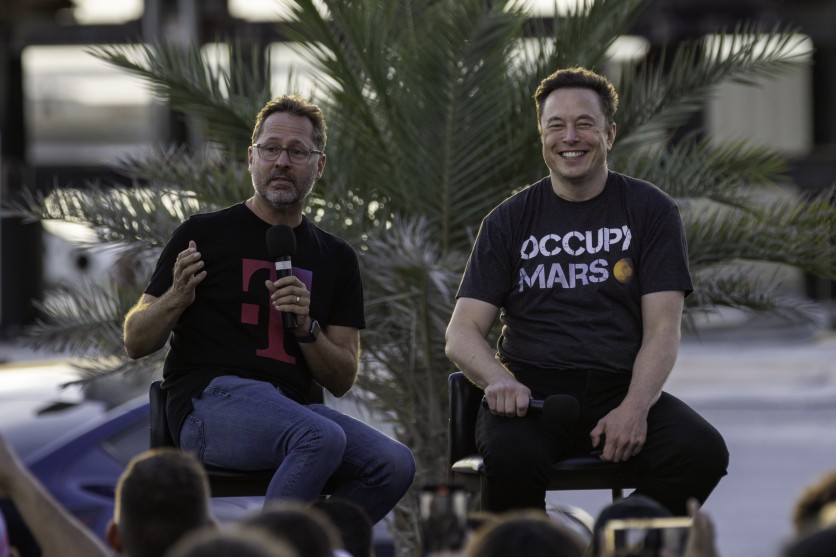
SpaceX founder Elon Musk and T-Mobile CEO Mike Sievert on stage during a T-Mobile and SpaceX joint event on August 25, 2022 in Boca Chica Beach, Texas. The two companies announced plans to work together to provide T-Mobile cellular service using Starlink satellites. Michael Gonzalez/Getty Images
SpaceX took its largest step yet toward becoming a retail wireless carrier on Friday when President and COO Gwynne Shotwell told investors at the company's IPO roadshow that SpaceX is considering launching a Starlink-branded mobile phone service for US consumers — and may eventually build its own terrestrial cellular network to support it. The announcement, first reported by the Financial Times, signals that the company that just completed the largest IPO in financial history is not content to remain a behind-the-scenes connectivity wholesaler. The US wireless market, with roughly 400 million active lines and hundreds of billions in annual revenue, is the largest adjacent prize Starlink has not yet touched.
The disclosure lands two weeks after SpaceX's June 12 debut on the Nasdaq under the ticker SPCX, which raised nearly $86 billion at a $135-per-share price and valued the company at more than $2 trillion. Starlink — the satellite connectivity arm — is the company's primary revenue engine, generating $11.4 billion of SpaceX's $18.7 billion in total 2025 revenue. As of March 31, 2026, Starlink counted 10.3 million active subscribers across more than 160 countries. But the US mobile market, served today by AT&T, Verizon, and T-Mobile — each of which has more than 100 million subscribers — is a fundamentally different and much larger prize.
From Wholesaler to Competitor: What Changed
SpaceX already sells satellite connectivity in the US, but not to consumers directly. Its existing deal with T-Mobile makes Starlink a background provider for T-Mobile's T-Satellite service, which fills dead-zone gaps for T-Mobile subscribers in areas beyond terrestrial cell tower reach. In that arrangement, T-Mobile owns the customer relationship; SpaceX operates the satellite layer.
A direct-to-consumer Starlink mobile plan would invert that dynamic. SpaceX would sign up subscribers, bill them directly, and control its own brand in a market it currently accesses only through a partner. David Barden of New Street Research called the competitive threat structurally significant, noting that the prospect of Starlink entering the retail market directly serves as leverage at the negotiating table, regardless of whether it ever fully materializes. All three major US carriers have publicly declined to offer SpaceX an MVNO deal, with AT&T and T-Mobile CEOs saying so explicitly during Q1 2026 earnings calls.
Read more: SpaceX Surges in Its Record Debut tops $160: What the Market Is Really Buying Beyond $2 Trillion
SpaceX Spectrum and EchoStar: What SpaceX Actually Bought
The ambition is grounded in a real infrastructure move. In May 2026, the FCC approved SpaceX's $17 billion acquisition of wireless spectrum from EchoStar, part of a broader $40 billion transaction that also included AT&T purchasing 50 megahertz. SpaceX's portion — 40 megahertz of AWS-4 spectrum, 15 megahertz of unpaired AWS-3, and 10 megahertz of H-Block — amounts to 65 megahertz of exclusive-use, contiguous nationwide mid-band frequencies in the 1.9–2.2 gigahertz range. It is the first time SpaceX has obtained exclusive-use, contiguous nationwide spectrum for a direct-to-device service.
The FCC granted SpaceX waivers allowing that spectrum to be used flexibly across terrestrial, space-based, and hybrid network architectures — regulatory language that amounts to permission to build exactly the kind of hybrid carrier Shotwell described to investors. The licenses are expected to fully transfer to SpaceX by November 2027. The FCC conditioned the approval on a $2.4 billion escrow account tied to disputes from Dish Network's abandoned 5G buildout — a cautionary story that looms over SpaceX's own terrestrial ambitions.
SpaceX also filed trademarks including "Starlink Mobile" and "Powered by Starlink" in October 2025, reinforcing that a consumer-facing brand is in active development.
How the Direct-to-Cell Technology Actually Works
Understanding what Starlink's current satellite technology can and cannot do is essential to evaluating the consumer wireless announcement. Each of Starlink's direct-to-cell satellites carries an LTE eNodeB modem payload — the same type of baseband processing unit found inside a terrestrial cell tower — embedded alongside the satellite's standard connectivity hardware. From a phone's perspective, the satellite presents a standard LTE signal under 3GPP Release 17 Supplemental Coverage from Space protocols, which were standardized precisely to allow satellite base stations to mesh with terrestrial networks using the same spectrum, the same protocols, and the same devices — no hardware modifications required.
Making this work involves solving difficult physics problems. Each satellite orbits at roughly 550 kilometers altitude and travels at approximately 17,000 miles per hour relative to users on the ground. At those speeds, the Doppler shift — the frequency change caused by the satellite's motion — is far beyond what standard LTE receivers are designed to handle. SpaceX addresses this by embedding software-defined radio on each satellite that calculates the Doppler shift for every device in its coverage footprint and pre-compensates the transmitted frequency before the signal reaches the phone. The satellite also handles timing advance calculations and power-control signaling to allow a standard phone to complete the connection.
Data routing exploits the constellation's inter-satellite laser links: a phone transmits to an overhead satellite, which relays the signal through Starlink's optical mesh network — satellite to satellite at the speed of light through the vacuum of space — until the data descends to a ground station and enters the carrier's core network.
What Satellites Cannot Do for City Subscribers
The architectural reality behind this technology is the critical constraint for any consumer wireless ambition. Each satellite's cell beam covers a large geographic area with limited shared capacity per beam — functional at low population density, but prone to bottleneck in dense user scenarios. An independent crowdsourced measurement study of Starlink's direct-to-cell network, analyzing data collected between October 2024 and July 2025, confirmed a significant negative correlation between Starlink DTC usage and population density — the service is concentrated in areas with weak terrestrial coverage, not cities.
This is not a bug — it is the design intent. Starlink's satellite technology is built as supplemental coverage: when a phone loses a terrestrial signal, it falls back to the satellite layer. In areas already served by dense terrestrial networks, the phone will always prefer the stronger ground signal. Changing that in cities requires terrestrial infrastructure that SpaceX does not currently have.
Analysts note that SpaceX's 65 megahertz of spectrum contrasts starkly with the approximately 1,020 megahertz the Big Three carriers collectively hold. Oppenheimer analysts predicted that SpaceX can disrupt the $1.6 trillion US communications industry and projected 15 million US Starlink subscribers by 2030. New Street Research's David Barden was more cautious, saying that SpaceX "doesn't currently have enough spectrum to go it alone" for a standalone terrestrial network and that building a competitive urban wireless network remains a formidable challenge.
Read more: SpaceX Hits 1,500th Starlink Satellite of 2026 on Its First Launch as a Public Company
Starlink's Structural Advantage Over Dish's Failed Attempt
SpaceX holds one advantage that Dish Network — which spent billions on spectrum it ultimately could not turn into a competitive carrier — never had: vertical integration across the full stack. SpaceX manufactures its own satellites, launches them on its own rockets, and operates one of the largest low Earth orbit constellations in existence. Every new batch of Starlink satellites is deployed at SpaceX's own marginal launch cost — not at a market rate paid to a third-party provider — giving it a cost structure for constellation expansion that no competitor can match.
That advantage does not solve the terrestrial buildout problem, but it does mean SpaceX can expand its satellite layer continuously and at a structural cost advantage, potentially increasing direct-to-cell capacity ahead of any retail launch. Whether it can translate that orbital advantage into a credible urban carrier — where dense terrestrial cells remain superior in capacity and speed — is the question that will ultimately determine whether Friday's disclosure describes a business plan or a negotiating strategy.
The Strategic Ambiguity SpaceX Is Exploiting
Some analysts have framed Shotwell's disclosure as deliberate leverage: by publicly signaling to investors that it intends to compete directly, SpaceX makes itself more threatening to carrier partners, potentially extracting better terms from T-Mobile and others on future agreements. Morningstar has described SpaceX's broader wireless plans as a matter of intense speculation. The fact that all three Big Three carriers declined MVNO deals with SpaceX ahead of the IPO, and that AT&T, Verizon, and T-Mobile subsequently formed a joint venture focused on shared spectrum in underserved areas, suggests the incumbents are treating the threat seriously regardless of whether a full SpaceX consumer network ever materializes.
SpaceX has not confirmed pricing, timelines, or commercial specifics for any retail mobile product.
Frequently Asked Questions
Can Starlink replace my current cell phone plan?
Not yet, and with current satellite technology, not in cities. Starlink's existing direct-to-cell service is designed as a supplemental layer that activates when a phone loses terrestrial signal — filling dead zones in rural areas, national parks, and highways. In urban and suburban markets already served by dense cell towers, satellite capacity cannot compete with terrestrial networks on throughput or reliability. Any consumer Starlink wireless plan that aims to serve city subscribers would require SpaceX to build terrestrial cellular infrastructure it does not currently have.
How does Starlink's direct-to-cell technology work on a standard phone?
Each direct-to-cell satellite carries an LTE eNodeB modem payload — the same baseband processing hardware found in a terrestrial cell tower — and presents itself to a phone's radio as a standard LTE signal under 3GPP Release 17 Supplemental Coverage from Space protocols. Because the satellite is traveling at roughly 17,000 miles per hour overhead, SpaceX uses software-defined radio to pre-calculate and compensate for the Doppler frequency shift before the signal reaches the device. No hardware modification, app, or special SIM is required on compatible LTE phones.
What wireless spectrum does SpaceX now hold, and why does it matter?
The FCC approved SpaceX's acquisition of 65 megahertz of exclusive-use, nationwide mid-band spectrum from EchoStar in May 2026: 40 megahertz of AWS-4, 15 megahertz of unpaired AWS-3, and 10 megahertz of H-Block. Before this purchase, Starlink had to use carrier-provided spectrum for its direct-to-cell service, making it dependent on partner agreements. Exclusive-use spectrum gives SpaceX the legal and technical basis to operate an independent wireless service without routing capacity through a partner carrier — once the licenses fully transfer in late 2027. It is a necessary precondition for a standalone consumer brand, but not sufficient on its own: a full competitive network also requires physical ground infrastructure.
Will Starlink's wireless ambition actually challenge AT&T, T-Mobile, and Verizon?
Analyst views diverge sharply. Oppenheimer projects SpaceX could reach 15 million US subscribers by 2030 and disrupt the $1.6 trillion US communications industry. New Street Research's David Barden argues the spectrum holdings and the logistics of building a competitive urban network remain formidable barriers. A third view holds that the disclosure may be partly strategic: the credible threat of a direct competitor typically concentrates minds at telecom negotiating tables, making it easier for SpaceX to extract favorable terms from the carriers it currently depends on as partners.

-
 C114 Communication Network
 -
 Communication Home
