
 Search

mwcshanghai.com
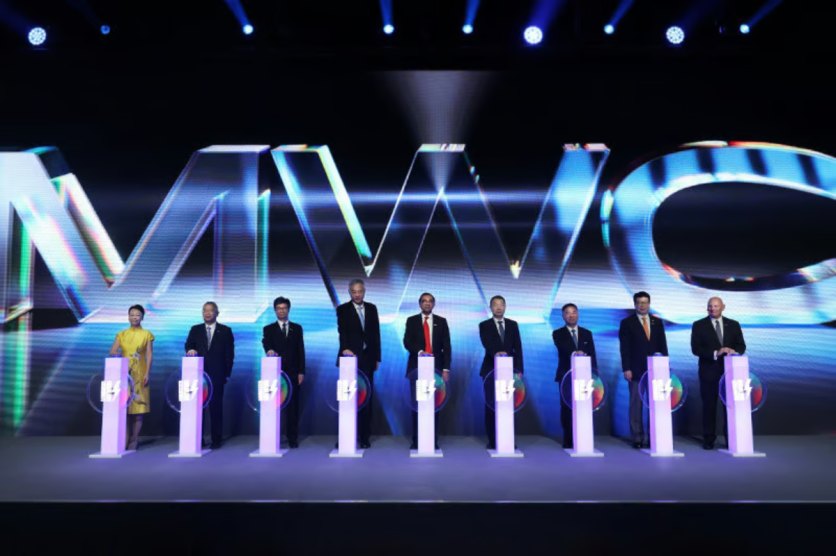
When MWC Shanghai 2026 opens Wednesday at the Shanghai New International Expo Centre, it will mark the clearest signal yet of how far China's carriers have pulled ahead in the technologies that will define mobile connectivity for the next decade — and how much is at stake for the Western companies watching the show from the outside. China has already deployed 5G-Advanced infrastructure across more than 330 cities, creating the world's largest commercially active network operating under 3GPP Release 18 specifications, while most European and American carriers are still in planning or early testing phases — a gap Omdia analysts estimate at 12 to 18 months. The stakes at this year's event are not merely commercial: the real-world field data that Chinese carriers are accumulating at the U6GHz spectrum band (6,425–7,125 MHz) will directly shape which architectural assumptions are written into 6G's global standard, a process that runs through the International Telecommunication Union's IMT-2030 framework and 3GPP's Release 19 and Release 21 specifications, with the binding 6G protocol freeze locked to December 2028.
China's 5G-A Deployment Lead Becomes a 6G Standards Weapon
The competitive gap is concrete. China is the first country to dedicate the U6GHz band specifically to 6G testing — a formal spectrum allocation by China's Ministry of Industry and Information Technology (MIIT) that gives Chinese operators and equipment vendors a head start in collecting the propagation data, capacity measurements, and interference profiles that will dominate technical submissions at the World Radiocommunication Conference in 2027. Those submissions are how spectrum bands get globally standardized. The country that arrives at that negotiation with the most field data typically wins the allocation argument.
China Mobile has translated this spectrum advantage into standards leadership. The carrier leads multiple international 6G standard projects within 3GPP and serves as lead rapporteur for the first formal 6G scenario and demand standardization project — a procedural role that provides early influence over the framing of what 6G is supposed to do and for whom. China Mobile has also launched what it describes as the world's first 6G architecture verification satellite, a working test system rather than a whitepaper proposal.
Analysts have warned that the same fracture that produced a divided 5G ecosystem — with Western carriers building on Qualcomm, Ericsson, and Nokia while China relied on Huawei and ZTE — is now set to repeat in 6G, but with higher stakes. "6G could generate well over $50 billion in the first five years of rollout," with the majority flowing to infrastructure and equipment vendors whose underlying technical choices were embedded in the standard years earlier.
Read more: Telco AI Forum 2026 Opens: AT&T and Operators Race to Close 6G Readiness Gap
How ISAC Works: One Antenna for Data and Radar
The most technically significant demonstration expected at MWC Shanghai this week is Integrated Sensing and Communication, or ISAC — a capability that makes 5G-A networks do two jobs with one transmitter.
In a conventional 5G network, base stations handle communications and sensing as entirely separate functions. ISAC dissolves that separation by repurposing the Orthogonal Frequency-Division Multiplexing (OFDM) waveform — the same signal format used to transmit data to mobile devices — as a dual-purpose radar system. When a base station transmits a downlink OFDM data frame, the signal reflects off nearby objects: vehicles, pedestrians, drones, industrial machinery, environmental obstacles. The reflected signal is captured by the same antenna, processed through standard radar algorithms for range estimation and Doppler shift analysis, and used to generate real-time environmental maps.
Ericsson has demonstrated in proof-of-concept testing that current 5G massive MIMO radios can already perform sensing tasks using existing hardware, with software and hardware optimization enabling full ISAC potential. The sensing and communication functions share the same frequency band, spectrum, and hardware — the same OFDM waveform carries data to subscribers while its echo off nearby objects is processed simultaneously for environmental awareness. At 3GPP's RAN #108 meeting in June 2025, ISAC was officially designated a "Day 1" feature for 6G, guaranteeing it will be in the first generation of 6G standards rather than a later optional enhancement.
Chinese carriers are expected to showcase enterprise case studies at MWC Shanghai demonstrating ISAC deployments in manufacturing facilities and logistics operations, where the sensing layer delivers object-detection and motion-tracking data that previously required separate sensor networks. The business implication is a new monetization layer: carriers can charge for sensing-as-a-service on top of existing connectivity contracts.
China Carriers Abandon Connectivity Growth: Computing Gets 35 Percent of Capex
The financial data from China's three carriers tells the underlying story of what MWC Shanghai 2026 actually represents: the moment when the world's largest mobile operators formally declared that selling connectivity is no longer a growth business.
All three carriers reported declining or flat traditional service revenues in the first quarter of 2026. China Mobile reported communication service revenue fell 1.1% year-over-year to 219.9 billion yuan, despite overall operating revenues of 266.5 billion yuan. China Telecom's total revenues fell 2.32%. China Unicom reported a 0.5% decline in operating revenues. GSMA Intelligence head Peter Jarich put it plainly at the ETTelecom 5G/6G Congress: "The promise of 5G was that it was going to unlock new revenues and capabilities. As we have seen across the world, we haven't quite done that."
The response from China's carriers has been a sharp reallocation of capital even as total spending falls. China Mobile cut overall 2026 capital expenditure by 9.5% to approximately 136.6 billion yuan while simultaneously increasing investment in computing power networks by 62.4% to 37.8 billion yuan. China Telecom reduced total capital spending by 9.2% but directed 35% of its remaining budget toward computing infrastructure. China Unicom trimmed capital expenditure by nearly 8% while channeling more than 35% into AI infrastructure and data centers. The early results support the strategy: China Unicom's computing power business generated 15.4 billion yuan in first-quarter revenue, an 8.3% increase year-over-year.
Token Packages: AI Compute Billed Like a Mobile Data Plan — With Hidden Costs
The most visible consumer-facing product to emerge from this strategic shift is the AI token subscription package, which China's three carriers launched commercially in May 2026. The model is straightforward: users purchase monthly allocations of AI inference tokens — the computational units consumed when a large language model generates a response — billed through their existing phone accounts. China Telecom priced entry-level plans at 9.9 yuan per month for 10 million tokens. China Mobile offered Shanghai-market packages at approximately one yuan per 400,000 tokens. China Unicom's entry plans started at 15 yuan for 6 million tokens.
Daily AI token consumption across China surged from roughly 100 billion in early 2024 to over 140 trillion by March 2026 — a thousandfold increase in two years — according to CGTN citing data from China's National Data Administration, documenting the scale of the infrastructure demand these subscriptions are meant to serve.
The economic logic for carriers mirrors mobile data: infrastructure costs are fixed once a GPU cluster is built, so the marginal cost of serving additional tokens approaches zero. Carriers amortize the cluster investment across millions of subscribers while model providers act as tenants in the compute marketplace.
But independent testing has surfaced a gap between headline pricing and real-world costs. Reporters from China's National Business Daily found that simply inputting the word "hello" in a large language model consumed approximately 50,000 tokens. A 15-yuan package containing 6 million tokens was depleted in under an hour of casual testing. Developers who calculated actual monthly usage for production workloads found costs running five to six times higher than headline package prices suggest, and significantly above existing AI subscription alternatives. Frontline carrier staff in some markets remained unaware the products existed at all. The packages appear better suited to occasional users than to the developers and small businesses they were primarily marketed toward.
China Mobile's token ecosystem alliance, announced at its May 2026 Mobile Cloud Conference with seven partners including Tencent, Alibaba, and Huawei, integrates approximately 300 AI models into a centralized platform and claims centralized operations can reduce per-token costs by around 30%.
Satellites Join the Stack: Tiantong, Beidou, and Low-Earth Orbit
A third technical storyline running through MWC Shanghai 2026 is the integration of non-terrestrial networks. All three Chinese carriers now hold licenses supporting integrated Tiantong and Beidou satellite communications services. Beidou — China's state-owned global navigation satellite system — received commercial trial approvals for short-message public applications from MIIT for China Telecom and China Unicom. MWC Shanghai 2026 will feature the debut of a "Constellations of the Future" exhibition zone, the first dedicated satellite industry showcase in the event's history, expected to serve as a launch platform for low-Earth orbit constellation announcements and direct-to-device satellite connectivity demonstrations. The conference program will address 3GPP Release 19 non-terrestrial network standards, orbital spectrum management, and sustainable business models for satellite-terrestrial convergence.
Read more: What Will 6G Networks Bring? Expected Launch, Benefits, and Future Connectivity
Security and Standards: What Huawei and ZTE at the Table Mean
Huawei and ZTE are central participants in MWC Shanghai 2026 and in 3GPP standards development, and their presence carries legal context that any enterprise buyer or Western policymaker attending this week should understand clearly.
Huawei and ZTE are listed on the FCC's Covered List of equipment posing an unacceptable national security risk to the United States. In November 2022, the FCC banned new authorizations for telecommunications equipment from both companies — the first time in the agency's history it had prohibited equipment authorization on national security grounds. China Mobile, China Telecom, and China Unicom are also on the Covered List. Germany is in the process of phasing Huawei and ZTE components out of its 5G core networks by the end of 2026, with access and transmission infrastructure to follow by 2029.
The underlying legal framework for these concerns is fixed, not contested. China's National Intelligence Law (2017), Article 7 states that "all organizations and citizens shall support, assist, and cooperate with national intelligence efforts in accordance with law." China's Cybersecurity Law (2017) requires network operators to cooperate with government inspections and provide technical support. China's Data Security Law (2021) imposes data localization requirements and government access provisions. These laws apply to all Chinese organizations regardless of where their equipment is deployed or what their privacy policies state. The scope and enforcement mechanisms of Article 7 are contested among legal scholars — China Law Translate's Jeremy Daum argues the obligation lacks explicit enforcement provisions and that "intelligence" is left undefined — but US and allied governments have consistently treated the combination of laws as creating a compelled-access risk that corporate policy alone cannot mitigate. The FCC cited the National Intelligence Law by name in its June 2020 order designating Huawei a covered company. Huawei has publicly stated that it has never provided and would never provide user data to any government.
In March 2026, the governments of the United States, United Kingdom, Canada, Japan, Australia, Sweden, and Finland formally announced the Global Coalition on Telecoms (GCOT), with principles designed to embed security and supply-chain diversity into 6G specifications before the standard is finalized. The coalition explicitly drew lessons from 5G, where security was retrofitted rather than designed in from the start.
China's 6G Standardization Push Shapes the Global Rulebook
The deepest implication of MWC Shanghai 2026 is one the event's exhibitors are unlikely to name directly: whoever shapes the 6G standard shapes the security architecture, vendor ecosystem, and regulatory assumptions of global telecommunications for the 2030s.
The architectural decisions being made now — which spectrum bands to standardize, whether ISAC is a core feature or optional enhancement, how AI is embedded in the radio access network — are the decisions that will determine not just performance but which countries' equipment can interoperate and whose cannot. The Western GCOT coalition of March 2026 was formed specifically because governments have concluded that those architectural decisions carry geopolitical weight that exceeds their technical content.
China's 5G-A deployment across 330 cities is not just a commercial achievement. It is a data-generation machine feeding Chinese standards proposals to 3GPP with field evidence that competing proposals from carriers who have not yet deployed cannot match. GSMA Intelligence's 2026 State of 5G report found that the gap in advanced 5G capabilities — including 5G-A, uplink performance, and fixed wireless access — is widening, not closing, between leading markets and the rest. An Accenture study found 79% of global telecom operators are currently at Level 0 or Level 1 on the TM Forum's six-level network-autonomy scale, meaning operations remain largely manual or rely on only basic monitoring assistance. China Mobile has already reported measurable operational gains from Level 4 deployments.
For Western carriers and policymakers, MWC Shanghai 2026 is a useful mirror. The event will not determine the 6G standard — that work runs through 3GPP and the ITU on a timeline extending to 2028, with the binding Stage-3 protocol freeze in December 2028. But it will make visibly clear how much of the work needed to influence that standard requires real-world deployments that most Western carriers have not yet built. The countries whose carriers are deploying 5G-A at scale today are the countries whose vendors will arrive at 3GPP with real-world field data in hand when those negotiations reach their most consequential stage.
Frequently Asked Questions
What is ISAC and why does it matter for 5G-Advanced?
Integrated Sensing and Communication (ISAC) allows a 5G or 6G base station to simultaneously transmit data and perform radar-style sensing of the surrounding environment using the same OFDM waveform, hardware, and antenna. When a downlink data signal bounces off a vehicle or pedestrian, the base station processes the reflected signal to determine range, speed, and position. 3GPP officially designated ISAC a "Day 1" feature of 6G at its RAN #108 meeting in June 2025, meaning it will be part of the first generation of 6G standards rather than a later add-on. For enterprise buyers, ISAC means a 5G-A network can deliver continuous environmental sensing for autonomous vehicle guidance, factory automation, and smart-city monitoring without requiring separate sensor infrastructure.
How far ahead is China in the 6G standards race?
China holds structural advantages that are difficult for Western nations to close quickly. It is the first country to have dedicated the U6GHz spectrum band (6,425–7,125 MHz) specifically to 6G field testing, giving its carriers and equipment vendors real-world propagation data that will directly inform their submissions to 3GPP and the ITU's World Radiocommunication Conference in 2027. China Mobile serves as lead rapporteur for the first 6G scenario and demand standardization project within 3GPP — a procedural role that provides early influence over the framing of global 6G specifications. Closing these advantages requires Western governments to accelerate spectrum allocation and their carriers to accelerate technical participation in standards bodies, not merely announce 6G research programs.
Are Chinese carriers' AI token packages a good deal for enterprise developers?
The headline pricing is eye-catching but misleading for high-volume users. Real-world testing by China's National Business Daily found that casual AI conversation — inputting a single word — consumed approximately 50,000 tokens, and a 6-million-token package was depleted in under an hour of ordinary use. Independent developer analysis found monthly costs for realistic production workloads running five to six times above what the package prices suggest. The model is more viable for occasional consumer users than for enterprise or developer workloads. China Telecom, China Mobile, and China Unicom launched these plans commercially in May 2026, and the market remains early-stage.
What security risks do Huawei and ZTE present at MWC Shanghai 2026 and beyond?
Any organization adopting Huawei or ZTE equipment operates under a fixed legal condition that corporate privacy policies cannot override. China's National Intelligence Law (2017) Article 7 requires all Chinese organizations to support, assist, and cooperate with state intelligence work. China's Cybersecurity Law (2017) and Data Security Law (2021) add cooperation mandates for government inspections and data access. The FCC cited these laws by name when designating Huawei a national security risk in 2020 and has since banned new equipment authorizations for both companies. The scope of the Article 7 obligation is genuinely disputed among legal scholars, but the US and allied governments have consistently treated the combination of laws as creating an unmitigable compelled-access risk. Huawei has publicly denied providing or intending to provide data to any government. For buyers outside China, no contractual arrangement with a Chinese vendor can alter the legal obligations those vendors carry under Chinese law.

-
 C114 Communication Network
 -
 Communication Home
