
 Search


Asus.com
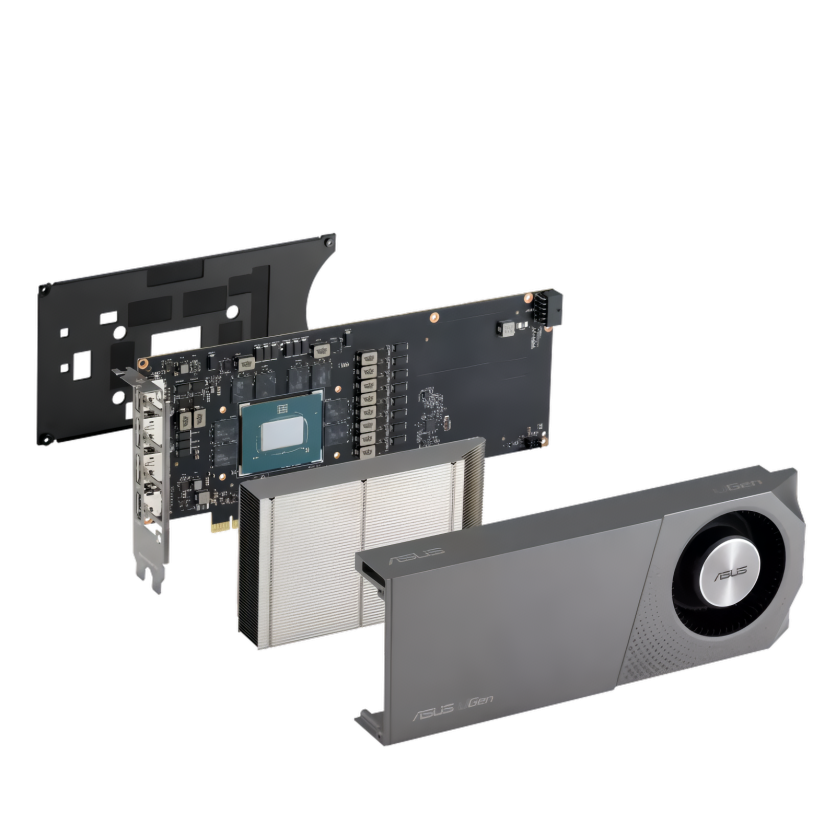
ASUS has entered the Intel Arc Pro B70 market — seven months after Intel launched the card at a $949 reference price — with a European retail tag of €1,799 (approximately $2,094 USD) in Germany and Austria, its first Intel Arc discrete card since the passively cooled Iris Xe DG1-4G in 2021. The same card lists at CHF 1,799 in Switzerland. ASUS has not announced a US price or release date.
The announcement, confirmed through an official ASUS press release published October 27, 2026, makes ASUS the largest and most globally recognized add-in board (AIB) partner to commit to Intel's professional GPU lineup — a signal of ecosystem confidence that matters well beyond a single product listing.
What Is ASUS Calling This Card — and Why Does the Brand Name Matter?
Rather than filing the card under ProArt — its established lineup for creative professionals — ASUS placed the UGen Arc Pro B70 inside the ASUS UGen AI sub-brand, alongside products like the UGen300 USB AI accelerator shown at CES 2026. The naming choice signals that ASUS is not pitching this as a visualization card for 3D artists or video editors; it is explicitly targeting AI developers, machine-learning engineers, and enterprise teams building or deploying large language models (LLMs) on local workstations.
That positioning is consistent with the software stack ASUS highlights: the card is listed as compatible AI software stack including Ollama, llama.cpp (both SYCL and Vulkan backends), vLLM, PyTorch XPU, Intel OpenVINO, oneAPI, Intel LLM Scaler, and ComfyUI for image generation. This is a developer-facing toolkit, not a consumer graphics or content-creation application list.
How the Xe2 XMX Engines Actually Power Local AI
The ASUS UGen Arc Pro B70 uses the same Intel BMG-G31 chip specifications found in every Arc Pro B70 on the market: Intel's largest Battlemage die, manufactured on TSMC's N5 process, with all 32 Xe2 cores fully enabled.
What makes Xe2 specifically useful for LLM inference is the XMX (Xe Matrix Extensions) engine inside each Execution Unit. XMX performs Dot Product Accumulate Systolic (DPAS) operations in a four-deep systolic array, accelerating matrix-multiply operations — the computational backbone of every transformer-architecture language model. Intel reports that XMX delivers 16 times the compute density of baseline FP32 vector operations for INT8 workloads: four times by packing four 8-bit values into one 32-bit data path, and another four times through the systolic array depth.
The 32 XMX engines across 32 Xe2 cores produce a rated 367 TOPS INT8 performance peak for AI workloads. That figure, however, is a theoretical peak, not benchmark result — an important distinction buyers should understand before comparing it to other products' TOPS claims.
Why 32GB ECC Memory Is the Real Story for LLM Buyers
For most LLM inference workloads, memory capacity and bandwidth are the binding constraints — not compute throughput. During the "decode" phase of auto-regressive generation, the GPU reads model weights from memory once for every token generated, so throughput scales directly with how fast weights can be loaded, and model capacity scales directly with how much VRAM is available.
The 32GB ECC GDDR6 bandwidth, connected through a 256-bit interface at 19 Gbps for 608 GB/s, determines which models this card can run without offloading to system RAM. ECC (Error-Correcting Code) adds single-bit error correction and double-bit error detection to the memory subsystem — a significant advantage over consumer cards for long-running AI inference sessions where silent data corruption could produce subtly wrong outputs without triggering any visible error.
ASUS confirms that a single card supports most models under 27 billion parameters and allows a context window of up to 128K tokens with Llama 3.1 8B, scaling to 64GB VRAM in a dual-card configuration and 128GB across four cards — enough to run certain 120-billion-parameter mixture-of-experts models entirely on-device without cloud dependency. According to the company, ASUS dual-card inference performance reaches 43.4 tokens per second on 80B-class models in a two-card setup.
Why ASUS Chose a Blower Cooler — and What That Means for Noise
The ASUS UGen Arc Pro B70 uses a dual-slot blower (also called Direct Heat Exhaust) cooler design. Blower coolers draw air from inside the chassis and expel it directly through the rear I/O bracket rather than circulating it within the case. In a workstation with multiple cards installed in close proximity, this is the engineering-correct choice: an open-air cooler on card one would exhaust hot air directly onto card two, causing thermal runaway. Puget Systems notes the multi-GPU workstation blower design works well precisely because the blower exhausts heat through the rear bracket rather than recirculating it inside the chassis.
The tradeoff is acoustics. Independent testing by IgorLab of the Intel-branded Arc Pro B70 reference card at 230 W measured 50.6 dB under load under sustained full load at a 50 cm (19.7 in) distance — audible but manageable in a professional setting. ASUS's UGen card runs at 310 W — 80 W above Intel's 230 W reference and above the 160–290 W range Intel specified for AIB partners — which will drive the blower fan faster and produce more noise under sustained inference loads. ASUS has not published independent acoustic measurements for its variant. Buyers sensitive to office acoustics should factor this in.
The card uses a 12V-2×6 power connector and requires a 750 W (minimum) power supply unit.
Pricing Context: How €1,799 Compares to the Market
The €1,799 (approximately $2,094 USD) ASUS European ask requires careful framing. Intel launched the Arc Pro B70 reference card at $949 in March 2026, but that headline price no longer reflects what buyers actually pay. Price tracking found the Intel reference card German pricing at approximately €1,507 (approximately $1,754 USD) in Germany and €1,639 (approximately $1,907 USD) in France as of early October 2026. In Finland, the Finland retail listing price for the ASUS card itself is €1,849.90 (approximately $2,153 USD).
ASRock, which launched its Arc Pro B70 Creator at lower European price points earlier in the year, remains the available lower-cost alternative within Intel's own ecosystem. On the NVIDIA side, the RTX Pro 4000 market pricing — Intel's primary reference competitor — carried an average market price of approximately $1,800 at Intel's launch and has since moved past $2,000 in several markets.
For the value-per-VRAM-gigabyte comparison that made the Arc Pro B70 compelling at $949, the math at €1,799 is significantly less favorable.
Does ASUS's Entry Signal Intel's Arc Pro Ambitions Are Real?
Beyond the specific card, the more significant story is what ASUS's participation signals for the Intel Arc Pro ecosystem. ASUS sat out both the Alchemist (A-series) and consumer Battlemage discrete GPU generations — a five-year discrete GPU absence from Intel's discrete AIB market. Its return to Intel's professional segment, under a new AI-focused brand, alongside a formal press announcement naming segment targets (prosumers, small businesses, enterprise departments), suggests ASUS evaluated the Arc Pro market and found it commercially viable.
A partner with ASUS's global distribution, retail presence, and procurement relationships brings the Arc Pro B70 into corporate IT buying cycles that niche AIB partners like Sparkle or Gunnir simply cannot reach. That distribution reach is arguably what ASUS contributes most to Intel's professional GPU ambitions.
Is the Arc Pro B70's Software Ecosystem Ready?
At the $949 Intel reference price, the software tradeoffs of Intel's oneAPI/SYCL-based ecosystem versus NVIDIA's CUDA stack were reasonably easy to accept: 32GB ECC GDDR6 at under $1,000 simply had no CUDA-native competitor. At €1,799, however, that gap narrows enough that buyers need to ask harder questions about software compatibility.
oneAPI, Intel's open programming framework based on the Khronos-standard SYCL (single-source C++ for heterogeneous compute), is a genuine and vendor-neutral alternative to CUDA — but CUDA carries roughly 15 years of ecosystem momentum, the Intel oneAPI versus CUDA stack comparison has been well-documented, and CUDA remains home to the dominant AI libraries (cuBLAS, cuDNN, TensorRT, Flash Attention) and the default compilation target for most PyTorch and JAX workflows. Developers whose existing workflows depend on CUDA-native extensions or libraries will find the B70 requires either porting effort or accepting the constraints of Intel's supported framework list.
An independent analysis published earlier in 2026 found that if raw tokens-per-second throughput is the primary objective and model size fits within 24GB, NVIDIA hardware remains the more compelling choice due to CUDA maturity and support for FP4 quantization — a finding reflected in B70 local LLM analysis. The AMD Radeon AI Pro R9700 — also priced around $1,299 at Arc Pro B70 launch — offers marginally higher memory bandwidth (640 GB/s versus 608 GB/s) and the more mature ROCm software for buyers whose stack is ROCm-compatible, as documented in independent R9700 memory bandwidth advantage testing.
Intel's Intel Pro Day 2026 claims — 2x tokens per dollar versus the RTX Pro 4000, 6.2x faster multi-agent response times — are based on internal benchmarks using launch list pricing, not independent third-party testing. At current European market prices for both cards, the tokens-per-dollar advantage Intel claims either compresses or reverses depending on the specific retail comparison.
Specifications at a Glance
| Feature | Specification |
|---|---|
Architecture | Intel Xe2 (Battlemage / BMG-G31) |
Xe Cores | 32 |
XMX AI Engines | 256 |
Memory | 32 GB ECC GDDR6 |
Memory Bus | 256-bit |
Bandwidth | 608 GB/s |
FP32 Compute | 22.94 TFLOPS |
INT8 AI Performance (peak) | 367 TOPS |
Boost Clock | 2,800 MHz |
TDP (ASUS UGen) | 310 W |
Interface | PCIe 5.0 x16 |
Connector | 12V-2×6 |
Recommended PSU | 750 W |
Display Outputs | 3× DisplayPort 2.1, 1× HDMI 2.1b |
Max Resolution | 7,680 × 4,320 @ 120 Hz |
Multi-GPU Support | Up to 4 cards (128 GB combined VRAM) |
Cooling | Dual-slot blower |
Sub-brand | ASUS UGen AI |
Currency conversions in this article are approximate, based on exchange rates at time of publication, and may vary.
Frequently Asked Questions
What makes the Intel Arc Pro B70 useful for running LLMs locally, and what are its real limits?
The card's 32 GB of ECC GDDR6 memory is its primary advantage: it allows a single card to run most models with up to 27 billion parameters without offloading data to slower system RAM, and four cards can pool 128 GB — enough for certain 120-billion-parameter models on-device. The 256 XMX matrix-multiply engines accelerate INT8 inference at a theoretical peak of 367 TOPS, though real-world throughput depends on model quantization, framework implementation, and the fact that LLM generation is memory-bandwidth-bound rather than compute-bound. The binding constraint for most buyers is software: Intel's oneAPI/SYCL ecosystem supports Ollama, llama.cpp, vLLM, PyTorch XPU, and OpenVINO, but developers whose existing workflows depend on CUDA-native libraries will encounter friction.
Why is the ASUS version priced so much higher than Intel's reference card?
Intel launched the Arc Pro B70 reference at $949 in March 2026, but AIB partner cards carry premiums reflecting custom engineering, thermal design, brand positioning, and distribution costs. ASUS's €1,799 (approximately $2,094 USD) European ask also reflects current market conditions: the Intel-branded card itself now sells for approximately €1,507 (approximately $1,754 USD) in Germany — well above its launch price — due to sustained demand and memory market dynamics. ASUS's premium over current market rates for the Intel card is real but narrower than the comparison to the original $949 launch price suggests. ASUS has not announced US pricing.
Does the Arc Pro B70 require NVIDIA's CUDA for AI workloads, and what are the alternatives?
No — the Arc Pro B70 runs on Intel's oneAPI stack, which uses SYCL as an open, vendor-neutral alternative to CUDA. Frameworks including Ollama, llama.cpp, vLLM, PyTorch XPU, and OpenVINO all support the card through Intel's XPU backend or Vulkan. However, CUDA carries roughly 15 years of ecosystem momentum and remains the default compilation target for most ML tooling. Developers with CUDA-dependent codebases will need to evaluate porting effort. At €1,799, the narrower price gap versus NVIDIA's RTX Pro 4000 makes that software ecosystem tradeoff more important than it was at the $949 launch price.
How does running four Arc Pro B70 cards compare to NVIDIA's multi-GPU approach?
Four Arc Pro B70 cards pool 128 GB of combined VRAM under Intel's oneAPI on Linux, enabling model deployments that would otherwise require much more expensive hardware. However, inter-GPU communication runs over PCIe 5.0 x16 connections, which provides approximately 128 GB/s of bidirectional bandwidth between cards. NVIDIA's NVLink interconnect in professional GPU systems delivers roughly 900 GB/s between GPUs — making it significantly faster for workloads that require frequent large data transfers between cards. For most inference workloads where the full model can be distributed across cards and generation is memory-bandwidth-bound within each card, PCIe bandwidth is sufficient; for training or high-concurrency scenarios involving heavy inter-GPU communication, the gap with NVLink matters more.

-
 C114 Communication Network
-
 Communication Home
