
 Search


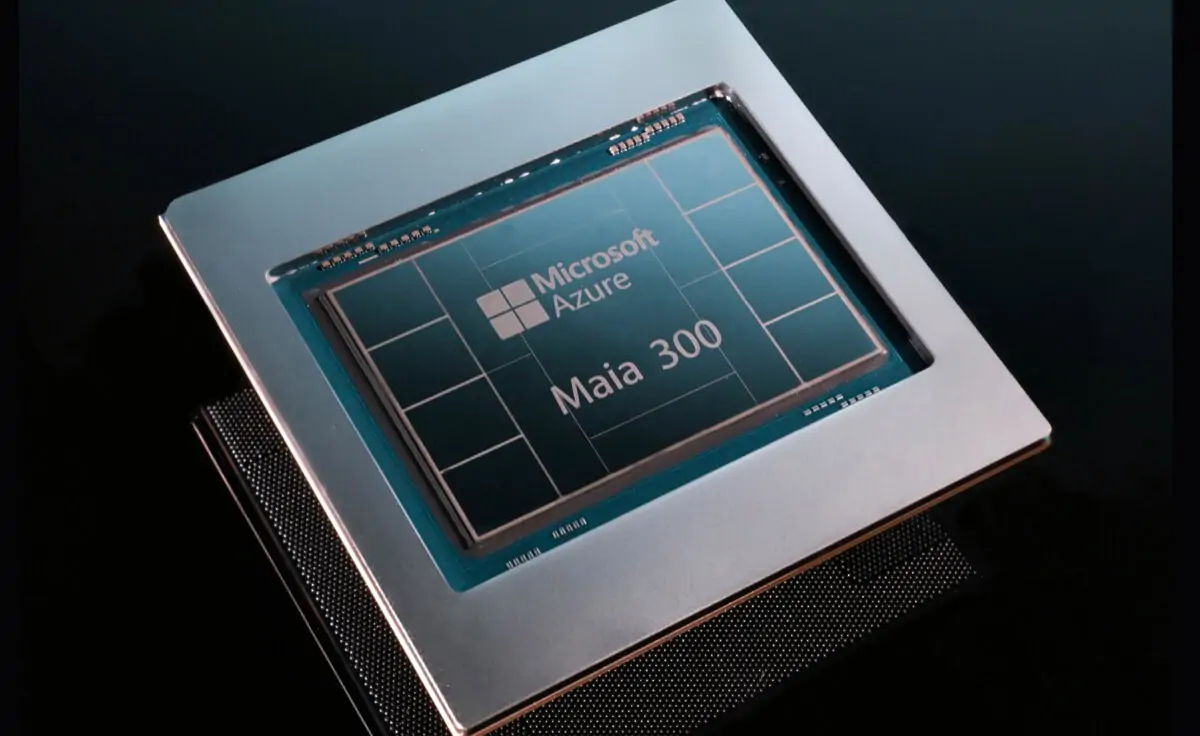
Microsoft is extending its custom-silicon strategy across both AI inference and the CPU workloads surrounding it, pairing its next-generation Maia 300 accelerator with Cobalt 200 processors optimized for agent orchestration, data retrieval, memory management and service calls. Writing in the Microsoft Azure Blog on October 13, Reynold D’Sa and Rani Borkar outlined the strategy in “Infrastructure for the frontier era: Scaling intelligence through open industry collaboration.” Microsoft projects that Maia 300 will deliver 40% more tokens per watt than leading GPU-based systems and up to seven times Maia 200’s rack-scale token throughput in a 96-accelerator configuration. The company separately reports that Cobalt 200 delivers more than 50% higher performance than Cobalt 100, alongside 33% lower agent-call latency and 23% higher throughput on agentic workloads. The overview did not identify the competing GPU systems or provide the benchmark configurations behind these comparisons.
Maia targets long-context reasoning, interactive inference and sustained, multi-step agent execution, with Microsoft designing models, application frameworks, kernels, communication libraries and silicon within a common optimization process. Maia 200 is deploying across the United States, Europe and Australia; Microsoft reports up to 1.7 times more tokens per watt for built-in AI capabilities in Teams, Copilot and Cowork compared with leading GPU infrastructure. Maia 300 production deployments are planned for 2027. Cobalt addresses the accompanying general-purpose computing requirements, while Azure Boost offloads infrastructure functions including compression, networking transactions and security processing. Microsoft’s earlier Cobalt 200 disclosure identified an Arm Neoverse V3-based chiplet architecture manufactured using TSMC’s N3P process, positioning the CPU as a platform for cloud services as well as agent workloads.
Microsoft is coupling these processors with contributions spanning networking, power, cooling and security. Its Multipath Reliable Connection, developed with industry partners, distributes traffic across multiple Ethernet paths and network planes to support training clusters exceeding 100,000 GPUs with two switching tiers. Separate Scale Up initiatives include the Optical Compute Interconnect MSA and Ethernet for Scale-Up Networking, which Microsoft says has released specification version 1.0. For facilities, Microsoft highlighted the transition toward 800 VDC infrastructure, its Mt. Diablo disaggregated power architecture supporting approximately 100 kW to more than 1 MW, and Mt. Atlas heat-exchanger units offering nearly twice the previous generation’s cooling capacity within the same footprint. Microsoft, Marvell and Oracle also introduced Tessera Integrated HSM, an initiative to open-source integrated hardware-security-module architecture and implementation resources.
| MAIA + COBALT | AI Infrastructure |
| • Maia 300: Microsoft projects 40% more tokens per watt versus leading GPU systems; comparison hardware was not identified in the overview. |
| • Rack throughput: Up to 7× Maia 200 with 96 Maia 300 accelerators. This is a rack-level comparison. |
| • Cobalt 200: Microsoft reports more than 50% higher performance than Cobalt 100, 33% lower agent-call latency and 23% higher agentic-workload throughput. |
| • Ethernet fabrics: MRC targets large training clusters; OCI MSA and ESUN address separate Scale Up requirements. |
| • Power and cooling: 800 VDC development, disaggregated Mt. Diablo power infrastructure and higher-capacity Mt. Atlas heat exchangers. |
| • Deployment: Maia 200 is deploying internationally; Maia 300 production deployments are planned for 2027. |
“Maia and Cobalt are designed in the loop with our largest enterprise workloads,” wrote Reynold D’Sa and Rani Borkar in the Microsoft Azure Blog.
Analysis
The architectural significance is the division of work between accelerators and CPUs. An agent may invoke a model repeatedly, but it also retrieves information, executes tools, manages state and communicates with other services. Maia addresses the model-serving portion; Cobalt addresses CPU execution around those calls. Faster token generation can therefore coexist with delays elsewhere in the application. Evaluating the combined infrastructure requires measurements of completed tasks, response times and resource consumption across the entire workflow.
The performance figures need to remain separate. Maia 300’s projected 40% improvement measures token output relative to power, while its sevenfold improvement measures total rack throughput against Maia 200. The latter does not establish a sevenfold improvement per accelerator or per watt. Similarly, Cobalt’s general performance, agent-call latency and agentic throughput figures describe different outcomes. Without the workload definitions, concurrency levels and comparison configurations, they cannot be combined into a single end-to-end agent-performance claim.
Networking also involves distinct architectural domains. Microsoft describes MRC in the context of very large GPU training clusters. OCI MSA addresses optical connectivity for multi-rack Scale Up systems, while ESUN develops requirements for Ethernet-based Scale Up networking. Their inclusion in the same infrastructure announcement does not establish that Maia 300 implements MRC, OCI or every ESUN requirement. Microsoft’s separate Maia disclosure describes an Ethernet-based custom AI transport for communication across accelerators and racks.
Power and cooling complete the system-design picture. Separating power conversion from compute allows electrical infrastructure and accelerator racks to scale independently, while higher-voltage distribution reduces current for a given delivered power level. Microsoft’s cooling strategy similarly accommodates different temperature requirements through independent coolant loops. These developments support the broader objective of increasing useful computing output within facility constraints; the announcement does not establish a specific combined efficiency gain for Maia, Cobalt, networking and facilities.
| Microsoft NASDAQ: MSFT · Company Profile | |
| Microsoft develops cloud, productivity, AI and enterprise software platforms. Its Azure infrastructure includes Maia AI accelerators, Cobalt CPUs and Azure Boost offload hardware. | |
| Headquarters | Redmond, Washington |
| Leadership | Satya Nadella, Chairman and CEO |
| Cloud platform | Microsoft Azure |
| Custom silicon | Maia AI accelerators; Cobalt CPUs; Azure Boost infrastructure offload |
| Coverage | AI infrastructure · Cloud computing · Ethernet · Power · Cooling |
Source: Microsoft Azure Blog, “Infrastructure for the frontier era: Scaling intelligence through open industry collaboration,” October 13, 2026, by Reynold D’Sa and Rani Borkar.
https://azure.microsoft.com/en-us/blog/infrastructure-for-the-frontier-era-scaling-intelligence-through-open-industry-collaboration/

-
 C114 Communication Network
-
 Communication Home
