
 Search

Amd.com
AMD's stacked-cache architecture — a technology that transformed gaming CPU performance — officially crossed into the professional workstation market when Lenovo Korea held a CEO-level media showcase at the Mondrian Seoul Itaewon hotel on September 1, debuting the ThinkStation P4 as the first certified enterprise workstation to pair AMD's 3D V-Cache processors with NVIDIA's Blackwell professional GPU line. The Seoul event confirmed domestic availability of a machine Lenovo had announced globally in May.
The Seoul event was not a quiet channel announcement. Lenovo Korea President Shin Kyu-sik opened with a keynote address. An AMD Korea executive presented benchmark data. And engineers from both companies faced live questions at the Seoul Q&A about liquid cooling, leakage risk, and how the machine compares to the Intel-based ThinkStation P3 — a machine it does not replace but now sits alongside.
South Korea became one of the first Asian markets to receive a formal launch, roughly a month after the P4 became available in North America in mid-August. A wider Asia-Pacific rollout is expected to follow.
What 3D V-Cache Actually Does Inside a Professional Workstation
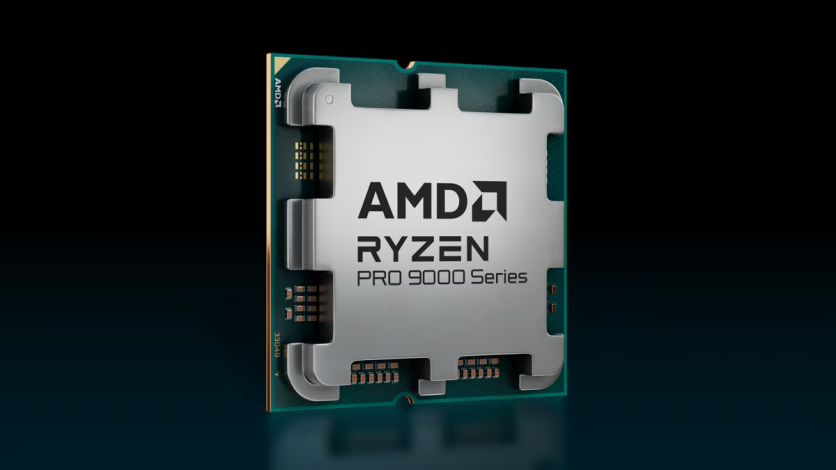
AMD's 3D V-Cache technology works by bonding an additional SRAM die on top of a processor die using through-silicon vias — microscopic vertical conductors that pass electrical signals between stacked layers. The result is a dramatically enlarged L3 cache pool without widening the chip. Where a standard Ryzen PRO 9000 processor carries 64MB of L3 cache, the top-end Ryzen 9 PRO 9965X3D carries 128MB of L3 — with total CPU cache reaching 144MB when combined with the chip's L2 layer.
That gap matters because L3 cache latency runs at approximately four to five nanoseconds, while fetching data from DDR5 main memory costs closer to 70 nanoseconds. In workloads that repeatedly cycle through large working datasets — finite-element simulation, computational fluid dynamics, CAD assembly loading, and matrix factorization operations — reducing the frequency of those DRAM round-trips produces real, measurable gains.
AMD Korea Executive Director Song Sung-woon presented internal benchmark comparisons at the Seoul event. Models with 3D V-Cache showed gains of up to 15% in AI and machine learning tasks, up to 21% in data science workloads, up to 19% in computational fluid dynamics simulation, and up to 20% in matrix factorization operations — all measured against otherwise-identical non-3D V-Cache configurations. AMD representatives at the event separately noted that real-world improvements in professional applications range from a minimum of 10% to over 30% depending on workload memory access patterns.
These figures represent a markedly different performance claim than what 3D V-Cache has historically been associated with. In the consumer market, AMD's X3D chips have been positioned primarily as gaming processors. Their arrival in professional compute — with AMD PRO enterprise management features, long-term firmware validation, and ISV certification requirements — signals a deliberate expansion of the architecture beyond its gaming identity.
Read more: Lenovo Lists ThinkPad P16v 2026 in China With Arrow Lake-HX and Blackwell GPUs
Korea's K-Culture Industry Drove the Decision
Lenovo was unusually candid about why South Korea received one of the earliest Asia-Pacific formal launches. The company said it actively pursued the Korea launch after reflecting feedback from field professionals in Korea's media and content industry representing K-Culture.
That framing has structural backing. Korean content exports hit $14.9 billion in 2025, making K-Culture the country's twelfth-largest export sector. Gaming alone accounts for 64.3% of that total, with K-pop and webtoons growing sharply. For professionals producing K-drama visual effects, K-pop music video graphics, and AAA game assets, GPU-accelerated workstations are production infrastructure, not premium purchases. The government's Hallyu 4.0 framework has raised its target for total cultural industry value to 400 trillion won (approximately $265 billion), with streaming infrastructure investment as one of its four operational pillars.
The entry-level promotional pricing at the Seoul launch sat near 2,700,000 won (approximately $1,970 USD, exchange rate as of September 2, 2026; conversions are approximate) — a threshold Lenovo specifically calibrated against the Korean gaming PC market, where top-tier consumer systems have converged toward similar pricing levels.
Inside the Machine: Blackwell GPU, Liquid Cooling, and the RTX PRO 6000
The ThinkStation P4's headline configuration features the NVIDIA RTX PRO 6000 Blackwell Workstation Edition GPU — NVIDIA's current professional-class flagship, carrying 96GB of GDDR7 ECC memory across a 512-bit bus at 1.8 TB/s of memory bandwidth and delivering 4,000 TOPS of AI processing through fifth-generation Tensor Cores.
GDDR7 memory achieves its speed improvement over GDDR6X through a shift in signaling architecture — using PAM3 encoding in GDDR7 (three signal levels, 1.5 bits per cycle) with doubled channel count and improved noise suppression, reaching 28 Gbps per pin while reducing power draw per operation. The practical result for AI workloads is that the card can handle large language models with up to approximately 70 billion parameters at quantized precision on a single card — a capability that previously required a data center GPU or multi-card configurations.
A note on current market availability: the United States configurations that went on sale in mid-August topped out at RTX PRO 5000 Blackwell with 48GB of GDDR7, not the RTX PRO 6000 that Lenovo prominently featured at global announcement events. The Seoul showcase demonstrated RTX PRO 6000 configurations, but enterprise buyers outside Korea should confirm GPU option availability in their region before specifying — purchased configurations and published platform maximums are not always identical at initial retail launch.
Alongside the GPU, Lenovo introduced what it describes as the first all-in-one sealed liquid cooling system in a mainstream desktop workstation. Coolant absorbs heat from the CPU, transfers it through an internal radiator, and recirculates — with no user-serviceable access ports and no required coolant top-offs. Lenovo's Seoul liquid cooling data showed the liquid-cooled configuration handled approximately 23% higher CPU power draw (TDP) than an equivalent air-cooled design while maintaining the same operating temperature at 25°C (77°F) ambient under 100% CPU load.
In enterprise fleet settings, that thermal efficiency has direct financial consequences. Lower heat output per workstation means reduced cooling infrastructure costs, lower per-unit noise levels, and — most importantly for sustained compute — prevention of thermal throttling during extended simulation and rendering jobs.
Lenovo addressed leakage concerns during the Seoul Q&A session. Company representatives confirmed the system is designed as a fully sealed module with no manual coolant injection required, and that internal testing has eliminated the possibility of leakage. In the event of a hardware issue, Lenovo's service centers provide modular replacement support rather than component-level repairs.
Specifications and Platform Context
The ThinkStation P4 is a 29.9-liter (7.9-gallon) desk-side tower. In its highest configurations it supports the AMD Ryzen 9 PRO 9965X3D: a 16-core, 32-thread processor running at boost clocks up to 5.5 GHz with a 170W TDP. Platform supports seven total processor options spanning the Ryzen PRO 9000 lineup from six to sixteen cores, including both 3D V-Cache and non-V-Cache models.
System memory scales to 256GB of DDR5 across four DIMM slots. Buyers planning maximum-capacity configurations should note that the full 256GB requires non-ECC CUDIMMs running at up to 6,400 MT/s; ECC UDIMMs top out at 128GB. For engineering simulation, scientific analysis, and financial processing workloads where long-running memory integrity matters, 128GB ECC is the more conservative specification to plan against.
Storage supports up to six total drives — a combination of M.2 PCIe Gen 5 NVMe SSDs and 3.5-inch SATA HDDs. The machine ships with PCIe Gen 5 x16 and multiple Gen 4 expansion slots, 2.5GbE integrated networking, Wi-Fi 7 with Bluetooth 5.4, and power supply options of 500W, 750W, and 1,100W. The system starts at $1,849 in the US; Korean base pricing was approximately 2,849,027 won (approximately $2,079 USD) for a Ryzen 5 PRO 9655 configuration before promotional launch pricing applied.
The ThinkStation P4 is certified for professional software from Autodesk, ANSYS, Dassault Systèmes, PTC, Siemens, Bentley, Avid, Altair, and Nemetschek. It carries EPEAT Gold registration, ENERGY STAR 9.0 certification, and TCO Certified 10. The chassis incorporates 95% post-consumer-content ABS plastics and 16% recycled steel.
Lenovo's ThinkShield security suite is integrated — including discrete TPM 2.0, BIOS-level protections, secured wipe capability, a chassis intrusion switch, and an e-lock mechanism.
Not a P3 Successor — and Why That Matters
At the Seoul Q&A, media asked directly whether the ThinkStation P4 outperforms the Intel-based ThinkStation P3. Lenovo's response was deliberate: the P4 is not a P3 successor. It is a separately established AMD-architecture platform that coexists with the P3, giving enterprise buyers a genuine choice between AMD and Intel silicon architectures within the same ThinkStation form factor, support ecosystem, and ISV certification framework.
The distinction matters for IT procurement. AMD's PRO platform for the P4 includes enterprise management and security features — remote management, long-term firmware and driver validation, and supply stability guarantees — that match what Intel vPro provides for P3 buyers. The P4's arrival does not make the P3 obsolete; it extends the ThinkStation portfolio into AMD territory. Organizations already standardized on ThinkStation hardware and management processes can add AMD-architecture machines to their fleet without changing procurement or support workflows.
Read more: Seoul Hosts Global AI Hardware Forum Friday: NVIDIA, Cisco, AMD Join OCP Korea Tech Day
What Lenovo's Chinese Ownership Means for Enterprise Buyers
Lenovo Group Limited is incorporated in Hong Kong and listed on the Hong Kong Stock Exchange. The company's largest shareholder includes a state-backed Chinese institutional investor, and the company operates under China's National Intelligence Law (2017), Cybersecurity Law (2017), and Data Security Law (2021) — laws that legally compel all Chinese organizations and citizens to support, assist, and cooperate with national intelligence work on request, including providing government access to data. This legal obligation is a fixed structural condition, not a contested risk to be weighed against price.
For a desktop workstation like the ThinkStation P4, the practical risk profile differs meaningfully from consumer IoT devices or networking equipment. The machine does not contain a cellular radio, does not route traffic through Lenovo servers as a core product function, and does not harvest behavioral data from its users. Its primary security exposure is through firmware — the update mechanisms and any cloud-connected remote management features Lenovo enables by default.
A pending 2026 class-action lawsuit (filed in US federal court) alleges that Lenovo's advertising infrastructure transmitted American consumer data to China through pre-installed tracking software, in alleged violation of the Department of Justice Bulk Data Transfer Rule. Lenovo has denied the allegations. The case remains pending as of this writing.
Enterprise buyers evaluating the ThinkStation P4 for use with sensitive professional data should apply standard security controls: audit enabled cloud features, apply network segmentation for firmware update traffic, and consult security teams about the Chinese ownership context. ThinkShield's hardware-level protections — TPM 2.0, BIOS hardening, and secured wipe — provide genuine enterprise-grade protection for the workstation's operating environment. They do not eliminate the structural legal condition that applies to any Lenovo-manufactured hardware.
What the Seoul Launch Signals About Asia-Pacific
Korea's formal entry — with a CEO keynote, joint AMD presentation, live Q&A, and demonstrated RTX PRO 6000 configurations — positions the country as a strategic launch priority rather than a follow-on market. Lenovo's explicit invocation of K-Culture content professionals as the impetus reflects a broader recognition that South Korea's creative economy generates sustained, high-end professional compute demand that other markets in the region do not yet match at the same density. K-Culture exports underpin that demand structurally.
The global rollout — announced at NXT BLD London in May, launched in select markets in June, reaching North America and Asia-Pacific from August onward — positions South Korea as one of the first major Asian markets with a dedicated launch event, ahead of most of the broader regional rollout still expected to follow. What Lenovo framed as a market entry driven by K-Culture professionals is also, structurally, the first time AMD's cache-stacking architecture has appeared on a product with professional-grade thermal management, enterprise security, ISV certification, and corporate fleet support — all at once, in a desk-side tower form factor that most enterprise workflows can accommodate.
Frequently Asked Questions
What is AMD 3D V-Cache, and why does it matter for professional workloads specifically?
AMD 3D V-Cache stacks an extra layer of SRAM cache memory directly on top of the processor die using through-silicon vias, expanding the L3 cache from 64MB (standard Ryzen PRO 9000) to 128MB (3D V-Cache models), with total CPU cache reaching 144MB. The relevance for professional workloads is about memory latency: simulation, CAD, and matrix operations repeatedly cycle through large datasets, and L3 cache access runs roughly 15 times faster than DDR5 main memory. AMD's Ryzen PRO 9000 X3D processors represent the first time this architecture has been offered in the commercial professional desktop segment with enterprise management and ISV certification. Documented benchmark gains at the Seoul event ranged from 15% to 21% in simulation, data science, and AI/ML workloads compared to non-3D V-Cache configurations.
Can the ThinkStation P4 actually run large language models locally, and what size?
The configuration featuring the NVIDIA RTX PRO 6000 Blackwell — with 96GB of GDDR7 ECC memory — is capable of running large language models with up to approximately 70 billion parameters at quantized (INT8) precision on a single card, or roughly 40 billion parameters at full FP16 precision. For context, that capacity matches what a single NVIDIA H100 SXM data-center GPU carries in VRAM, making this the first desk-side professional workstation configuration to clear that threshold. Buyers should confirm RTX PRO 6000 availability in their specific region — US configurations launched with the RTX PRO 5000 (48GB).
How does the ThinkStation P4 relate to the Intel-based ThinkStation P3?
The P4 is not a successor to the P3 — it is a separately established AMD-architecture product line that coexists with it. Both machines carry the ThinkStation name and share Lenovo's support ecosystem, ISV certifications, and ThinkShield security suite. The P3 runs Intel Core processors; the P4 runs AMD Ryzen PRO 9000 with Zen 5 architecture and optional 3D V-Cache. Enterprise buyers now have a genuine choice of CPU architecture within the ThinkStation portfolio without changing procurement workflows.
What should enterprise buyers know about Lenovo's Chinese ownership before purchasing?
Lenovo operates under China's National Intelligence Law (2017), which legally requires cooperation with Chinese government intelligence requests including data access. This is a fixed legal condition applicable to Lenovo regardless of where a device is physically located or what Lenovo's own privacy policy states. For a desktop workstation — unlike a smartphone or networking device — the practical risk centers on firmware update channels and any cloud-connected management features rather than the hardware itself. Enterprise buyers handling sensitive data should audit cloud features, apply network segmentation for firmware traffic, and consult security teams. ThinkShield's hardware protections (TPM 2.0, BIOS hardening, secured wipe) provide genuine enterprise-grade endpoint security for the workstation itself.

-
 C114 Communication Network
 -
 Communication Home
