
 Search

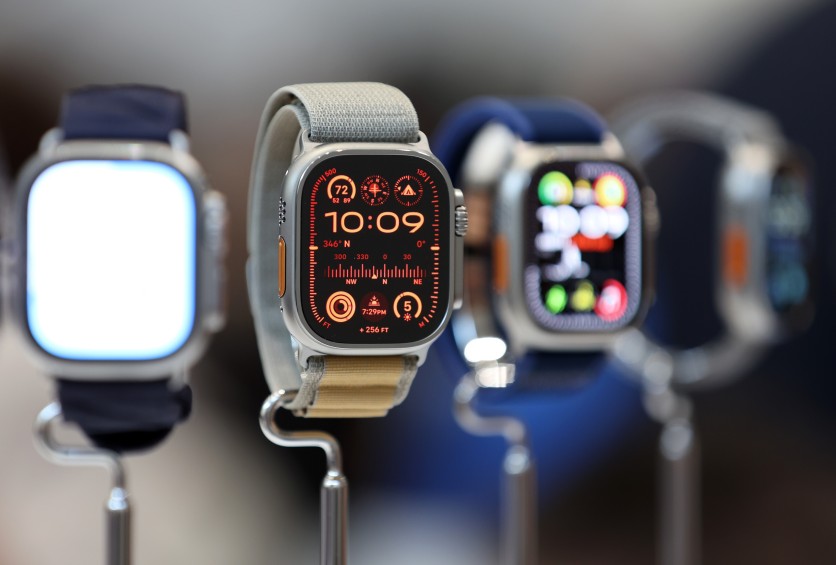
The new Apple Watch series 10 is displayed during an Apple special event at Apple headquarters on September 09, 2024 in Cupertino, California. Apple held an event to showcase the new iPhone 16, Airpods and Apple Watch models. Justin Sullivan/Getty Images
The European Commission adopted a delegated act on July 14, 2026, formally exempting smartwatches, fitness trackers, smart glasses, and wireless earbuds from the user-replaceable battery requirement set to take effect across the EU in February 2027. The decision means that Apple Watch, Meta Ray-Ban smart glasses, Samsung Galaxy Watch, Garmin fitness devices, and AirPods can remain sealed by design — no battery door, no consumer-accessible compartment — and do not need to be redesigned for the EU market. For the wearable industry, the ruling arrives as a structural relief. For the right-to-repair movement, it represents a clear retreat. And for analysts of EU regulatory power, it provides a rare documented case of US diplomatic pressure successfully softening a major EU product mandate before it could spread globally.
The same week that Amazon confirmed it was rebuilding every Kindle model for EU compliance and Nintendo announced a battery-swappable Switch 2 revision, wearable makers learned they face no equivalent obligation. That contrast — compliance for some device categories, exemption for others — defines the practical landscape of EU battery law heading into its 2027 enforcement window.
Read more: EU Battery Law Redesigns Switch 2 This Autumn, Retires Switch 1 in Europe
What EU Batteries Regulation Article 11 Required
The EU's Batteries Regulation (Regulation EU 2023/1542), which entered into force in August 2023, has been rolling out requirements in phases. Its most structurally demanding provision is Article 11, which requires that from February 18, 2027, any portable device sold across the EU's 27 member states must carry a battery that consumers can remove and replace without specialist tools or technical training. The regulation frames this as both an environmental and a consumer empowerment measure: user-replaceable batteries extend device life, reduce electronic waste, and support recycling by making it easier to collect spent cells.
Exemptions already existed for medical devices and "wet appliances" — electric toothbrushes, water flossers, and similar products designed to operate in water — on the grounds that user-accessible battery compartments create safety risks when improperly resealed. Wearables occupied an ambiguous middle ground: clearly designed to withstand water exposure, clearly miniaturized to the point where battery access is engineering-constrained, but not yet explicitly categorized either way. The July 14 delegated act resolved that ambiguity by adding six new product categories to the existing exemption list, with wearables as the most commercially significant addition.
Why Sealed Li-ion Enclosures Cannot Simply Be Opened
The safety rationale behind the wearable exemption is grounded in the chemistry of lithium-ion batteries. Li-ion cells must be hermetically sealed to prevent moisture contact: lithium reacts with water to form lithium hydroxide and hydrogen gas, and the organic carbonate electrolyte used in most cells ignites on exposure to air if the cell is punctured. Mechanical damage to the battery during user-initiated removal — a tool slipping, a cell wall flexing — can trigger thermal runaway, a self-reinforcing cycle of heat buildup that can lead to fire or rupture. This is not a hypothetical risk: a 2022 Fitbit Ionic recall documented 115 reports of batteries overheating in the United States, with 78 confirmed burn injuries including second- and third-degree burns.
The problem is compounded by the sealing demands of water resistance. A smartwatch rated for pool or ocean immersion achieves that rating through a continuous perimeter gasket maintained under consistent clamping force — the kind of continuous seal that is structurally incompatible with a user-openable battery door. The Commission's delegated regulation text acknowledges this explicitly, noting that miniaturization of wearable devices "may result in situations where the battery is so tightly encapsulated in its receptacle that its removal may create a non-negligible risk of damage or piercing of the battery." Replacing a sealed adhesive bond with a screw-on panel and compressed O-ring gasket — the engineering path taken by Amazon for its Kindle redesigns — works for e-readers but requires re-engineering an entire chassis; for a device whose form factor is measured in millimeters of wrist clearance, that tradeoff is not currently feasible.
The exemption's solution is "partial" rather than absolute: wearable batteries still must be removable and replaceable, but by independent professional repairers rather than end users. Manufacturers must ensure that any specialized tools required for professional replacement are available to independent repair shops at reasonable, non-discriminatory prices. The distinction preserves the regulation's recycling objective — spent batteries can still be extracted and processed by trained technicians — while acknowledging that consumer-accessible battery compartments are not technically achievable in current wearable form factors without compromising either safety or water resistance.
Fitbit, Notional Disruption for Apple and Samsung, Real Impact on Meta
For most wearable manufacturers, the exemption's practical effect is the absence of a disruption they were bracing for. Apple Watch, Samsung Galaxy Watch, Garmin fēnix, and Samsung Galaxy Buds can retain the sealed, precision-machined designs that define their category. According to IDC data, global wearable shipments reached 611.5 million units in 2025, a scale that makes the regulatory stakes considerable.
For Meta Platforms, the exemption is more immediately consequential. Meta's rollout of display-equipped Ray-Ban smart glasses in the EU had been blocked by two distinct regulatory barriers since the product launched in the United States in September 2025. One was the forthcoming battery requirement: the glasses' sealed design could not comply with Article 11 without a redesign that would require significant compromise of the slim frame profile that defines the product. The second barrier — EU AI Act compliance for the computer vision and real-time assistant features — remains unresolved.
The battery barrier's removal is the clearer win for Meta. The issue had attracted diplomatic attention: Andrew Puzder, the US Ambassador to the EU, publicly called out the standoff at an event earlier this year, stating that the one market in the world where the glasses could not be sold was the European Union, specifically because the battery was not removable. EssilorLuxottica, the Franco-Italian eyewear company that owns the Ray-Ban brand and produces the glasses with Meta, declined to comment on the announcement in prior reporting; its shares rose in the days following the Puzder remarks. The Commission's spokesperson, responding to The Register's question about whether the exemption resulted from industry pressure, denied the connection: "The Commission has not given in to anyone's pressure. Our proposals follow a broad public consultation with consumer associations, industry stakeholders and the Member States."
Read more: Amazon Rebuilds Entire Kindle Lineup for EU Battery Law Due in February
Does the Brussels Effect Still Work?
The broader significance of this exemption may lie less in the specific products it covers and more in what it reveals about how EU regulatory power operates under geopolitical pressure.
The Brussels Effect — a term coined by Columbia Law professor Anu Bradford — describes the EU's documented ability to export its regulatory standards globally without any formal legal mechanism. Because the EU's single market of roughly 450 million consumers is too large for most multinationals to exit, companies manufacturing products for EU sale typically adopt EU-compliant standards globally rather than maintain separate production lines for each market. The USB-C charging mandate illustrates the dynamic exactly: the EU required a standard that applied only within the bloc, and Apple adopted it globally because producing two hardware variants was economically irrational. Industry analysts had assumed the same logic would apply to the Article 11 battery requirement: EU-compliant wearable designs would become global wearable designs, full stop.
The wearable exemption complicates that picture. The product category most directly affected by the USB-C precedent logic — wearables, which are also manufactured in a single global hardware variant — has now been excluded from the requirement that would have driven that global propagation. What changed between the USB-C precedent and the battery case was the presence of sustained, high-profile US diplomatic pressure during the rulemaking process. The Puzder intervention, Meta's direct engagement with EU authorities, and the specific framing of the issue as a trade barrier at a time of US-EU regulatory friction created a political dynamic that did not exist in the USB-C context.
Recent scholarship has begun questioning whether the Brussels Effect is "in retreat" under conditions of geopolitical rivalry and regionalized rulemaking. The wearable battery exemption, adopted on July 14, 2026, is a concrete data point for that argument: EU regulation, under sufficient external pressure, can be softened before it generates the global compliance pressure that the Brussels Effect depends on. What the USB-C precedent established as a near-automatic mechanism has, in this case, been prevented by diplomatic intervention — a development worth tracking as US-EU technology trade tensions continue.
Six Categories, Not One
The wearable exemption is the highest-profile element of a delegated act that covers six new product categories. Beyond smartwatches, fitness trackers, smart glasses, and wireless earbuds, the Commission also added electric toys with rechargeable batteries — bringing them into alignment with the new EU Toy Safety Regulation (EU) 2025/2509 — and equipment covered by the ATEX Directive, which governs devices used in potentially explosive atmospheres such as explosion-proof motors, sensors, pumps, and forklift trucks used in chemical or mining facilities.
The Commission's updated guidelines separately added wireless thermometer probes designed for food contact and on-body medical delivery systems. For all exempted categories, the professional-replaceability requirement applies: batteries must be accessible to trained technicians, and the tools to perform that work must be available to independent repair shops at non-discriminatory pricing.
The Commission also used the update to clarify a question that had created uncertainty for charging case manufacturers: charging cases for wireless earbuds constitute a "portable battery in themselves" rather than a product incorporating a portable battery, and therefore fall entirely outside Article 11's scope.
Phones and Tablets Are Not Affected
The wearable exemption does not extend to smartphones or tablets, which face their own partially separate regulatory path. The iPhone and most flagship Android phones already qualify for an exemption under the interaction between the EU Batteries Regulation and the Ecodesign Regulation for Smartphones and Tablets (Regulation EU 2023/1670) — devices meeting specific battery cycle-life performance thresholds and IP waterproofing ratings can satisfy the combined regulatory framework without requiring user-accessible battery compartments, though batteries must remain replaceable by independent professionals.
The distinction matters because it means the 2027 replaceability requirement will still reshape design decisions for device categories not covered by existing exemptions. The Nintendo Switch 2 is being revised specifically for the EU market to add user-accessible battery compartments ahead of the February 2027 deadline, and Amazon has confirmed it is rebuilding its entire Kindle e-reader lineup with screw-fastened chassis to enable user battery replacement. The Right to Repair advocacy organization iFixit, writing on July 14, 2026, characterized these compliance-driven redesigns as evidence that EU battery laws "are slowly working" — while noting, pointedly, that the wearable carve-out limits battery service to professional repairers in a way that carries an "annoying" cost for what the regulation ultimately delivers to consumers.
What Right-to-Repair Advocates Have Said
Right to Repair Europe, the coalition representing consumer and environmental advocacy organizations that pushed for the original Article 11 requirement, had specifically flagged the wet-environment exemption pathway as a risk as far back as 2023. Thomas Opsomer, Policy Engineer for iFixit and a voice within the coalition's advisory network, warned then that "some stakeholders are trying to use the exemption for products used in wet conditions to avoid compliance" and that the exemption was "based on unfounded safety claims, as there are many products already on the market that operate in wet conditions with easy to replace batteries."
That prediction has now materialized into the July 14 delegated act. The coalition's broader concern — that exemptions based on professional-only replaceability reinforce a false dichotomy between durability and repairability — reflects the contested premise at the heart of the Commission's reasoning: that a device can be either water-resistant and sealed or user-repairable, but not both at current manufacturing scales. Engineering developments, including gasket-based chassis designs that maintain IP ratings without adhesive, suggest that the constraint is not permanent — but it is genuine for current wearable generations.
What Comes Next
The delegated act adopted on July 14 is not yet in force. Following adoption by the Commission, it must now be transmitted to the European Parliament and the Council of the EU for a formal scrutiny period; it will take effect 20 days after publication in the Official Journal of the EU, provided neither body objects. Objections within the scrutiny window could delay or block the exemption, though such outcomes are relatively rare for delegated acts of technical nature.
Alongside the delegated act, the Commission published updated guidelines to help product manufacturers apply the new derogations consistently across the market.
A separate regulatory deadline arrives even sooner: the EU's Right to Repair Directive (Directive 2024/1799) takes effect on July 31, 2026 — 16 days from today. That directive requires manufacturers to offer repairs at reasonable prices, provide spare parts and repair manuals, and prohibits the use of software to prevent repair — including parts-pairing mechanisms that restrict battery replacements to first-party components. While wearables are not currently listed in the directive's scope for repair obligations, future Ecodesign regulations may add them, and the prohibition on software-based repair restrictions applies more broadly.
For now, the wearable industry has its regulatory answer. Apple Watch stays sealed. Smart glasses stay slim. The February 2027 overhaul that once loomed over every device worn on the human body will pass without forcing a rethink of how these products are built. Whether that outcome resulted from sound engineering analysis, effective industry lobbying, or diplomatic pressure that softened a regulation before the Brussels Effect could do what it usually does — that question, the Commission's public denial notwithstanding, will define how this moment is remembered.
Frequently Asked Questions
Can I still get my smartwatch or fitness tracker battery replaced under the new EU rules?
Yes — but not by yourself. The exemption is a partial derogation, not a blanket carve-out. Wearable batteries still must be removable and replaceable, but only by independent professional repairers rather than end users. Manufacturers are required to ensure independent technicians can access the battery without destroying the device, and any specialized tools needed for the work must be available at reasonable, non-discriminatory prices. This means a third-party repair shop, not just the manufacturer's authorized service center, must be able to service the battery.
Why can't I replace my smartwatch battery myself if I can replace a phone battery?
A smartphone's battery sits inside a flat, rectangular chassis where engineering teams have room to design a screw-fastened or pull-tab accessible compartment while maintaining the overall form factor. A smartwatch battery lives inside a casing whose exterior is a continuous, gasketed enclosure that creates the water resistance rating — open that enclosure without proper resealing and the IP rating is voided, and water access to the lithium-ion cell creates a fire risk. Li-ion cells must stay sealed from moisture because lithium reacts with water; a punctured or improperly resealed cell can ignite. The Commission's delegated regulation specifically cites the risk of battery "damage or piercing" during miniaturized enclosure access as the technical basis for the exemption.
Does the exemption mean Meta's Ray-Ban smart glasses can now be sold in Europe?
Partially. The battery barrier has been cleared: the glasses' sealed design no longer disqualifies them from EU sale under the Batteries Regulation. However, a second regulatory issue remains unresolved — the EU AI Act's requirements for the glasses' computer vision and real-time assistant features, which involve biometric data processing and environmental analysis. EU regulators have flagged these AI capabilities as requiring additional scrutiny, and Meta has reportedly found it unappealing to launch the product in the EU without its full feature set. Battery law is no longer the blocking issue; AI compliance still is.
Does this exemption mean the Brussels Effect — EU rules going global — failed in this case?
For this product category, yes, at least for now. The Brussels Effect operates by creating economic incentives for manufacturers to adopt EU standards globally rather than maintain separate product lines. Article 11 had been expected to force a global redesign of wearables because producing separate EU and non-EU hardware would be economically irrational. The wearable exemption removes that incentive: there is no EU-specific hardware requirement for wearables to propagate globally. What changed between the USB-C precedent and this case was the presence of sustained, named US diplomatic pressure — the Puzder intervention, Meta's direct engagement with EU authorities — during the rulemaking process. The exemption, adopted July 14, is a concrete data point for the emerging argument that the Brussels Effect can be softened when US-EU trade friction is sufficiently high.

-
 C114 Communication Network
 -
 Communication Home
