
 Search

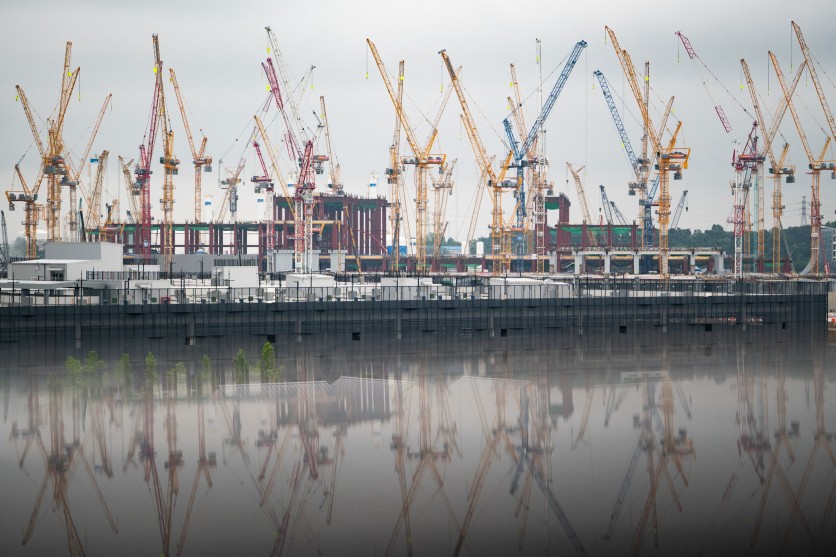
Tower cranes are seen at the construction site of the Samsung Electronics factory in Pyeongtaek on May 28, 2026. Shin Yong-ju/AFP via Getty Images
Samsung Electronics expects its foundry business to return to annual profitability in 2028 — later than some in the industry had recently hoped. Han Jin-man, president and head of the foundry business in Samsung's Device Solutions division, told employees at a June 12 management briefing that a turnaround next year looks difficult, but that profitability in 2028 is likely.
The remark lands as a deliberate cooling of expectations. Just days earlier, reporting and at least one securities analyst had floated the possibility that the contract-chipmaking unit could break even as early as the third quarter or second half of this year, on the strength of better chip yields and a wave of new orders. Han's message draws a sharper line: a single profitable quarter is not the same as a profitable year, and the structural work needed for the latter runs into 2028.
Why the Optimistic and Sober Numbers Can Both Be True
The near-term hopefulness is not wrong, exactly — it is just measuring something smaller. Two things are genuinely improving. On the advanced nodes, Samsung is understood to have raised its 2nm yield above 60% in the first quarter, up from the 20% range late last year. Yield — the share of usable chips per wafer — is the hinge of foundry economics, because a fab's costs are largely fixed and only a high yield spreads them across enough good dies to make money; above-60% puts Samsung within sight of the roughly 70% level generally treated as the threshold for healthy mass production.
On the mature nodes, utilization is climbing as Samsung fills its 4nm and 8nm lines with steady work: base dies for its HBM4 memory (which it makes on its own 4nm process, unlike rivals that outsource them), Groq's AI inference chip, and a processor for a next-generation Nintendo console. The Groq part is the Groq 3 inference chip, work that Nvidia CEO Jensen Huang publicly credited at the GTC conference in March.
Higher yields and fuller lines can lift a quarter into the black. What they cannot do quickly is fix the things Han says keep the annual result negative.
Read more: Samsung Pursues Nvidia HBM4E Supply and LP40 Foundry Work After Seoul Bilateral
The Drags That Push Profit to 2028
Han was candid about the headwinds. Samsung will gradually wind down its 8-inch legacy foundry business — a saturated, thin-margin segment he described as a "red ocean" — to improve profitability, noting that while some orders were taken at low prices during the COVID period, more recently won customers have brought better margins. He also pointed to the company's new special management performance bonus — funded by 10.5% of the semiconductor division's operating profit under a recent labor-management agreement — as a cost now weighing on the foundry's timeline. Because that bonus is charged across the whole DS division, the loss-making foundry helps fund it in 2026, before a provision that would shrink unprofitable units' share takes effect in 2027.
Beyond those, he named the deeper structural reasons for the unit's losses: a slow shift away from a mobile-centric customer base, insufficient technological maturity, a low-margin order book, and a weak strategy for mature process nodes. "It is ultimately management's responsibility that losses were incurred," Han said, pledging to strengthen the business's fundamentals. "As head of the business, I feel a heavy sense of responsibility... We have the technology and execution capability to regain our competitiveness, so let's trust one another and work together."
The Tesla Anchor and the Taylor Timeline
Samsung's foundry prospects also rest heavily on Tesla. The company signed a $16.5 billion multiyear deal last year — running through 2033 — to produce Tesla's next-generation AI6 chips, which are to be made on Samsung's 2nm process at its new fab in Taylor, Texas. After repeated delays, that plant is now scheduled to begin volume production in the second half of 2027 — which is part of why a full-year profit only comes into view the year after.
Read more: Samsung Taylor Fab Production Confirmed for 2027: SF2P+ 2nm Process Goes In
The picture Han painted, then, is neither the quick rebound some had sketched nor a business in trouble. It is a turnaround on a longer clock: the demand is arriving, the yields are climbing, and the marquee customers are real, but the legacy cleanup, the bonus burden, and the Taylor ramp all land between here and a profitable year. On Samsung's own telling, that year is 2028.
Frequently Asked Questions
When will Samsung's foundry business be profitable?
Samsung's foundry chief, Han Jin-man, said on June 12 that an annual operating profit is unlikely next year and that 2028 is the realistic target. That is later than some recent reports and analysts had suggested, with a few floating a possible quarterly break-even as early as the second half of 2026.
Why is Samsung's foundry losing money?
Han cited several reasons: the cost of a new performance bonus funded by 10.5% of the semiconductor division's profit, a slow shift away from a mobile-centric customer base, insufficient technological maturity, a low-margin order book, a weak strategy for mature process nodes, and a saturated, thin-margin 8-inch legacy business it is now winding down.
What is Samsung's 2nm yield?
Samsung is understood to have raised the yield on its 2nm gate-all-around process above 60% in the first quarter of 2026, up from the 20% range late last year. That approaches the roughly 70% level generally regarded as the benchmark for healthy mass-production economics, and it is a key reason the foundry's near-term outlook has improved.
Which customers is Samsung's foundry winning?
Samsung is producing base dies for its own HBM4 memory on its 4nm process, an inference chip for U.S. startup Groq, and a processor for a next-generation Nintendo console, while filling advanced-node capacity for a multiyear Tesla contract worth $16.5 billion to make AI6 chips at its Taylor, Texas fab from the second half of 2027.

-
 C114 Communication Network
 -
 Communication Home
