
 Search

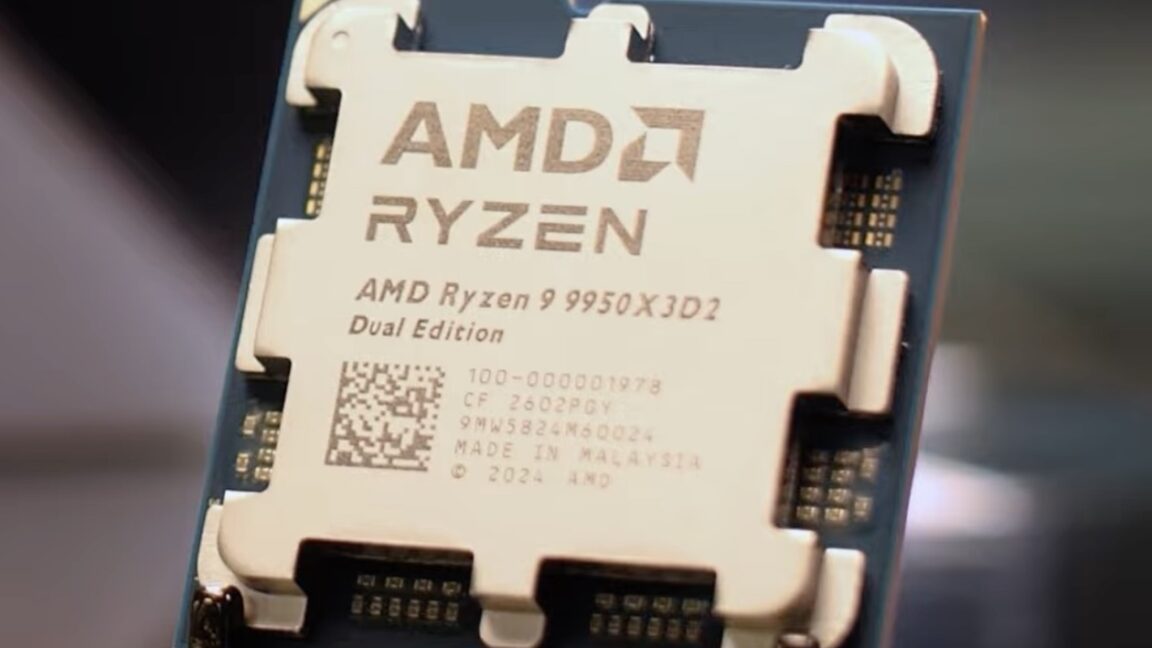
Credit: AMD
For about four years now, AMD has offered special “X3D” variants of its high-end desktop processors with an extra 64MB of L3 cache attached, an addition that disproportionately benefits games. AMD calls this “3D V-Cache” because it stacks the cache directly on top of (for Ryzen 5000 and 7000) or beneath (for Ryzen 9000) the CPU die.
The 12- and 16-core Ryzen chips have their CPU cores split between two silicon chiplets, which has historically made the 7900X3D, 7950X3D, 9900X3D, and 9950X3D a bit weird. One of their two CPU chiplets has the 64MB of 3D V-Cache attached, and one does not. AMD relies on its driver software to make sure that software that benefits from the extra cache is run on the V-Cache-enabled CPU cores, which usually works well but is occasionally error-prone.
Enter the Ryzen 9 9950X3D2 Dual Edition, a mouthful of a chip that includes 64MB of 3D V-Cache on both processor dies, without the hybrid arrangement that has defined the other chips up until now. This gives the chip a grand total of 208MB of cache—16MB of L2 cache, the 32MB of L3 cache built into each of the two CPU dies (for a total of 64MB), and then another 64MB chunk of 3D V-Cache per die. In total, AMD says the new chip should be as much as 10 percent faster than the 9950X3D in games and other apps that benefit from the extra cache.
The extra cache does have mild downsides. The 9950X3D2’s peak clock speed is 5.6 GHz, down very slightly from 5.7GHz for the 9950X and 9950X3D, and its default TDP is 200 W instead of 170 W. Higher power consumption typically comes with higher cooling requirements. And AMD’s initial announcement video didn’t include pricing; the vanilla 9950X3D currently retails for around $675, not far from its $699 launch price. We’d expect the 9950X3D2 to run at least a couple hundred dollars more.
But the Ryzen 9000 series has steadily eroded the downsides of older Ryzen 5000 and Ryzen 7000 X3D chips. The 9950X3D2 will be fully overclockable and tunable via AMD’s Precision Boost Overdrive/Curve Optimizer/Ryzen Master features; stacking the cache beneath the CPU makes it easier to keep those CPU cores cool; and there’s no longer a several-hundred-megahertz-large gap between the base and boost clock speeds. The periodic “core parking” issues with the hybrid X3D chips was one of their last downsides; the 9950X3D2 may be an expensive solution to the problem, but it’s also a foolproof fix that won’t require OS reinstalls or driver updates, which might make it worth it to a certain type of high-end PC user.
The Ryzen 9950X3D2 Dual Edition will be available starting April 22.

-
 C114 Communication Network
 -
 Communication Home
