
 Search

(Image credit: AMD)
-
Facebook -
X -
-
-
Flipboard
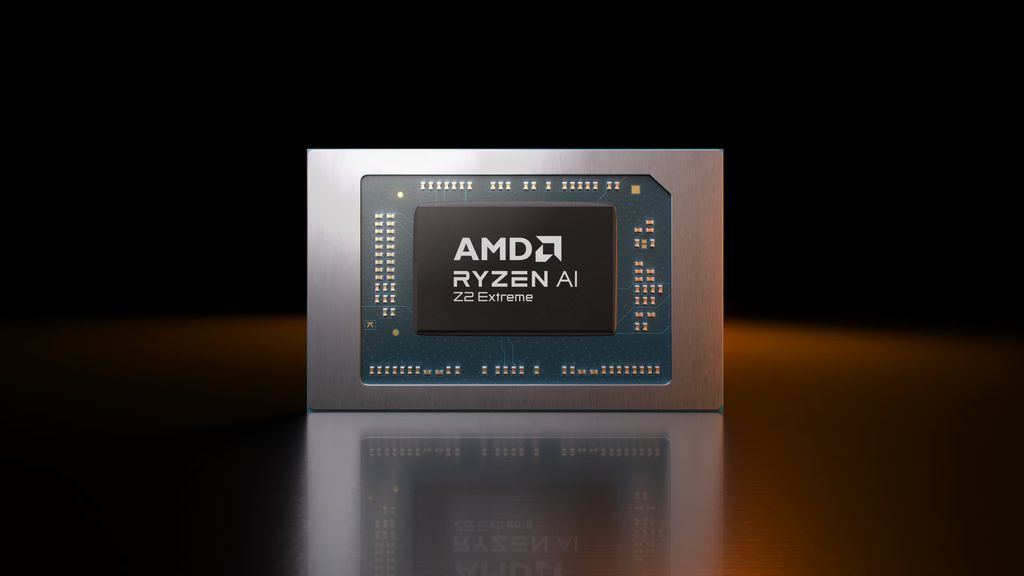
CES 2026 has brought us a wealth of friendly back-and-forth jabbing between AMD and Intel, and this latest piece is no exception. PCWorld reports that AMD has clapped back at Intel after it claimed its Z2 chips were based on "ancient silicon," riposting that its Panther Lake mobile chips carry too much baggage to be suitable for handheld use. AMD even backed up its claims with a lab test (sort of).
The rebuttal occurred during a roundtable interview with AMD's senior VP and GM of client business, Rahul Tikoo. PCWorld recorded Tikoo's response to Intel's aforementioned claim after the news outlet asked about AMD's future plans in the handheld space.
AMD claims that its handheld-specific chip has a much higher chance of success in the handheld market. "You can’t just use mobile silicon and put it in the handheld. You can, but the handheld or the consoles, they care about high graphics. They don’t care about as much compute, and they don’t care about the I/O."
AMD further clarified that Panther Lake is like a Swiss Army Knife that is "good for certain things." It admitted that AMD provides chips that operate like Swiss Army Knives, too, and even has its more conventional mobile CPUs in some handheld systems. But in general, AMD claims that this is more of an exception and that the core handheld gaming industry wants "...purpose-designed, purpose-built chips that have great graphics technology, great software like FSR, integration with game developers on Xbox, PlayStation, etc."
To prove its point, Tikoo told a story of a customer who claimed that they could get more battery life with Intel Lunar Lake chips compared to the Ryzen AI 300 series. AMD opted to test the customer's claims in a lab and found that "...As soon as you go in DC Mode, battery life climbs while performance drops. The Core i7 performs like a Core i3."
"So, the E-cores are very good for efficiency, very bad for performance. We balance the two, and we’re already making those choices for our customers and saying, hey, you don’t have to worry about it.”
The Core Ultra 3 series represents the fastest and most power-efficient mobile chips Intel has pumped out yet. On the gaming side of things, the X-branded Core Ultra 7 and 9 trims take advantage of Intel's fastest integrated graphics chip yet, the Xe3 Arc B390. Intel claims the GPU can perform at the same level as Nvidia's RTX 4050 laptop GPU, but at a much lower power envelope. We were able to test Panther Lake in a multitude of games, and found the Xe3 GPU can perform at well over 60 FPS at 1080p with XeSS upscaling mixed in.
Intel's jab at AMD, calling its Z2 chips "ancient silicon," is truly comedic, given how only one of the models uses Zen 2, but these little arguments demonstrate how truly competitive AMD and Intel are against each other in the CPU space right now. AMD is unfazed by Intel's new Panther Lake chips and has already stated that its outgoing Ryzen AI Max (Strix Halo) APUs already compete against Panther Lake with better (alleged) GPU performance. AMD even opted to update its Strix Halo lineup during CES to include a new 8-core and 12-core model that boasts the same 40CU RDNA3+ flagship iGPU that was exclusive to the flagship 16-core 395 model.

Follow Tom's Hardware on Google News, or add us as a preferred source, to get our latest news, analysis, & reviews in your feeds.

-
 C114 Communication Network
 -
 Communication Home
