
 Search


Google is dropping a game-changing artificial intelligence upgrade to Search with the release of Gemini 4 Hydrogen, a new model designed to understand complicated questions, interpret user intent, and deliver more relevant answers at greater speed.
The update aims to make searching online feel less like entering keywords into a search box and more like having a conversation with an intelligent assistant.
According to Google, Gemini 4 Hydrogen represents its biggest model improvement to Search yet. The model is built to handle detailed instructions, multiple-part questions, and even confusing spelling mistakes while helping users discover more useful websites, visual information, and structured answers through Google's AI Mode.
Gemini 4 Hydrogen Brings a New Approach to Google Search
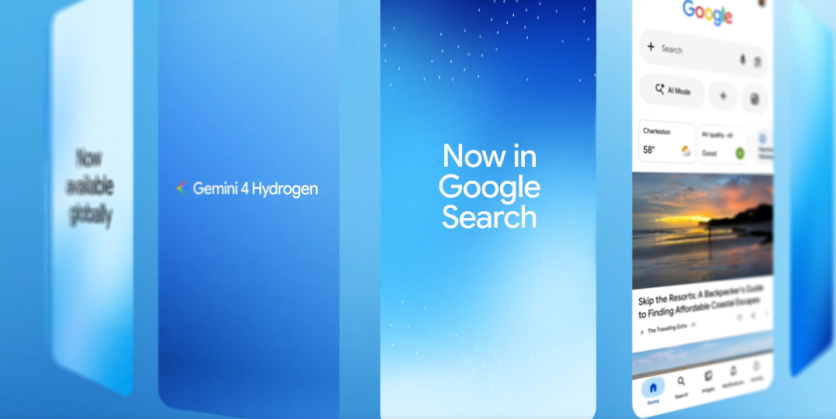
Gemini 4 Hydrogen is designed around speed and efficient task execution. While Google's more powerful frontier models, Gemini 4 Carbon and Gemini 4 Argon, focus on deeper reasoning for demanding problems, Hydrogen is optimized for faster performance across different AI-powered workflows.
Google describes these workflows as agentic tasks, where artificial intelligence can independently carry out multiple steps to complete a request.
The idea is that not every question requires the most computationally demanding model. For everyday tasks, a faster model that can understand instructions and produce useful results may be more practical.
Google claims Gemini 4 Hydrogen completes tasks 2.5 times faster than its predecessor, Gemini 3.8 Flash. Despite its focus on speed, the model has also demonstrated strong performance in intelligence evaluations.
On the Artificial Analysis Intelligence Index, Hydrogen reportedly outperformed the more powerful Gemini 4 Argon at its default high thinking level.
Read more: Microsoft 365 Faces Major Service Disruption as Server Overload Affects Multiple Platforms
Google Search Can Now Understand More Complicated Questions
One of the most important improvements involves how Google interprets search queries.
TechCrunch reports that traditional keyword-based searches often require users to simplify their questions or break complicated requests into several separate searches. Gemini 4 Hydrogen is designed to reduce that effort by understanding questions containing multiple requirements.
For example, a user can describe several conditions in one search rather than submitting separate queries for each detail. The model can identify the different parts of the request and provide a more focused response.
It is also designed to recognize difficult typos and understand what users intended to ask, even when their wording is imperfect.
This improvement could make Google Search more useful for people who naturally type questions as they think of them instead of carefully constructing search phrases.
Improved Search Fan-Out Helps Users Discover More Websites
Another important development involves Google's search fan-out technique.
This process breaks down a single question into multiple related subqueries. Instead of relying on one search phrase, Google explores different aspects of the original request to identify potentially relevant information.
Gemini 4 Hydrogen improves this process through stronger reasoning and better instruction-following capabilities.
For users, this could mean discovering websites and resources that might otherwise remain hidden behind a narrow interpretation of their original query.
The feature is particularly relevant for complicated research questions, product comparisons, and topics that require information from several sources.
Indeed, the search engine giant has gone beyond simple keyword matching through AI-powered search.
Google AI Mode Gets More Visual and Interactive Responses
The Gemini 4 Hydrogen upgrade is not limited to producing better written answers. Google is also expanding the types of visual responses available through AI Mode.
The updated experience can include more images, structured information, comparison tables, and custom tools depending on the user's request.
These features can make complicated information easier to understand without requiring users to navigate several separate pages.
For instance, comparison-based questions may benefit from organized tables, while other searches may be better answered through visual content or specialized interactive tools.
Gemini 4 Hydrogen Introduces Four Thinking Levels
Gemini 4 Hydrogen offers four thinking levels: low, medium, high, and extra-high, also known as xhigh.
The default setting is high, while the additional options allow the model to adjust how much reasoning it applies to a task.
This provides flexibility across different types of requests. Simpler tasks may benefit from lower thinking levels, while more complicated instructions can use higher reasoning settings.
Google says these levels are designed to complete tasks faster while using fewer output tokens.
The different settings also support the model's broader purpose: balancing response quality, speed, and computational efficiency instead of treating every request as equally demanding.
The AI Model Can Handle Coding and Multi-Step Workflows
Although Gemini 4 Hydrogen is being introduced to improve Google Search, its capabilities extend beyond finding information online.
Google says the model can independently assist with everyday development tasks, including writing code, running tests, and verifying code changes.
It can also work alongside Gemini 4 Carbon and Gemini 4 Argon in workflows that involve multiple models.
This arrangement allows different models to contribute according to their strengths, with Hydrogen handling faster execution and other models supporting more demanding reasoning tasks.
On Agent Arena benchmarks involving multi-step activities such as deep research, data analysis, and navigating large codebases, Google reports that Hydrogen ranks fifth.
These capabilities suggest that the model is intended to support both everyday AI assistance and more involved technical workflows.
Gemini 4 Hydrogen Is Expanding Across Google's AI Products
Google's rollout of Gemini 4 Hydrogen extends beyond its search engine.
The model is also coming to all tiers of Google AI Studio, the Gemini API, and the Gemini App. Paid AI Pro and Ultra subscribers can also access it through Google's Antigravity development platform.
For developers, integration through the Gemini API and AI Studio can support the development of applications that require faster AI processing. Meanwhile, Gemini App users can access its capabilities through Google's consumer-facing AI experience.
Google also says the Search update is rolling out globally to all users, bringing the improved model to its wider search audience.
Frequently Asked Questions
What is Gemini 4 Hydrogen?
Gemini 4 Hydrogen is Google's AI model designed for faster task execution, improved instruction-following, and agentic workflows. It is also being used to improve Google Search and AI Mode.
How does Gemini 4 Hydrogen improve Google Search?
It improves the way Search understands complicated questions, interprets user intent, handles typos, and identifies relevant websites. It also supports more visual and structured responses in AI Mode.
Is Gemini 4 Hydrogen faster than Gemini 3.8 Flash?
According to Google, Gemini 4 Hydrogen completes tasks 2.5 times faster than Gemini 3.8 Flash, its previous fast model.
What are the four thinking levels of Gemini 4 Hydrogen?
The model offers low, medium, high, and extra-high (xhigh) thinking levels. High is the default setting, while the other levels provide additional flexibility depending on task requirements.
Is Gemini 4 Hydrogen available in Google Search?
Yes. Google says Gemini 4 Hydrogen is rolling out globally to Search users, including through the AI Mode experience.
Can Gemini 4 Hydrogen be used for coding?
Yes. Google says the model can independently assist with coding tasks, running tests, and verifying code changes. It can also work alongside other Gemini models in more complex workflows.
Where else is Gemini 4 Hydrogen available?
Beyond Google Search, the model is coming to Google AI Studio, the Gemini API, the Gemini App, and the paid AI Pro and Ultra tiers of Google's Antigravity development platform.

-
 C114 Communication Network
-
 Communication Home
