
 Search


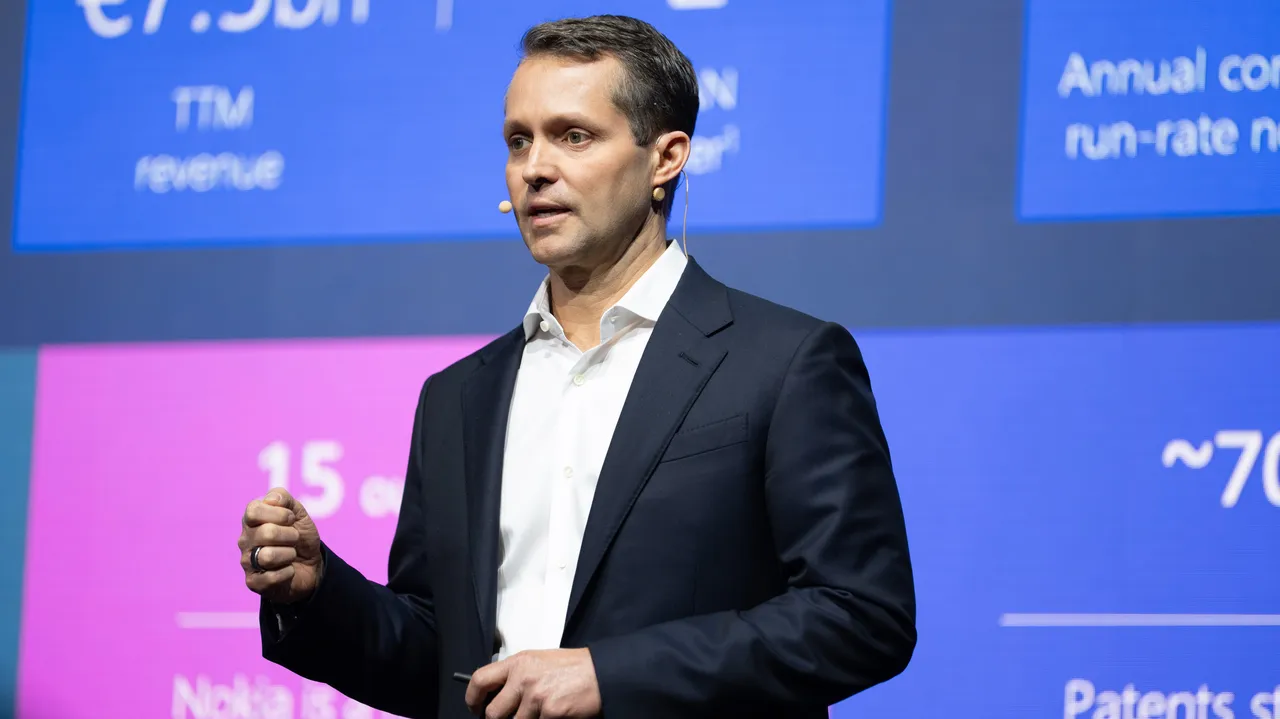
Justin Hotard, Nokia's CEO, says data center demand for connectivity is still rampant.(Source: Nokia)
The optical looks good for Nokia. With about €1.5 billion (US$1.7 billion) in new orders from AI and cloud customers, and more than double the sales it reported a year ago, third-quarter business was booming. No wonder the smile on the face of CEO Justin Hotard, now 18 months into the job, seemed a little broader than usual during his regular quarterly catch-up with reporters. He is now guiding for sales growth of 25% to 30% at the combined optical and Internet Protocol (IP) units next year, up from a previous forecast of just 18% to 20%. Even Nokia's more troublesome mobile business performed well.
But it was the Finnish company's exposure to the ongoing AI boom that really made the difference to headline sales. Overall revenues grew a tenth year-over-year, to about €5.15 billion ($5.77 billion). Strip out the contribution from those AI and cloud customers and they would have risen just 2%. The big data-center buildout has been a huge blessing for Nokia, especially after last year's $2.3 billion takeover of Infinera, an optical specialist. For the first nine months, Nokia owed €1.4 billion ($1.6 billion) of its sales to those customers, up from just €680 million ($761 million) for the same period of 2025.
Hotard also seems unfazed by the apparent difficulties at neoclouds such as Nscale and Coreweave, both of which are Nokia customers. Microsoft has reportedly pulled out of a contract with Nscale in the UK because of power delays, while Coreweave's share price has been tumbling due to investor concern about debt levels.
"We're not seeing any slowdown in connectivity demand – I think quite the converse," said Hotard earlier today in response to a Light Reading question. "We're seeing the investment increase and accelerate around connectivity." Most of Nokia's business is with hyperscalers using its products to stitch their data centers together across longer distances as well as at a campus level, he emphasized.
Components squeeze
Even so, the buildup of orders does seem to partly reflect the supply constraints affecting Nokia as it races to add production capacity at optical fabs in the US. A facility in San Jose is due to be operational around the clock by the end of October, although not then at full capacity. Investment is also going into a photonics plant in Pennsylvania. Yet some things are beyond Nokia's control.
"It's constraints in terms of the demand that TSMC has, which gets talked about quite a bit, and in other parts of the semiconductor supply chain," said Hotard. Based in Taiwan, TSMC continues to be responsible for manufacturing most of the world's most advanced chips. Hotard's expectation is that supply will remain "tight" into next year and even 2028 before there is much relief. "For things like memory, the reality is the fabs are not going to be completed and online until 2029."
At the network infrastructure (NI) business group housing those optical and IP units, third-quarter sales were up 15%, to about €2.16 billion ($2.42 billion), rising 11% on a constant-currency basis. The only real negative was a 22% slide in sales of fixed network products used for broadband services, to €386 million ($432 million). Nokia appears to be exiting low-margin activities and prioritizing what it sees as the more profitable optical line terminal segment, which provides the equipment for the telco end of the connection, over the more competitive market for optical network terminals, the boxes installed at customer premises.
Component shortages and higher prices are also affecting Nokia's newer mobile infrastructure (MI) business group, comprising its large radio unit, the division responsible for core software and the technology standards part of the company. Concern about the worsening dynamics seems to have prompted some customers to bring forward their spending plans.
MI revenues accordingly grew 5%, to about €2.9 billion ($3.3 billion), thanks largely to a 10% increase at the radio unit, which accounts for more than two-thirds of the group total. "I do believe we're seeing customers become more diligent about taking supply, recognizing supply shortages," said Hotard. "I don't think it's necessarily pricing related as much it is supply."
Profits still under pressure
The potential worry for investors is that the current quarter may be weaker than previously expected, with radio still the largest of Nokia's six separate units by sales. The company's share price was down roughly 5% in early-afternoon trading on October 22, even though headline results beat analyst expectations.
There are also still unanswered questions about Nokia's mobile strategy. That now entails a close partnership with Nvidia to develop 5G and 6G network products based on the company's graphics processing units (GPUs), the chips normally associated with AI. Nokia claims GPUs will allow it to substitute AI for conventional radio access network (RAN) algorithms and improve spectral efficiency far more than it could with custom silicon.
In the last few days, it has revealed the names of numerous telcos participating in GPU trials of so-called AI-RAN. But it needs commercial deals next year to silence the critics who think GPUs remain too expensive and power hungry to be used in mobile networks. Ericsson, moreover, is boasting AI-RAN improvements on its custom silicon.
Nokia continues to look far less attractive from a profitability perspective, too. On a reported basis, its operating margin shrank to 1.6% for the first nine months, from 3% a year earlier, although net profit more than doubled, to €248 million ($278 million). Successive rounds of restructuring claimed more than 14,000 jobs between 2020 and 2025, about 15% of the earlier total, and more jobs are set to go this year.
When it reported second-quarter results, Nokia said it expected to incur full-year restructuring charges of €800 million ($896 million), up from an earlier estimate of just €250 million ($280 million). The sharp increase was blamed on plans to save more in Europe and integrate its China business with global operations after buying out shares held by its Chinese partner. Since then, it has confirmed plans to close facilities in China, where its sales have been falling for years as it loses out to local vendors. It now forecasts restructuring charges of €1.1 billion ($1.2 billion) for the whole year.
Hotard attributed the €300 million ($336 million) increase to a speeding up of the integration with Infinera as well as swift progress in China. "We expect to be 90% complete with the integration of China by the end of this year," he said. "We are going to deliver a more durable cost base underneath, so I think it's a positive."
Despite guiding for higher sales of optical and IP products, Nokia made no alternation to its headline guidance of 12% to 14% revenue growth at NI next year. It looks primed for explosive sales to AI and cloud customers provided the AI boom lasts. But it may have to work hard to protect those margins while its main telco market remains such a tough environment. For the first nine months, sales to telecom providers were unchanged. Converting some of those AI-RAN trials into contracts would be the best remedy of all.

-
 C114 Communication Network
-
 Communication Home
