
 Search


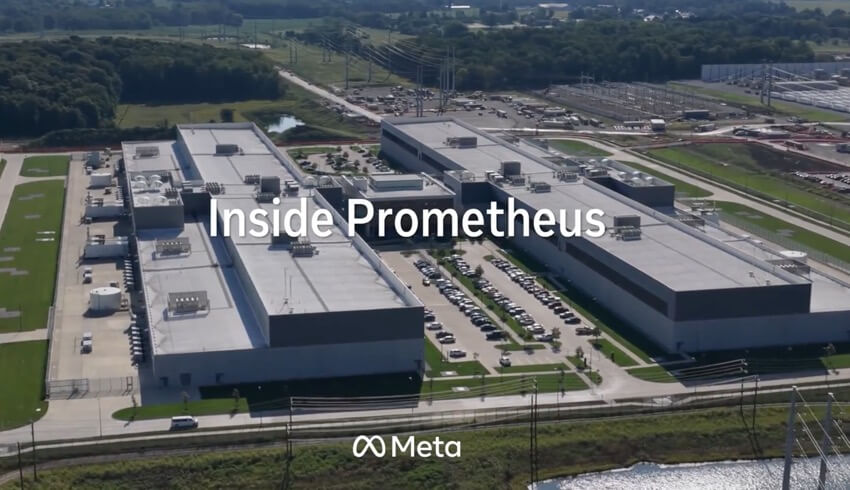
Meta has completed the first phase of its Prometheus AI supercluster in New Albany, Ohio, deploying hundreds of thousands of NVIDIA GPUs across interconnected buildings, with a plan to expand toward approximately one million GPUs. Meta engineers Kevin Lee, Yashar Bayani, Ahmed Sharif and Yee Jiun Song detailed the architecture in an October 19 engineering blog. Prometheus has trained Meta’s Muse foundation models, including Muse Wonder.
Prometheus operates Catalina, a GB200-based two-rack Ariel configuration with 800 Gbps scale-out connectivity per GPU, and Clemente, a GB300 NVL72 platform using ConnectX-8 SuperNICs. San Miguel, based on Vera Rubin NVL72, is planned next. Each building-level Ethernet back-end fabric supports up to 20,736 GPUs. Meta evolved from a Disaggregated Scheduled Fabric to a Non-Scheduled Fabric using 51.2 Tbps Minipack3 and Minipack3N switches running FBOSS.
The Backend Aggregation (BAG) network connects building fabrics over 2 km to more than 100 km using Arista 7800 chassis with Broadcom Jericho3 silicon. Optics include 2×400G FR4 Lite pluggables and 800G-ZR coherent modules for longer links. Meta reports millions of optical transceivers in Prometheus.
Meta reports a 99% reduction in training interruptions from a mid-2025 peak near 1,000 events per 8,000 GPUs per day. Muse Wonder training achieved more than 85% pre-training goodput and more than 90% reinforcement-learning goodput. Mean time between interruptions has subsequently exceeded 54,000 GPU-hours. Each NVL72 rack allocates 64 GPUs to a training slice with eight in-rack spares. Meta uses Parallelism-Aware Fault Tolerance, asynchronous delta checkpointing and predictive diagnostics.
Synchronized AI training workloads can cause 30–40% power transients. Meta uses Dynamo Dimmer GPU power capping and electrical smoothing measures. San Miguel is expected to exceed 170 kW per rack, versus approximately 135 kW for Clemente.
Prometheus: Key Technical Details
| META PROMETHEUS | KEY TECHNICAL DETAILS | |
| GPU scale | Hundreds of thousands deployed; approximately 1 million planned |
| Platforms | Catalina GB200; Clemente GB300; San Miguel Vera Rubin (planned) |
| Scale-out | 800 Gbps per GPU |
| Building fabric | Up to 20,736 GPUs; 51.2 Tbps Minipack3 / Minipack3N; FBOSS |
| Regional BAG | Arista 7800 / Broadcom Jericho3; 2 km to over 100 km |
| Optics | 2×400G FR4 Lite; 800G-ZR coherent |
| Goodput | >85% pre-training; >90% reinforcement learning |
| Reliability | 99% fewer interruptions; MTBI >54,000 GPU-hours |
| Power | 30–40% load transients; Dynamo Dimmer |
Reliability at Million-GPU Scale
Meta provisions spare GPUs within NVL72 racks and uses parallelism-aware fault tolerance and asynchronous checkpointing to improve training continuity. Its stated reliability objective is approximately 100,000 GPU-hours between interruptions.
Power and Cooling
Dynamo Dimmer coordinates GPU power capping to manage rapid power fluctuations, alongside battery and capacitor-based smoothing. Higher-density Vera Rubin racks increase facility cooling and electrical demands.
Analysis: Coherent Optics Becomes Part of the AI Training Fabric
The most significant networking disclosure is Meta’s integration of geographically distributed compute resources into a unified AI training environment. Prometheus uses a hierarchical Ethernet architecture in which latency-sensitive operations remain within building-level fabrics supporting up to 20,736 GPUs, while more latency-tolerant data-parallel traffic traverses a regional Backend Aggregation (BAG) network spanning distances exceeding 100 km. This aggregation layer uses Arista 7800-series systems equipped with Broadcom Jericho3 silicon, providing deep buffering and multiple petabits per second of connectivity between regions. Meta also reports deploying millions of optical transceivers, ranging from 2×400G FR4 Lite pluggables inside buildings to 800G-ZR coherent optics for longer connections. The architecture demonstrates how coherent optical transport is becoming an integral component of distributed AI training infrastructure, extending beyond its traditional role in data center interconnect.
Another important development is Meta’s transition from its original Disaggregated Scheduled Fabric (DSF) toward a Non-Scheduled Fabric (NSF) architecture. The initial design relied on sub-packet multipath routing, virtual output queues, credit-based flow control and packet reordering to manage congestion across large GPU clusters. With newer NICs supporting endpoint packet reordering, Meta has introduced shallow-buffer 51.2 Tbps Ethernet switches using dynamic load balancing and adaptive routing. This evolution shifts some traffic-management responsibilities toward the endpoints while simplifying aspects of the switching fabric. Meta’s October 12 OCP disclosures also introduced Flattened Planar Fabric, 102.4 Tbps IceCube switches and MetaRoCE, although these developments should be distinguished from the specific technologies currently deployed in Prometheus. Together, these initiatives illustrate Meta’s continuing investment in Ethernet architectures optimized for large-scale AI training.
The operational metrics are equally significant. Meta reports reducing training interruptions by 99% from their mid-2025 peak, achieving more than 85% goodput during Muse Wonder pre-training and more than 90% during reinforcement learning. Reliability improvements have increased mean time between interruptions beyond 54,000 GPU-hours, with a target of approximately 100,000 GPU-hours. Maintaining these performance levels as Prometheus expands toward one million GPUs will require continued improvements in fault isolation, checkpointing, optical connectivity and power management. The planned introduction of NVIDIA Vera Rubin-based San Miguel systems, with rack power requirements exceeding 170 kW, will further increase demands on the electrical and cooling infrastructure. Prometheus provides a substantial production deployment from which Meta can evaluate these technologies as it develops its next generation of AI superclusters.
Editorial Note: This article follows Converge Digest’s October 13, 2026, coverage of Meta’s Prometheus presentation at the OCP Global Summit in San Jose. That report focused on the project’s construction, deployment strategy and gigawatt-scale infrastructure plans. Today’s article examines the additional technical disclosures published by Meta Engineering on October 19, including GPU configurations, Ethernet fabric architecture, coherent optical connectivity, training reliability and power management.
Company Profile
| COMPANY PROFILE | META PLATFORMS | |
| Company | Meta Platforms, Inc. (Nasdaq: META) |
| Headquarters | Menlo Park, California |
| AI infrastructure | Prometheus — New Albany, Ohio; Hyperion — Louisiana (planned) |
| Platforms | NVIDIA GB200, GB300 and planned Vera Rubin NVL72 |
| Networking | FBOSS; Minipack3 / Minipack3N; Arista 7800 / Jericho3 |
| Optics | 400G / 800G; 800G-ZR coherent |
| Website | meta.com |
Source: Meta Engineering, October 19, 2026

-
 C114 Communication Network
-
 Communication Home
