
 Search

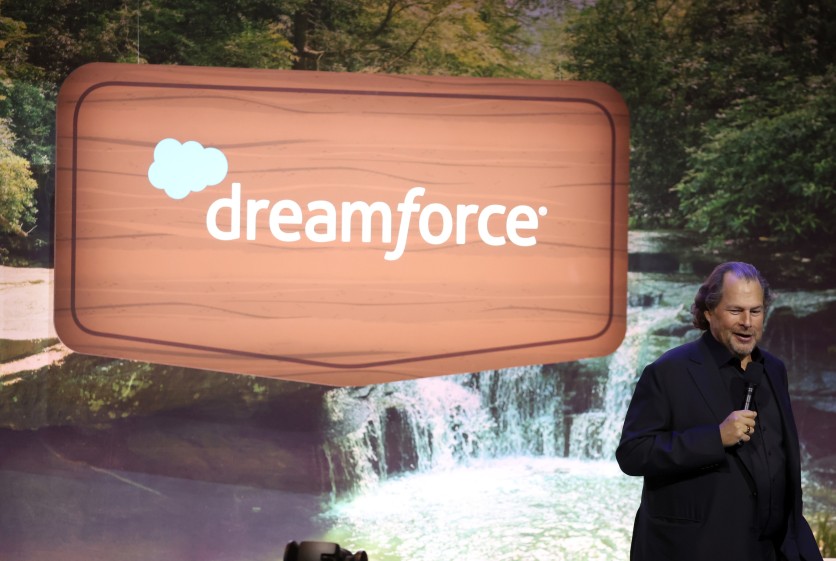
Salesforce CEO Marc Benioff speaks during Salesforce's Dreamforce on September 17, 2024 in San Francisco, California. Justin Sullivan/Getty Images
Salesforce's Winter '27 release announcement, published Monday and scheduling general availability for October 12, 2026, marks the first Agentforce product cycle where the "autonomous agent" promise is visible in production data rather than in projections. More than 550 users at PowerSchool are running the flagship Adaptive Experiences feature today. Commerce merchants are reporting a 13% conversion lift from Agentic Commerce Search before the release ships to the general install base. Insurance carriers are processing First Notice of Loss claims through a voice-enabled agent across six business lines, with no customer service representative required. The release spans service, sales, marketing, commerce, developer tooling, and six industry verticals.
What that production footprint signals is a structural shift in what Agentforce is doing inside enterprise organizations. In every prior release cycle, the operative question was whether AI agents would ever reliably complete a workflow from start to finish — not just suggest the next step, but own the whole job. Winter '27 is the first release where named organizations are providing an affirmative answer with specific figures attached.
That affirmative answer carries a workforce dimension the feature announcements do not foreground. When Salesforce characterizes Winter '27 as producing "reduced operating costs" and "faster resolutions," the mechanism is that agents are completing tasks previously assigned to employees — claims intake, appointment booking, case resolution, audience modeling, code review. A global survey of 2,025 agentic AI decision-makers that Salesforce published alongside this release found that production deployments cut operational costs 29% and resolve issues 31% faster. Salesforce describes this as freeing employees to do higher-value work. Both descriptions can be accurate simultaneously.
Adaptive Experiences: Ambient AI That Replans in Real Time
The most technically distinctive Winter '27 feature is Adaptive Experiences and Dynamic Plans, and the distinction is architectural, not just functional.
Every prior Agentforce service agent operated reactively: a customer or employee submitted a query, the agent responded, and the loop closed. Adaptive Experiences breaks that pattern. An ambient AI agent listens to a live case or messaging conversation continuously, reasons over the evolving context as the issue changes in real time, and updates its resolution plan mid-conversation without waiting for an explicit new prompt. This is ambient computing applied to enterprise service: the agent is not waiting for instructions, it is permanently present in the session, re-evaluating as new information arrives.
The practical difference matters in complex cases. A service interaction that starts as a billing inquiry and escalates to a technical problem and then to a retention risk requires a human rep to manually shift their approach at each stage. Adaptive Experiences — which Salesforce describes as continuously generating and updating resolution plans as issues change — does that replanning automatically. The broader Service Rep Assistant program has surpassed 100 enterprise customers, with PowerSchool alone accounting for more than 550 active users. Four customers are currently live in production on Adaptive Experiences specifically.
The ambient architecture also has a consequence the announcement does not name: an agent that listens continuously captures every turn of every service conversation, creating a richer audit trail but also a larger data footprint than on-demand agents that only retain query-response pairs.
How Agentic Commerce Search Produces a Conversion Lift
The 13% conversion lift Salesforce reports for Agentic Commerce Search is the most specific performance figure in the Winter '27 release, and the architecture behind it explains why the lift is plausible.
Standard e-commerce search matches keyword strings from a query against keyword strings in a product catalog. It fails predictably: a shopper who types "something cozy for fall evenings under fifty dollars" returns zero results or irrelevant ones, because the catalog does not contain those words. Agentic Commerce Search replaces that keyword matching with a small language model (SLM) trained specifically on each merchant's catalog data and that merchant's historical shopper behavior patterns. The SLM interprets the intent behind natural-language queries and maps them to catalog attributes using behavioral weighting — what shoppers who phrased requests this way actually bought.
The architectural choice that makes this commercially viable at scale is the SLM itself. Training a single large frontier model per merchant would be prohibitively expensive and slow. A small, domain-specialized model trained on a bounded dataset — one merchant's catalog, one merchant's shopper behavior — is achievable in cost and latency terms. It also demonstrates the pattern that Salesforce's own ROI research identifies as the strongest predictor of successful agent deployment: clean, accessible data applied to a tightly bounded use case.
Early deployments show both a 13% lift in conversion rates and a 17% increase in add-to-cart rates, which Salesforce reports across commerce merchants already live on the Shopper Agent platform. These are Salesforce-reported figures from production deployments, not independently audited third-party benchmarks. The feature is now standard for all Shopper Agent customers.
Agents in the Data Stack: Informatica Headless and Tableau Knowledge
Two features in Winter '27 address the same root cause from different angles: agents hallucinate or produce bad outputs when they retrieve data through general-purpose inference rather than governed pipelines.
Informatica Headless decouples the back end of Informatica's Intelligent Data Management Cloud from its user interface. Instead of requiring an administrator to log into Informatica's interface to run a data pipeline, the back end is now callable as an API from VS Code, Cursor, Slack, or any client that supports MCP (Model Context Protocol) servers. A developer building an AI agent can call a governed enterprise data pipeline directly from their editor without switching contexts. The effect is a reduction in the inference steps between an agent's question and a governed data answer — fewer steps mean fewer points where incorrect inference can compound.
Tableau Knowledge approaches the same problem from the knowledge graph side. It automatically ingests structured and unstructured enterprise data, constructs what Salesforce describes as a living knowledge graph, and delivers curated context to agents through open standards. The distinction from a static knowledge base is that the graph updates continuously as business data changes, rather than requiring manual curation to stay current. Business subject-matter experts retain control over what the agents can access, which is the governance layer that keeps the system audit-compliant.
Both features address a gap that Salesforce's ROI study identified as the single most significant predictor of whether a production agent deployment succeeds or fails: clean, accessible data available at the moment an agent acts was credited by 36% of successful deployers as the top factor, tied only with tightly defined agent scope.
What Preparation — Not Speed — Separates Successful Deployments
The Salesforce research released alongside the Winter '27 announcement cuts against the conventional advice to move fast on AI agents.
Among the 30% of organizations in Salesforce's survey that have fully deployed agents in production, meaningful ROI arrives in approximately eight months. The industries that reached ROI fastest — Professional and Business Services, Supply Chain and Logistics, at 6.5 months and 7.2 months respectively — were among the slowest sectors to begin adopting AI agents. High Tech, one of the biggest deployers by volume, posted one of the slowest times to ROI at 10.1 months. Being first to deploy did not produce being first to see returns.
The two factors most predictive of successful deployment — identified by 36% of surveyed deployers each — were clean, accessible data at the moment an agent acts and a tightly bounded use case. Neither requires fully unified enterprise data as a prerequisite. Only 31% of production deployers had unified all their data before launching; the 69% who launched with partially integrated data still reached ROI, but took 8.8 months on average versus 7.3 months for those who integrated first.
Governance timing also creates a real tradeoff the survey data makes explicit: organizations with lighter oversight structures reached positive ROI in 7.2 months, while those with heavier governance took 9.3 months. However, below-average-governance organizations were nearly twice as likely to discover an agent operating outside its parameters only after a consequential error had already occurred — 32% versus 18% among well-governed deployments.
Shibani Ahuja, Salesforce's SVP of Data and AI Strategy, summarized the finding this way in the report: "The advantage was never in starting first; it's in starting deliberately. The organizations getting real returns got specific about a shortlist of things before conditions were perfect: the data they made trustworthy for the job, the point where a person stays in the loop, and the guardrails they built before they needed them."
Read more: Salesforce Agentforce Multi-Agent Orchestration Hits GA: Agent Descriptions Now Drive Reliability
How Does Agentforce Orchestrate Agents From AWS, Azure, and Google?
Third-Party Agent Orchestration is the Winter '27 feature that addresses the multi-vendor problem most large enterprises are beginning to confront.
As organizations accumulate AI agents from different providers — Agentforce for CRM workflows, Azure AI agents for IT systems, AWS agents for cloud infrastructure — the default is fragmented handoffs: a workflow that crosses vendor boundaries requires a human to pick up where one agent left off and hand the task to another system. A2A (Agent-to-Agent), an open interoperability protocol introduced by Google in April 2025 and now stewarded by the Linux Foundation with more than 50 technology partners, resolves this by allowing agents to delegate work to each other directly, publishing capability descriptions (Agent Cards) that orchestrators read to determine which specialist is best suited for each sub-task.
Agentforce now supports A2A natively, enabling it either to orchestrate agents from AWS, Azure, and Google as subagents, or to participate as a subagent inside an architecture where a different platform is already acting as the primary orchestrator. This is the same interoperability logic that drove MCP adoption: Salesforce is positioned as a participant in a multi-vendor agent ecosystem rather than requiring enterprises to standardize entirely on one platform.
The practical consequence for IT buyers: an enterprise can now build a primary Agentforce agent that handles CRM-layer work and delegates out-of-CRM tasks to specialized agents on other platforms without writing custom integration code for each delegation path. The Agent Cards make each subagent's capabilities machine-readable, so the orchestration decision is automated rather than manually configured.
Slack Code and Agent Skills: Collaborative Development at Enterprise Scale
Winter '27 extends Agentforce into software development in two ways that address complementary problems.
Slack Code brings software development into shared Slack channels, where AI agents participate alongside developers, product managers, and non-technical colleagues in writing, reviewing, and shipping code. The intent is to address a structural gap in current AI-assisted development: most AI coding tools operate in isolated private sessions — one developer, one AI, no team visibility. Moving development into shared channels means that a feature being built by an AI agent is visible to the product manager who defined it and the QA engineer who will test it, in the same conversation thread where questions get answered and decisions get made.
Agent Skills and Plugins addresses the cold-start problem: every new AI agent begins with zero institutional knowledge of how its organization's workflows, systems, and conventions actually operate. Without prebuilt context, agents guess at best practices and produce inconsistent results regardless of the underlying model's capability. Salesforce has launched over 100 prebuilt skills covering common platform workflows. Organizations can author and publish their own skills into the same registry, and plugins bundle skills with MCP connectors and configuration so that a single install brings a complete, governed capability to any surface. Salesforce's own development plugin is currently available in the Claude Code marketplace.
What Does Winter '27 Change for Revenue, Insurance, and Field Service?
The features targeting specific business functions and industry verticals represent Agentforce's expansion from horizontal deployment (any enterprise, any department) to vertical deployment (specific industries with specific compliance and workflow requirements).
Autonomous Scheduling with Agentforce Voice compresses appointment-booking calls that previously took 15 minutes — requiring a customer to reach a human dispatcher who then checked technician availability against a scheduling system — down to seconds. The voice agent checks real-time technician availability and territory coverage the moment a customer calls, at any hour, without a human handoff. No human dispatcher is required.
Revenue Management Agent Enhancements extend quoting across three buyer types simultaneously: direct customers can order without a sales representative, partners can transact without leaving their own workspace, and account executives arrive at renewal conversations with a pre-assembled quote and risk signals already pulled from the CRM. The net effect is that the friction point of getting a quote — which historically required a sales rep to manually assemble one — is removed from the customer journey for direct buyers, and the renewal prep work that AEs previously did manually is automated.
Claims Service Customer Assistance gives insurers a voice-enabled agent template that handles First Notice of Loss intake by phone at any hour, across six business lines, without a customer service representative. The agent captures incident details, validates policy data against the CRM record, and creates claim and case records automatically. The operational argument for insurers is that FNOL intake — which typically requires a trained agent who knows the policy, the coverage limits, and the claim initiation process — has a high per-call cost that a 24/7 voice agent eliminates for straightforward cases.
Agentforce Becomes the Portfolio Name
Winter '27 also completes a rebranding exercise that reshapes how Salesforce's product portfolio is organized and marketed. Sales Cloud is now Agentforce Sales, Revenue Cloud becomes Agentforce Revenue Management, and Marketing Cloud Next carries the Agentforce Marketing label. The effect is that Agentforce is no longer a standalone product sitting alongside the clouds — it is the umbrella identity for the entire portfolio, signaling that agent capabilities are no longer an add-on but the default operating mode for every Salesforce product going forward.
The timing of this rebranding is directly connected to the partner-ecosystem positioning. When Salesforce announced Claudeforce — its expanded partnership with Anthropic that makes Claude the default model across Agentforce's Atlas Reasoning Engine — it simultaneously launched AIforce, the enterprise harness that exposes Salesforce's data and workflows to any MCP-compliant AI client. The Claudeforce launch and its MCP architecture make the portfolio rebranding legible to enterprise buyers: every surface is agent-native, every data record is agent-accessible, and the platform is the governed environment in which agents of any provider can be deployed.
Read more: Salesforce Launches Claudeforce, Posts Four-Year Revenue High as AI Threat Thesis Collapses
Winter '27 is generally available October 12, 2026. Salesforce has published full release notes and a dedicated Trailhead module covering the feature highlights. Sandbox preview is currently open for organizations that want to evaluate new capabilities before the GA date; the first production upgrade weekend for many instances is scheduled for September 4.
Frequently Asked Questions
What is the evidence that Agentforce is actually running in production, not just being piloted?
The clearest production evidence in the Winter '27 announcement is the named customer data attached to specific features. PowerSchool has more than 550 users active on Adaptive Experiences, the ambient AI feature that continuously replans service resolutions in real time. Agentic Commerce Search is showing measurable conversion lifts at commerce merchants already live on the Shopper Agent platform — Salesforce reports 13% lift in conversion and 17% in add-to-cart. These are Salesforce-reported figures, not independently audited, but they attach a specific organization and specific user count to the production claim rather than relying solely on aggregate metrics like Agentic Work Units. Salesforce's own research study of 2,025 agentic AI decision-makers, published simultaneously, found that among the 30% of organizations that have fully deployed agents, meaningful ROI arrives in approximately eight months — with 53% employee adoption and 29% customer satisfaction gains on average, according to the State of Agentic AI study.
What should enterprises do before turning on Winter '27 agents to avoid the "first-to-deploy" trap?
Salesforce's own research is direct on this: being first to deploy does not produce being first to reach ROI. The factors that best predicted successful outcomes were clean, accessible data at the moment an agent acts and a tightly bounded use case — both credited by 36% of production deployers as their top success factors. Practically, that means identifying one specific workflow with good data and narrow scope before attempting to deploy agents across the platform. Organizations that unified relevant data before deploying reached ROI in 7.3 months on average; those that launched with fragmented data and addressed it later took 8.8 months. For governance: lighter oversight structures produced faster ROI (7.2 months) but nearly twice the rate of discovering agents operating outside parameters only after a consequential error had occurred. The recommendation from the agentic AI deployment research is to define escalation paths and guardrails before deployment, not as a retrospective fix.
What happens to the employees whose workflows these agents are now completing?
Salesforce frames the agent deployments in Winter '27 as "freeing teams to focus on higher-value work" — and that characterization is consistent with what organizations typically say when they deploy automation at scale. The ROI study's finding of a 29% reduction in operational costs, paired with 31% faster issue resolution, represents a meaningful reduction in the labor input required per task completed. Salesforce's own experience is instructive: the company used Claude Code to compress a software migration scoped at 231 days into 13 days, then disclosed it would not hire additional software engineers in 2026. Whether agent deployment translates to headcount reduction, role redefinition, or genuine capacity expansion for growth depends on the specific organization's choices — but the automation is real and the operational cost reduction is the mechanism.
When is Salesforce Winter '27 generally available, and what can organizations access now?
Winter '27 will be generally available October 12, 2026. Sandbox preview is currently open — organizations with a sandbox instance can evaluate all new features now. Production upgrades roll out across three weekends: September 4, October 2, and October 9, 2026, with each organization's specific upgrade date listed on Salesforce's Trust maintenance calendar. Full release notes were published August 19, 2026. The Trailhead module covering Winter '27 highlights is available on the releases page immediately.

-
 C114 Communication Network
 -
 Communication Home
