
 Search

Qualcomm.com
Qualcomm has officially named and detailed the GPU architecture powering its next flagship Snapdragon platform — and the design draws a sharp architectural line between hardware-accelerated AI rendering and every mobile GPU that came before it. The company disclosed the Adreno Neural Fusion GPU on September 2, 2026, revealing that dedicated AI compute units called Matrix Cores now sit inside each of the GPU's three processing slices, and that both Unity and Unreal Engine already have native integration built in — meaning developers can enable AI-enhanced rendering without writing a single line of custom code.
The practical consequence for Android flagship buyers is this: the games they already play — or will download — on a next-generation Snapdragon device should run longer and look sharper on the same battery budget, through upscaling and frame generation that runs entirely inside the graphics chip rather than bouncing data across the chip to a separate AI processor.
Why Putting AI Inside the GPU Slice Changes the Equation
The defining architectural fact of Adreno Neural Fusion is not merely that the new GPU supports AI workloads — the existing Hexagon NPU in every Snapdragon chip already handles AI inference. What is new is where the AI runs: inside each of the three GPU slices, co-located with the 18MB of Adreno High Performance Memory (HPM) that the GPU uses for its tile-based rendering pipeline. Qualcomm's official blog describes the HPM as providing "large, low-latency memory directly to the GPU, allowing tile-based rendering, frame buffers, and compute workloads to remain local to the graphics subsystem."
Mobile GPUs process frames using tile-based deferred rendering — they subdivide the framebuffer into small tiles and complete all the processing for each tile in fast on-chip memory before writing the finished result to main system RAM. The 18MB HPM is that fast on-chip memory. Keeping AI inference data inside the same 18MB pool means the super-resolution and frame generation algorithms read from and write to the same memory the GPU is already using, at the same speed. The Snapdragon Game Super Resolution documentation on GitHub confirms that SGSR v2 already used temporal data to improve upscaling quality — Neural Fusion takes the next architectural step by putting that inference work on dedicated hardware.
Prior approaches — including Qualcomm's own Snapdragon Game Super Resolution — ran upscaling algorithms on the GPU's general shader cores, and more complex AI tasks were routed to the Hexagon NPU. The Futurum Group's analysis of early GSR describes the original approach: a single-pass spatial technique optimized for Adreno GPUs that achieved power savings at the cost of reconstruction quality. Sending data to the NPU required writing to shared memory or DRAM, crossing the chip's system interconnect bus, waiting for the NPU to run inference, and reading the results back — each step adding latency and energy overhead. The Matrix Cores eliminate those bus crossings by keeping AI inference physically adjacent to where frames are rendered.
Qualcomm claims this architectural approach delivers up to 40% lower power compared to the prior-generation Snapdragon Game Super Resolution system — a self-reported figure against Qualcomm's own prior solution, pending independent third-party validation after Snapdragon Summit. A separate 12% overall GPU efficiency improvement, generation over generation, applies to the broader GPU architecture regardless of Neural Fusion being active.
The Matrix Cores run at 1.45GHz — the same clock speed as the GPU slices they are embedded in — up from the 1.2GHz of the Adreno 840 GPU in the current Snapdragon 8 Elite Gen 5, according to AndroidHeadlines' coverage of the disclosure.
Completing Qualcomm's Matrix Compute Trifecta
The Adreno Matrix Cores are not an isolated addition. They complete what Qualcomm now describes as a platform-wide matrix acceleration strategy spanning all three of its core compute engines, as documented in XenoSpectrum's Neural Fusion analysis.
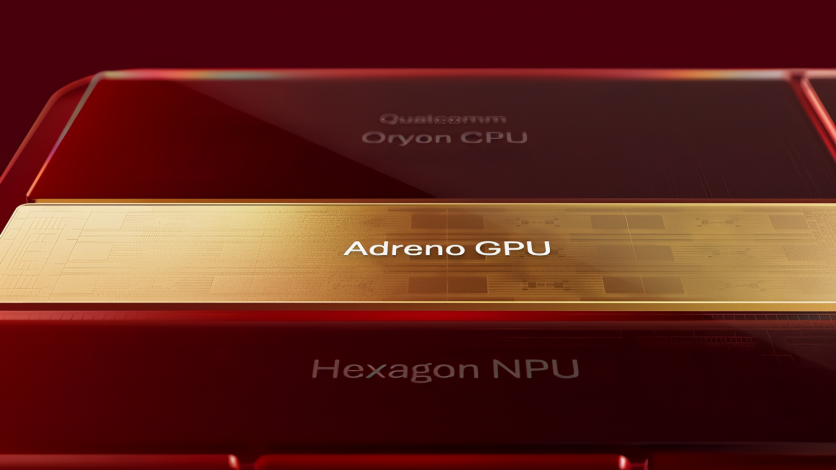
The Hexagon NPU has carried dedicated matrix compute units for multiple Snapdragon generations — it has long been the primary home for large AI inference workloads running in the background. The Oryon CPU, previewed on August 25, 2026, added Scalable Matrix Extension support, embedding matrix acceleration into the CPU cores for AI tasks that run in parallel with foreground applications. Now, with Matrix Cores inside the Adreno GPU slices, every major processing engine on the next flagship Snapdragon platform can accelerate General Matrix Multiply operations — the mathematical primitive underlying virtually all neural network inference.
The practical implication is workload routing: the platform can dynamically assign AI inference tasks to whichever engine is best suited — the NPU for sustained background models, the CPU for foreground tasks, and the GPU Matrix Cores for AI operations that need to happen inside the graphics pipeline frame by frame.
Anshel Sag, a principal analyst at Moor Insights & Strategy, noted in a Moor Insights analysis published September 2 that the Adreno Matrix Core architecture is "similar to what Apple did with Apple Silicon's GPU" — a reference to Apple's integration of GPU-embedded matrix compute units across its A-series and M-series silicon. He characterized the GPU Matrix Cores as providing meaningful complementary AI compute horsepower alongside the NPU — not replacing it, but routing an entire category of latency-sensitive AI work to silicon that was previously unavailable for it.
Super-Resolution and Frame Generation: How Neural Fusion Works
Adreno Neural Fusion bundles two distinct AI rendering capabilities under one pipeline. The first is AI super-resolution: the game renders internally at a lower resolution — reducing GPU workload and power draw — while the Matrix Cores run a neural network that reconstructs the full output resolution with sharp detail. Earlier mobile upscalers, including Qualcomm's GSR v1, used spatial algorithms without motion data; GSR v2 added temporal data but ran on conventional shader cores. Neural Fusion runs on dedicated hardware, allowing more sophisticated network architectures at lower power cost. The GSR GitHub repository documents this lineage from single-pass spatial upscaling to temporal reconstruction.
The second capability is frame generation: the Matrix Cores synthesize entirely new intermediate frames between natively rendered frames using motion vectors and optical flow data. Rather than rendering every displayed frame from scratch, the GPU renders fewer frames and uses AI to construct the frames in between — maintaining smooth visual output at lower GPU utilization. Qualcomm's official description positions this as delivering "stable frame rates and improved efficiency through AI-enhanced rendering built directly into the Snapdragon graphics pipeline."
A note that every major PC implementation of frame generation carries applies here as well: synthesized frames are computed after the rendered frames they sit between, which adds display latency compared to native rendering at the same frame count. PC frame generation latency research — including Hardware Unboxed's testing and Digital Foundry's analysis — documents latency additions of 10 to 30 milliseconds at common frame-rate targets, depending on configuration. For visually driven, single-player, and casual gaming experiences, this latency is imperceptible. For competitive mobile gaming requiring reflex-based input, frame generation is typically not the recommended mode — and Qualcomm's AI rendering suite does not change that underlying tradeoff. The suite's 40% power savings claim applies specifically to upscaling workloads; competitive-gaming players who prioritize touch-to-display latency should monitor how developers configure frame generation in titles they play.
Unity and Unreal Engine Integration: Why "Already Onboard" Matters
Hardware capabilities and consumer games exist on opposite ends of an adoption pipeline. A GPU that can do frame generation in a first-party demo is interesting engineering. A GPU whose frame generation runs in the game development tools that studios already use is what players actually experience.
Qualcomm confirmed that both Unity and Unreal Engine — the two platforms powering the substantial majority of mobile games globally — have already integrated Neural Fusion natively. Studios building on either engine can enable super-resolution and frame generation within their existing development workflows without writing custom rendering code or waiting for engine-level support to arrive. The integration is available at ship time, not on a future roadmap, as HotHardware confirmed in its coverage of the announcement.
This is the crossover mechanism. NVIDIA DLSS offers a useful parallel: the technology launched in 2018 requiring per-title custom integration. Adoption was slow. When Unreal Engine built native DLSS support into its plugin architecture, the number of supported titles expanded rapidly without requiring per-studio engineering investment. Qualcomm has apparently applied that lesson — securing engine-level integration before the chip is in consumer devices, so the features are available to any developer who targets the platform from launch.
Read more: Snapdragon 8 Elite Gen 6 Pro: Exclusive Die Size, LPDDR6 First, AI Frame Fusion Detailed
What Does Adreno Neural Fusion Do Differently Than Older Snapdragon GSR?
The Snapdragon Game Super Resolution system that Neural Fusion supersedes went through two generations: GSR v1 was a single-pass spatial upscaler using fixed-function sharpening algorithms — effectively a GPU-side equivalent to AMD FSR 1.0, efficient but limited in output quality. The Snapdragon GSR GitHub repository documents both generations: GSR v2 added temporal data (motion vectors and frame history), improving stability but still relying on general shader cores rather than dedicated hardware.
Neural Fusion moves to hardware-accelerated neural network inference with Matrix Cores — the architectural leap that separates DLSS from FSR on the PC side. Benchmark comparisons of DLSS and FSR show DLSS consistently producing cleaner output than FSR's algorithmic approach at equivalent frame rates, a gap explained by DLSS running on NVIDIA's Tensor Cores (dedicated GEMM accelerators in RTX GPUs). Neural Fusion is Qualcomm's implementation of the same fundamental principle: dedicated matrix compute hardware accelerating neural upscaling within the graphics pipeline, producing output with fewer ghosting and shimmering artifacts than temporal-only predecessors.
A Pre-Announcement Architecture Preview
Qualcomm has not officially named the Snapdragon platform that will carry this GPU. Neither the SKU designation nor the manufacturing process node has been publicly confirmed. What Qualcomm has confirmed is that the chip's architecture preview has arrived in two distinct disclosures — the Oryon CPU 5GHz and FlexCache cache architecture on August 25, followed by the Adreno Neural Fusion GPU on September 2 — with the Hexagon NPU details still to come.
The complete platform is expected to be unveiled at Snapdragon Summit 2026, which will take place September 22 to 24 in Maui, Hawaii. That event is expected to bring official benchmark results, confirmed specifications, and live demonstrations of Neural Fusion running in supported titles.
Publishing GPU microarchitecture details before the host SoC has been officially named is an unusual cadence — it signals that Qualcomm considers the graphics story significant enough to carry its own pre-Summit spotlight, separate from the full chip launch.
What This Means for Android Flagships
Premium Android handsets powered by the next Snapdragon platform should offer meaningful gains in sustained gaming — higher visual quality at lower power draw than current-generation Snapdragon devices — and those gains should appear in existing games built on Unity or Unreal Engine rather than only in titles developed specifically for the new hardware. Brands including Samsung, Xiaomi, OnePlus, and others routinely power their premium Android lineups with Qualcomm's flagship silicon.
Whether Qualcomm's 40% power savings claim holds up under independent testing remains to be established — that evidence will arrive after the chip ships in consumer devices. The comparison baseline ("previous solutions") is Qualcomm's own prior GSR system, and real-world results depend on workload, game engine configuration, target resolution, and thermal conditions. What is not in question is the architectural direction: GPU-embedded AI acceleration, on-chip memory adjacency, and engine-native developer tools are the mechanisms that convert a hardware announcement into a feature that players actually experience.
Read more: POCO F9 Ultra Launches at $799: Silicon-Carbon Battery, GPU Tiers, China Data Rules
Frequently Asked Questions
What is Adreno Neural Fusion and how is it different from what Snapdragon GPUs could do before?
Adreno Neural Fusion is Qualcomm's new mobile GPU architecture featuring dedicated Matrix Core AI compute units embedded inside each of the GPU's three slices. Prior Snapdragon GPUs used either fixed-function spatial upscaling (GSR v1) or temporal upscaling on general shader cores (GSR v2). Neither used dedicated AI hardware inside the graphics pipeline. Neural Fusion's Matrix Cores run neural network inference on the same on-chip memory the GPU uses for rendering — producing cleaner super-resolution output with fewer artifacts and enabling frame generation for the first time without routing AI tasks across the chip to a separate NPU. Qualcomm's official Neural Fusion blog describes this as the first time Adreno has packed dedicated AI-processing cores inside the graphics pipeline itself.
Will Adreno Neural Fusion work in games I already play, or only in new games designed for the chip?
Qualcomm confirmed that Unity and Unreal Engine already have native integration for the Neural Fusion stack, which means studios using either engine can enable the super-resolution and frame generation features within their existing development pipelines without custom code. Games that are actively maintained and built on these engines — the two most widely used mobile game development platforms — are the most likely candidates for Neural Fusion support, though each studio will need to enable and configure the feature. XenoSpectrum's Neural Fusion coverage confirms the Day 1 integration status for both engines. Games that are no longer in active development will not receive it.
Is frame generation good for competitive mobile gaming?
Frame generation produces visually smoother output by synthesizing frames between natively rendered frames, but it adds display latency — a tradeoff documented consistently in PC implementations of DLSS Frame Generation and similar technologies. Research on PC frame generation latency shows synthesized frames are computed after the rendered frames they follow, so the time from input to displayed image is higher than native rendering at the same frame count. For casual gaming, role-playing games, and narrative-driven experiences, this latency addition is not noticeable. For competitive mobile games where millisecond-level input response matters — battle royale shooters, fighting games — frame generation is not the recommended configuration. Qualcomm's 40% power savings claim applies primarily to super-resolution workloads; competitive players should evaluate how individual titles implement frame generation before assuming it is appropriate for their use case.
When will phones with Adreno Neural Fusion be available to buy?
Qualcomm has not named the Snapdragon platform carrying this GPU architecture or confirmed its release timeline. The chip is expected to be officially unveiled at Snapdragon Summit 2026, which is scheduled to take place September 22 to 24 in Maui, Hawaii. Commercial handsets based on the platform are widely anticipated to follow in the second half of 2026 and into early 2027, consistent with Qualcomm's typical flagship launch cadence.

-
 C114 Communication Network
 -
 Communication Home
