
 Search

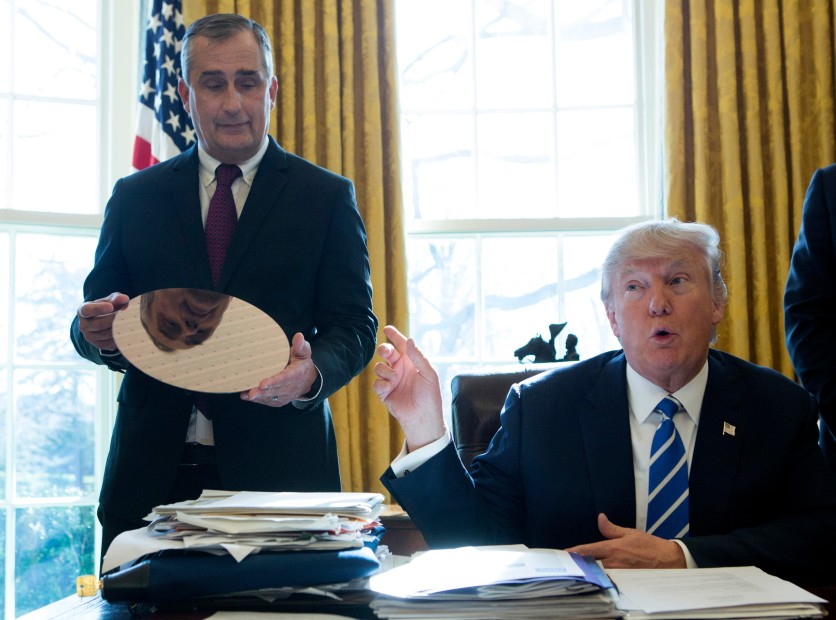
President Donald Trump speaks during a meeting with Intel CEO Brian Krzanich (L) at the White House February 8, 2017 in Washington, DC. Chris Kleponis-Pool/Getty Images
A Politico report published Thursday eight sources confirmed that the Trump administration is weighing a sweeping Phase 2 expansion of its semiconductor tariff regime — one that would extend duties from a narrow set of advanced chips to the laptops, gaming consoles, and AI data-center servers built from them. The timing could not be worse for companies that need to decide, before December 31, whether to break ground on a US semiconductor fab — because that date is also the expiration of the tax credit that has anchored more than $640 billion in announced domestic chip investment, and Congress has not yet extended it. Phase 2 tariff uncertainty and Advanced Manufacturing Investment Credit uncertainty are now converging into the same planning window, making it simultaneously more expensive to import chips and less certain that building domestically is viable. The administration has not yet answered either question.
Every company that designs, manufactures, or procures technology hardware — from hyperscalers buying GPU clusters by the tens of thousands to consumers replacing a laptop — will feel the outcome of decisions that have not yet been made, on a timeline that nobody in the industry can currently trust.
What Made Phase 2 Inevitable After the Supreme Court
Proclamation 11002, signed January 14, 2026, was not only the start of semiconductor tariffs — it was, as events unfolded, the beginning of a legal restructuring of all US tariff policy. The proclamation imposed a 25% duty on a narrow set of advanced AI accelerators, named Nvidia's H200 and AMD's MI325X in the accompanying fact sheet, and labeled the action "Phase 1." It explicitly authorized Phase 2: Commerce was directed to report to the president by July 1 on the data-center semiconductor market, and that report — now completed but not published — was designed to trigger broader tariffs.
Thirty-seven days later, on February 20, 2026, the Supreme Court ruled 6-3 in Learning Resources that the International Emergency Economic Powers Act does not authorize tariffs. Chief Justice Roberts, writing for the majority, held that when Congress has delegated its tariff powers, it has done so in explicit terms — and then pointed to Section 232 of the Trade Expansion Act of 1962 as the statutory model for how that delegation is done correctly. By striking down IEEPA, the Court effectively elevated Section 232 as the administration's primary surviving broad-tariff vehicle.
This distinction matters structurally, not merely legally. An IEEPA tariff could be terminated by executive order. A Section 232 tariff remains in effect indefinitely — until the president declares that the covered imports no longer threaten national security. No congressional action can remove it without the president's signature. Once the administration finalizes and publishes Phase 2 under Section 232, those tariffs on servers, laptops, and gaming consoles will not go away at the next presidential term, or the one after, unless the sitting president chooses to lift them. Industry is not dealing with a temporary cost disruption. It is dealing with a permanent cost reset that will outlast any trade negotiation in progress today.
Why Startups, Universities, and Research Labs Face the Sharpest Exposure
Phase 1's six exemption categories were not incidental. They were a deliberate structural design intended to keep the AI buildout advancing without tariff drag while the administration negotiated with Taiwan, South Korea, and Japan. The six categories covered chips used in US data centers, research and development, startups, repairs, non-data-center consumer and industrial applications, and public-sector uses.
The population most specifically named in those exemptions — and therefore most directly threatened by their elimination — is not Amazon, Google, or Microsoft. It is the second tier: AI startups, university research labs, federal agencies, and the commercial R&D community that powers the foundational science underlying AI development. Hyperscalers have large procurement teams, established relationships with TSMC and SK Hynix, and the negotiating leverage to secure supply agreements that smaller buyers cannot access. AI startups, mid-sized cloud providers, and research institutions do not.
There is an additional complication that has received almost no public attention: Proclamation 11002 defines "startups" as an exempt category, but the US Customs and Border Protection had published no formal definition or threshold for what qualifies as a startup as of April 2026. Companies in this category are importing chips against an exemption with no published eligibility criteria. Phase 2's potential elimination of that exemption removes even the uncertain protection currently in place.
Read more: Chip Industry Presses Congress to Extend the Tax Credit Anchoring $640 Billion in U.S. Fab Investment
Lutnick's Formula and the Math That Does Not Close
Commerce Secretary Howard Lutnick is the primary architect of the Phase 2 relief mechanism: a structure in which tariff-free import allowances would be tied to US manufacturing investment. The formula is designed to reward companies that build domestic fab capacity with proportional duty-free import rights. The more a company invests in US manufacturing, the more chips it can import without paying full tariffs.
For TSMC — which has committed $265 billion to Arizona, the largest foreign direct investment in US history — the formula's math reveals a structural ceiling. Under the Taiwan trade agreement negotiated alongside Proclamation 11002, TSMC can import chips duty-free at 2.5 times its current US manufacturing capacity while new plants are under construction, tightening to 1.5 times once facilities are operational. TSMC's own projections place only approximately 30% of its most advanced fabrication capacity in Arizona at full build-out. Even at the operational ratio of 1.5 times US output, the formula generates duty-free coverage for roughly 45% of what TSMC currently produces — leaving the majority of what American AI infrastructure operators need exposed to tariff liability.
CSIS estimated in May 2026 that approximately 54 cents of every dollar spent on US data center infrastructure goes to semiconductors, and that the $2.7 trillion in projected US data center capital expenditure through 2030 will require more than $1.4 trillion in chips — the overwhelming majority of which will be imported. Note: that analysis was funded in part by the Computer and Communications Industry Association, an industry advocacy group whose members include Amazon, Google, and Meta; its methodology is documented but readers should weigh that context. The CCIA separately estimated that taxing both chips and the finished products that contain them could cost the US approximately $90 billion in GDP annually, with roughly 20% of planned data-center construction projects through 2030 — approximately $450 billion in capital expenditure — delayed, canceled, or relocated abroad, threatening approximately 243,000 jobs.
Jonathan McHale, digital policy chief at the CCIA, compared the ongoing data-center buildout to "building the transcontinental railroad" and warned of investment risk from added cost and unpredictability. Administration officials have told industry representatives in private talks that three of the eight Politico sources say recent discussions moved against the industry's position — suggesting the formula-and-relief framework remains more attractive to the White House than the industry alternative of retaining Phase 1 exemptions.
Does Phase 2 Actually Solve the Reshoring Goal?
The administration's stated goal is to onshore semiconductor manufacturing. The mechanism is making imports expensive enough that foreign chipmakers invest in US fabs to avoid the tariffs. Industry representatives have raised a specific, quantifiable objection in private talks with Lutnick and Bureau of Industry and Security Undersecretary Jeffrey Kessler: even the largest possible US fab build-out, at the most optimistic timeline any credible source has proposed, cannot close the gap that Phase 2 would immediately create.
One person involved in the talks placed the realistic timeline for meaningful domestic chip output at more than five years. CSIS analysis of TSMC production costs found the cost per chip at the Phoenix, Arizona facility is approximately 50% higher than at TSMC's Taiwan counterparts — a gap that TSMC founder Morris Chang has previously described as making the facility uncompetitive on global markets. US fabs also take more than three years on average from permitting to first production — roughly 1.5 years longer than equivalent Taiwanese facilities starting permitting at the same time, according to the CSIS analysis.
The high-bandwidth memory side of the supply chain presents a parallel constraint. SK Hynix controls approximately 50% of the HBM market; Samsung holds roughly 30%; US-based Micron accounts for most of the remainder. The HBM market was sold out through 2026 as of recent reporting, and DRAM contract prices rose 90-95% quarter-on-quarter in the first quarter of 2026 — the steepest quarterly surge in the memory industry's recorded history. SK Hynix broke ground on its Indiana facility — a $4-billion-plus advanced-packaging hub at Purdue Research Park in West Lafayette — on August 27, in a ceremony attended by Indiana Governor Mike Braun and Senator Todd Young. Mass production of next-generation HBM4E chips there is not targeted until the second half of 2029, with a cleanroom opening projected for October 2028, meaning the US-based packaging operation will depend on Korean wafer production for years regardless of tariff levels.
Will Chip Tariffs Raise Laptop and Console Prices Further?
The Phase 2 framework under discussion would extend duties beyond chips to the finished electronics built from them — explicitly including laptops, gaming consoles, and data-center servers. Consumer electronics prices are already under substantial pressure. DRAM prices rose 90-95% in Q1 2026, and the gaming hardware market has already absorbed multiple price increases: Nintendo raises Switch 2 to $499.99 beginning September 1, PlayStation 5 currently retails at $549.99, and Xbox Series X reached $799.99 on August 1. Gartner forecasts PC prices rising 17% and smartphone prices 13% by the end of 2026 compared to 2025 levels.
Additional tariffs on finished electronics — beyond the DRAM-driven increases already in motion — would compound costs at the retail level on top of an already-strained consumer electronics market. The administration is considering a phase-in period to soften the transition, but no rates, exemption structures, or phase-in timelines have been finalized.
Read more: Trump Chip Tariff Phase 2 Targets Servers, Kills Data Center Carve-Outs
The AMIC Deadline: Incentive and Tariff Uncertainty Converge
The Advanced Manufacturing Investment Credit — AMIC under Section 48D — providing a 35% refundable tax credit for qualified investment in semiconductor manufacturing facilities — requires construction to begin by December 31, 2026. Any fab whose construction has not started by that date is ineligible for the credit regardless of subsequent build costs or completion timelines. The OBBBA raised the credit to 35%, signed July 4, 2025, for facilities placed in service after December 31, 2025 — but it left the December 2026 construction-start deadline unchanged.
SEMI brought senior tax executives to Capitol Hill on July 22, 2026, to press for a multi-year extension before the deadline. "The Advanced Manufacturing Investment Credit has been one of the most effective tools this country has for winning semiconductor investment, and its looming expiration is creating real uncertainty for companies planning projects today," said Joe Stockunas, President of SEMI Americas, at that event. On August 5, Senators Crapo and Wyden issued a bipartisan joint statement — Senate Finance Committee Chairman Mike Crapo (R-ID) and Ranking Member Ron Wyden (D-OR) — reaffirming their support for the credit and calling for its extension. No legislation has passed.
The specific harm this creates is precise and measurable. Building a semiconductor fab in the United States currently costs 30-50% more than in Taiwan, South Korea, or Singapore — a gap that is largely attributable to competing governments' incentive regimes. South Korea offers R&D tax incentives of 30-50% and 20-30% incentives for qualified investment costs. Taiwan offers R&D credits of up to 35% for advanced node technologies along with import duty exemptions on specialized equipment. Japan provides a 20% corporate income tax reduction each fiscal year alongside targeted grants. Without the AMIC, the US fab cost gap widens exactly when it matters most.
Companies that have not yet broken ground on US fab projects and are now evaluating whether to do so face the worst possible combination: the import cost of the chips they would use goes up if Phase 2 passes, and the incentive for building domestically may vanish on December 31 if Congress does not act. Neither variable is currently resolved. Every week of inaction on the AMIC extension compresses the runway for construction planning that takes months to mobilize.
One industry analyst writing before the Politico report was published identified the convergence explicitly: "The administration has every incentive to pair Phase 2 tariffs with an offset program before that deadline — creating maximum leverage for domestic fab commitments." That pairing may indeed be the strategy. But if Phase 2 and the AMIC extension are intended to work together — tariff pressure as the stick, tax credit as the carrot — the stick is materializing while Congress holds the carrot indefinitely.
Accountability Without Investment Requirements
A separate accountability dimension has resurfaced alongside the Phase 2 deliberations. When Congress extended and expanded the AMIC credit in the OBBBA last year, it did not add the worker protection conditions and anti-buyback provisions that critics of the original CHIPS Act had demanded. GlobalFoundries received $1.5 billion in CHIPS Act funding and announced $500 million in share buybacks in 2026 after hitting its first two program milestones. Intel received $7.8 billion in CHIPS Act awards and then accepted an $8.9 billion government equity stake, yet laid off more than 15,000 employees in 2024 while the fab investments it pledged continued to be built. The SIA's current extension push, like its earlier advocacy, does not include calls for stronger anti-buyback restrictions, job-retention requirements, or community benefit agreements.
The ITIF, in a June 4, 2026 analysis, was direct about the structural risk: "A blanket tariff on semiconductors and downstream goods would ultimately achieve the opposite of what the administration intends, weakening US growth, raising prices for consumers, and undermining American AI leadership." That warning applies whether the AMIC is extended or not.
What the Commerce Report Contains — and Why It Has Not Been Published
The Commerce Department's data-center semiconductor market report, mandated by Proclamation 11002 with a July 1 delivery deadline, has been completed. Its full contents have not been made public as of August 30, 2026, two months after it was due to the president. The administration has provided no explanation for why the report, which was designed to serve as the trigger for Phase 2, has been held back. The Politico report's eight sources suggest Phase 2 deliberations are active regardless of the report's publication — but its contents, and specifically whether it recommends eliminating the data-center exemption, remain unknown to the industry and the public.
The White House defended the overall direction without addressing the report's delayed publication. "Reshoring semiconductor manufacturing is a top priority for President Trump, whose policies have already secured hundreds of billions of dollars of investments in this key sector," White House spokesperson Kush Desai told Politico.
Frequently Asked Questions
Why does the Learning Resources Supreme Court ruling matter for Phase 2 chip tariffs?
The February 20, 2026 ruling struck down the administration's IEEPA-based tariffs and made Section 232 of the Trade Expansion Act of 1962 the primary remaining broad-tariff vehicle. This matters because Section 232 tariffs are structurally different from the IEEPA tariffs they replaced: they remain in force indefinitely until the president declares the national security threat resolved. Congress cannot remove them without a veto-proof majority. Once the administration enacts Phase 2 tariffs under Section 232 — extending duties to laptops, servers, and gaming consoles — those tariffs will not expire at a term limit or sunset date. Companies facing a Phase 2 tariff should not model it as temporary.
What is the AMIC tax credit deadline, and what happens if Congress does not extend it?
The Advanced Manufacturing Investment Credit (Section 48D) provides a 35% refundable tax credit for qualified investment in US semiconductor manufacturing facilities, but only for facilities whose construction begins by December 31, 2026. Any fab project that has not broken ground by that date loses the credit permanently, regardless of subsequent build costs. Senate Finance Committee Chairman Crapo (R-ID) and Ranking Member Wyden (D-OR) issued a bipartisan statement on August 5 supporting extension, but no legislation has passed. If the deadline lapses, the structural cost gap between US and Asian fabs — which the credit was designed to offset — will widen exactly when Phase 2 tariffs are expected to create maximum investment pressure.
How much more will laptops, gaming consoles, and data-center servers cost under Phase 2?
Specific tariff rates have not been finalized. The administration is considering a phase-in period. Consumer electronics are already under substantial price pressure from the AI-driven DRAM shortage: the Nintendo Switch 2 will rise to $499.99 on September 1, PS5 currently retails at $549.99, and Xbox Series X reached $799.99 on August 1. Gartner projects PC prices will rise 17% and smartphone prices 13% by end of 2026 compared to 2025. Additional tariffs on finished electronics would compound these increases at the retail level.
What does the Lutnick investment formula mean for companies that cannot build US fabs?
Commerce Secretary Lutnick's preferred framework grants duty-free chip import allowances proportional to a company's committed investment in US manufacturing capacity. Companies that build or finance domestic fab capacity receive larger tariff-free import quotas; companies that do not invest in US manufacturing receive no duty-free allowance. AI startups, mid-tier cloud providers, universities, and research labs — which generally lack the capital for semiconductor manufacturing investment — would have no pathway to tariff relief under this formula. They would face full tariff exposure on every chip they import, in a market where domestic supply cannot substitute for imports for at least five years by the most optimistic projections.

-
 C114 Communication Network
 -
 Communication Home
