
 Search

Volvocars.com
Volvo unveiled its 2028 XC60 and 2028 XC90 plug-in hybrid SUVs on Monday, September 15, 2026, and the headline number is 78 miles of estimated EPA-equivalent all-electric range for the XC60 — more than any plug-in hybrid currently sold in the United States or Canada. That figure more than doubles the outgoing model's 35 miles, and it crosses a threshold that prior PHEVs never cleared: enough electric range to cover the typical American round-trip commute of roughly 30 to 32 miles entirely on battery power, with room to spare. Volvo's Frank Vacca told the Globe and Mail that the new range was "a great leap forward" and "by far the most electric range of any car sold in Canada or the United States" — a statement from the company's director of vehicle product planning for the Americas.
There is a meaningful caveat that the launch materials do not highlight: the 2028 XC60 does not include DC fast charging. Its 41.2 kWh battery — the same total size as the entire pack in a Fiat 500e city car — recharges on AC Level 2 equipment only, taking approximately five to six hours for a full replenishment. For buyers who plan to plug in at home every night, that limitation is irrelevant. For buyers imagining a PHEV that works like an EV on long trips — topping up at highway charging stations during a coffee stop — it is a structural constraint that shapes how this vehicle actually lives.
How Volvo More Than Doubled the Range Without a New Platform
The engineering solution is a complete replacement of the battery pack, repositioned from the center tunnel to under the floor. In both the XC60 and XC90, the previous 18.8 kWh unit has been replaced by a 41.2 kWh floor-mounted pack, of which 37.9 kWh is usable. Moving the battery from the tunnel to a floor-mounted configuration is what enabled the capacity jump: the tunnel's confined geometry set an effective ceiling on how large the battery could grow. By spreading the cells under the cabin floor, Volvo engineers could approximately double the usable energy without requiring a new vehicle platform.
That architectural choice comes with tradeoffs. Second-row legroom in the XC60 shrinks from 965 mm (38.0 in) to 921 mm (36.3 in), and the XC60 gains roughly 47 kg (104 lbs) — bringing its total weight to approximately 2,197 kg (4,843 lbs). Volvo says cargo volume behind the second row is unchanged at 16.5 cubic feet.
The result for the XC60 T8 AWD configuration: approximately 126 km (78 miles) of WLTP-rated all-electric range, and an estimated 590 miles (949 km) of total range when the 2.0-liter turbocharged four-cylinder engine's gasoline tank is full alongside a fully charged battery. The XC90, which keeps the same powertrain upgrade, achieves approximately 117 km (73 miles) of WLTP electric range and roughly 560 miles (901 km) total.
For context, the leading PHEV in the American market before today's announcement was the Mercedes-Benz GLC 350e 4MATIC. That vehicle's GLC 350e's 54 EPA miles of all-electric range, and the 2028 XC60's estimated EPA figure would land significantly above that, based on the WLTP-to-EPA conversion pattern typically applied to Volvo models.
The DC Fast Charging Gap Is Bigger Than It Sounds
The absence of DC fast charging is not an unusual omission for a PHEV — the current XC60 also lacks it, as does nearly every PHEV in the market. What is new is the scale of the problem. When a PHEV carried a 14-to-19 kWh usable battery, a Level 2 charger at 7 to 11 kilowatts could refill it in two to three hours — annoying on a road trip, but manageable. At 37.9 kWh usable, a five-to-six-hour Level 2 charge means the 2028 XC60 cannot be meaningfully recharged during a lunch break or a shopping errand. An owner who depletes the battery on the morning commute will burn gasoline for the afternoon, not because the car lacks the range, but because it cannot recharge fast enough to be useful.
Volvo has confirmed the 2028 XC60 will not accept a North America Charging Standard (NACS) port for access to Tesla's Supercharger network, a disclosure Volvo officials made to the Globe and Mail at the London reveal event. Combined with the absence of CCS DC fast charging, this vehicle will recharge at home or at AC public chargers only. For a buyer who charges nightly and rarely needs a mid-day top-up, the 78-mile electric range makes day-to-day EV driving routine. For a buyer who travels frequently by car or lacks a home charger, the trade-off is significant enough to weigh carefully.
Power and Performance: Unchanged by the Battery Expansion
Both SUVs retain the same hybrid powertrain architecture: a turbocharged 2.0-liter four-cylinder driving the front wheels, paired with an electric motor on the rear axle for all-wheel drive. System output holds at 455 hp and approximately 523 lb-ft (709 Nm) of torque. The XC60 hits sixty in 4.5 seconds; the XC90 takes approximately five seconds.
Volvo continues to offer mild-hybrid variants for buyers who don't need the PHEV system. The XC60 B5 delivers 247 hp with EPA-rated 26 mpg combined. The XC90 B5 matches that 247 hp figure, while the XC90 B6 mild hybrid offers 295 hp.
What Changed on the Outside and Inside the XC60
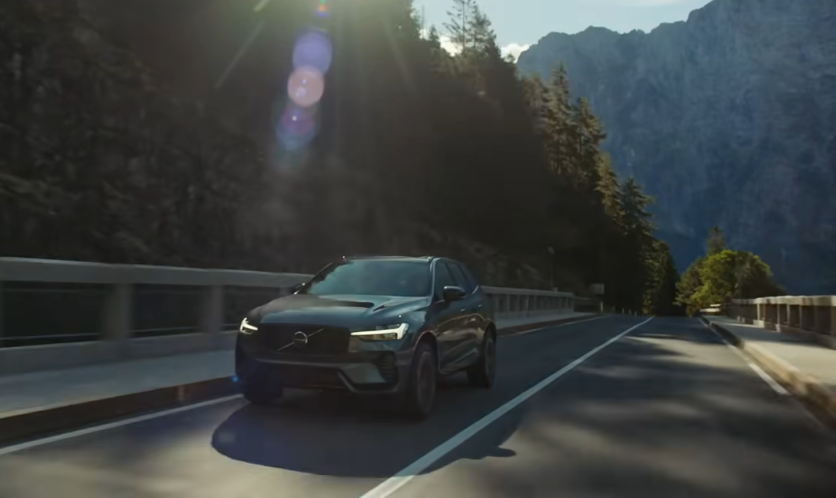
The 2028 XC60 receives its most significant exterior refresh since the second generation launched in 2017. Everything ahead of the front doors — grille, hood, front fenders, and bumper — has been redesigned to align the XC60 more closely with the XC90's existing look and Volvo's current design language. The Thor's Hammer LED headlights have been updated with a matrix-format system using multiple individually controllable segments that can dim specific zones to avoid blinding oncoming drivers while keeping the road illuminated.
A new exterior color, Heather Bronze — a metallic finish that shifts between brown, bronze, purple, and pink depending on lighting conditions — joins the palette. New 20- and 21-inch wheel designs are available.
Inside, the XC60 carries over the 11.2-inch portrait-format infotainment display and Google-based software interface introduced for the 2025 update, now integrated with Google's Gemini AI voice assistant. Physical volume and climate controls remain. Updated safety features include enhanced automatic emergency braking, automatic emergency steering, a door-opening alert for cyclists, and lane-change assist that can handle highway maneuvers when commanded by the driver. Over-the-air software updates are supported through a new processor.
The XC90: Same Powertrain Upgrade, Nearly Unchanged Exterior
For the three-row XC90, the 2028 changes are almost entirely under the skin. The exterior carries over the facelifted design from the 2024 update. The only external addition is a "Long Range" badge on the tailgate. The battery swap from the previous-generation pack to the 41.2 kWh floor-mounted unit lifts the XC90's electric range from approximately 61 km (38 miles) to approximately 117 km (73 miles) under the WLTP cycle.
The XC90's updated interior also retains the 11.2-inch display and Gemini integration introduced in the most recent refresh. Pricing for the 2028 XC90 PHEV has not been announced.
Why Volvo Is Pushing PHEV Range Further Than Any Western Rival
The timing and magnitude of this battery upgrade reflect a strategy that originates, in part, with Volvo's parent company Geely. The Chinese automaker has been building and selling extended-range PHEVs across its Galaxy and Lynk & Co brands with CLTC-rated electric ranges of 150 to 175 km, and Volvo itself launched the China-market XC70 PHEV launch in 2025 with up to 200 km of CLTC-rated electric range. The 2028 XC60 and XC90 represent Volvo bringing that extended-range PHEV capability to European and North American markets for the first time — using different battery chemistry and a WLTP/EPA-tested range that will land lower than the Chinese CLTC figure, but substantially higher than any Western PHEV alternative.
That market opportunity is real. PHEV sales were up 125 percent in some markets during 2025, and global buyer interest in PHEVs has resurged as EV charging infrastructure fails to keep pace with adoption expectations in many regions. The XC60 is already Volvo's all-time best-selling model, having surpassed the iconic Volvo 240 (2.68 million units, 1974 to 1993) with more than 2.7 million units sold. It was also the best-selling PHEV in Europe in 2024. Adding market-leading electric range to Volvo's most commercially important nameplate is not a modest upgrade; it is a direct bid to define what a Western-branded PHEV can do.
Availability and Pricing
Production of the 2028 XC60 is scheduled to begin in late fall 2026, with customer deliveries expected to start in early 2027. The current 2026 XC60 T8 starts at $62,545; the 2026 XC90 T8 is priced from $77,595. Volvo has not announced what the larger battery will add to either vehicle's price.
Frequently Asked Questions
How does the 2028 Volvo XC60's electric range compare to other PHEVs in the US?
The 2028 XC60 PHEV offers an estimated 78 miles of all-electric range on a full charge — more than any plug-in hybrid currently sold in the United States or Canada. The previous best was the Mercedes-Benz GLC 350e 4MATIC at 54 EPA-rated miles, and the outgoing XC60 itself was rated at approximately 35 miles. The new figure is enough to cover the typical American round-trip daily commute (roughly 30 to 32 miles) entirely on electricity in most conditions.
Can the 2028 Volvo XC60 PHEV charge at Tesla Superchargers or DC fast chargers?
No. Volvo has confirmed the 2028 XC60 will not include a North America Charging Standard (NACS) port for Supercharger access, and it also lacks CCS DC fast charging capability. The 41.2 kWh battery recharges only through AC Level 2 equipment, taking approximately five to six hours for a full charge. This makes the vehicle best suited to buyers who charge at home overnight — it cannot be meaningfully topped up during a highway road trip stop, because the charge time is too long to be practical at a charging station.
What is the total range of the 2028 XC60 PHEV on a full tank and full charge?
With the battery fully charged and the fuel tank full, the 2028 XC60 is rated at approximately 590 miles (949 km) of total range. The XC90 achieves approximately 560 miles (901 km) under the same combined calculation. These figures combine the 78-mile (126 km) electric-only range with the gasoline engine's contribution to overall range.
Why doesn't the larger battery fit in the same spot as the old one?
The previous XC60 PHEV battery sat in the center tunnel — the raised structure running through the middle of the cabin between the front seats. That packaging location limits how large the battery can grow because the tunnel's dimensions are fixed. Volvo moved the new 41.2 kWh pack to a flat floor-mounted position under the cabin, which provided enough space to more than double the battery's usable capacity. The tradeoff is a modest reduction in second-row legroom, which shrinks from 965 mm (38.0 in) to 921 mm (36.3 in).

-
 C114 Communication Network
 -
 Communication Home
