
 Search

Tesla.com
Maggie Espinosa's five children — including 2-year-old twins — lost their mother on March 25, 2026, when a Tesla Model Y turned left across oncoming traffic at a Batavia, Illinois intersection and struck a Dodge pickup. The crash was documented as an ordinary intersection collision. The question of whether Tesla's Full Self-Driving software executed the turn has never been answered publicly — not because the answer doesn't exist, but because the only party that holds it has filed it as confidential business information with federal regulators and shared nothing with the county prosecutor reviewing the case.
What Happened at Randall and McKee
At approximately 4:19 p.m. on March 25, 2026, a southbound 2026 Tesla Model Y attempted a left turn onto McKee Street from Randall Road in Batavia, a suburb approximately 40 miles west of Chicago. A northbound Dodge pickup with the right of way was crossing the intersection; the Tesla turned directly into its path. A Nissan SUV was also drawn into the collision.
Maggie Espinosa, 37, was a front-seat passenger in the Tesla. A former kindergarten teacher, she left behind five children. A GoFundMe campaign for her family raised more than $100,000. The Tesla's driver and two others sustained injuries. The Batavia Police Department investigated and turned the matter over to the Kane County State's Attorney's Office, which was reviewing it for potential charges as of September 1, 2026. No charges had been filed.
What neither the police report, nor the local news coverage, nor the county prosecutor's file contained was this: Tesla's own mandatory report to NHTSA confirms the car's driver-assistance system was active when the turn was made.
What Tesla Told the Federal Government — and What It Didn't
Under NHTSA's Standing General Order 2021-01, automakers are required to report any crash in which a Level 2 or higher driver-assistance system was engaged within 30 seconds of impact. For serious crashes — those involving fatalities, hospitalizations, or vulnerable road users — the report must be filed within 24 hours of the company learning of the crash.
Tesla filed such a report for the Batavia crash. In it, the company marked the automation "Engagement Status" as "Verified Engaged" and logged the 2026 Model Y's pre-crash movement as "Making Left Turn" at 24 miles per hour at an intersection. The filing confirms the Tesla struck the front of the Dodge pickup, which had the right of way, and states that Tesla retains the event-data recorder, telematics data, and video footage from the crash.
Then Tesla redacted the parts that could resolve the central question. The crash narrative — a field describing what the system did and why — was blacked out as "confidential business information." So was the FSD software version running at the time of impact. So was whether the intersection at Randall Road and McKee Street fell within FSD's approved operating area — an internal designation that determines whether the system was even sanctioned to control that turn.
That approved-operating-area field is not a minor detail. Under SAE's automation classification framework, every Level 2 system is designed for a specific Operational Design Domain — a defined set of conditions, road types, and geographic areas within which the system is intended to function safely. If FSD was operating outside its designed domain when it initiated the left turn at Randall and McKee, that is a categorically different safety failure than one that occurs within it. Tesla holds the answer to that question. No one else does.
Read more: Tesla Autopilot Claim in Fatal Katy Crash Hits 3.2 Million-Vehicle Recall Probe
Why a Left Turn Points to FSD, Not Basic Autopilot
The Batavia crash is notable for what it rules out as much as what it confirms. Tesla's basic Autopilot system — the lane-keeping and adaptive cruise-control feature available on highway-style divided roads — cannot execute an unprotected left turn at a signalized intersection. That is not within its design scope. Autopilot follows lane markings on divided roads; it does not navigate across opposing traffic at a cross street.
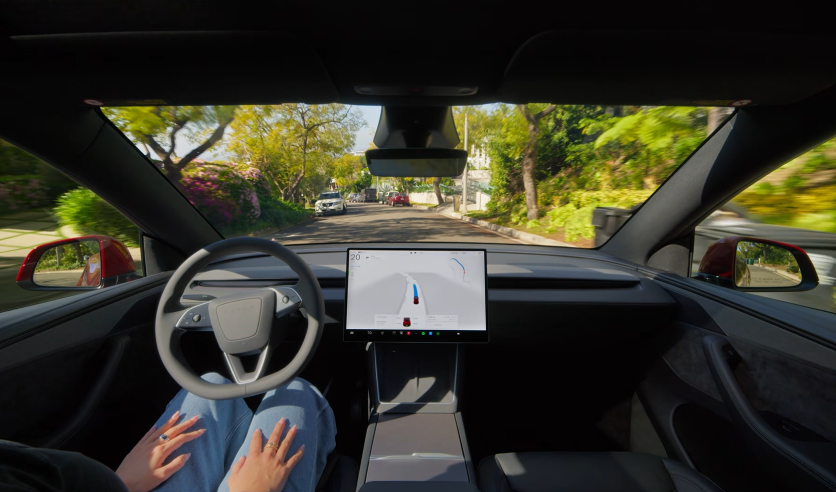
Full Self-Driving (Supervised), by contrast, is specifically engineered for city-street navigation, including unprotected left turns across oncoming traffic. Executing such a turn requires the system to evaluate the speed and closing distance of approaching vehicles using its cameras, judge whether the gap is safe to cross, and commit to the maneuver. Tesla's own FSD release notes across multiple software versions specifically document left-turn improvements — including what became known in the FSD community as the "Chuck Cook unprotected left turn," a notoriously difficult intersection case that took numerous software iterations to resolve consistently.
A vehicle confirmed "verified engaged" while "making a left turn" at an intersection was, in all reasonable technical probability, running Full Self-Driving, not basic Autopilot. And Tesla possesses the specific software version record that would confirm this definitively.
Tesla Holds the Evidence; the Prosecutor Has None of It
When Electrek's Fred Lambert cross-referenced unredacted NHTSA fields — location (Batavia), vehicle (2026 Model Y), the left-turn-into-a-pickup mechanics, the fatality, and the month — against publicly available crash records, he was able to match the filing to the Espinosa crash. The combination of those details was unique to this incident.
What made that identification possible was that NHTSA's database includes some unredacted fields — enough to locate the crash but not enough to explain it. The Batavia Police Department's public account contained no mention of Autopilot, Full Self-Driving, or any driver-assistance technology.
When Electrek notified Batavia PD of the NHTSA confirmation, the department acknowledged the crash remains under active investigation and is currently under review by the Kane County State's Attorney's Office. No charges had been filed. A county prosecutor reviewing whether to bring charges in a fatal intersection crash is, by definition, asking the question that Tesla's withheld data could directly answer: did the software initiate the turn, or did the driver?
That question remains formally unanswered. Tesla has not proactively connected its NHTSA submission to the widely covered story of Maggie Espinosa's death.
A Pattern of Selective Disclosure
The Batavia case does not stand alone. It is one entry in a growing body of evidence that Tesla's redaction policy functions not as a uniform privacy protection, but as a tool that benefits the company selectively.
In June 2026, a Tesla Model 3 crashed into a Katy, Texas home and killed 76-year-old Martha Avila. The driver, Michael Butler, told investigators the car was on Autopilot. In that case, Tesla released its data quickly and publicly — because the data showed Butler had manually overridden FSD by pressing the accelerator to 100%, sending the vehicle to 73 miles per hour on a residential street. Tesla Vice President Ashok Elluswamy posted the finding on social media. Tesla's data, released on Tesla's timeline, exonerated Tesla's software and established Butler's liability. Butler was charged with manslaughter on July 2, 2026.
In Batavia, where whether the software or the driver made the fatal left turn remains genuinely unknown, Tesla has released nothing.
Electrek's investigation, published September 1, 2026, documented five confirmed fatal crashes in a two-week span in which Tesla's SGO reports showed verified engagement but all narrative fields were blacked out — including a 23-year-old's crash in Clute, Texas (police attributed it to a possible medical episode; Tesla's data confirmed driver-assist was engaged at 104 miles per hour); a 43-year-old man who died when his Model 3 sat stopped in a live interstate lane in Lake Mary, Florida (Tesla's data confirmed driver-assist was engaged at 0 miles per hour); and a motorcyclist killed in Moraine, Ohio, by a vehicle not even publicly identified as a Tesla until Electrek's NHTSA cross-reference.
Across all 3,763 unique driver-assist crash reports Tesla has filed under Standing General Order 2021-01, the company has redacted the crash narrative on 99.9% of them, citing confidential business information. General Motors, Ford, Honda, and Toyota redact essentially none of their crash narratives. Tesla accounts for approximately 85% of the entire industry's ADAS crash reports — and is the only high-volume reporter that blacks out what its cars did.
Read more: Tesla Full Self-Driving Crash Raises Safety Concerns as Expert Warns of 'Supervision Trap'
The Federal Investigation That Cannot Answer What Tesla Can
The Batavia crash occurred one week after NHTSA had formally escalated its FSD investigation to Engineering Analysis status — the last stage before the agency can demand a mandatory recall.
NHTSA's Engineering Analysis EA26002, opened March 18, 2026, covers approximately 3.2 million Tesla vehicles and focuses on a specific failure mode: the camera-only degradation detection system's inability to identify when FSD cameras are blinded by sun glare, fog, or airborne dust. The investigation was triggered by nine crashes in which FSD was active under reduced-visibility conditions — including one fatality — and by evidence that Tesla may have underreported related incidents. In each of those crashes, NHTSA found that FSD either failed to detect a degraded state or failed to alert the driver with enough time to react.
The Batavia crash appears to involve different conditions — an afternoon intersection in apparent normal visibility — rather than the reduced-visibility failure mode at EA26002's center. But it lands in the federal record at the moment the regulatory machinery is most actively examining what Tesla knows about its camera-only system's limits, and when it knew it.
On July 2, 2026, NHTSA sent Tesla a 24-part information demand within EA26002. Request No. 4 specifically named an internal Tesla document titled "Radar Saves Us" — a reference to an apparent internal assessment of what the company's cameras-only system sacrificed when Tesla removed radar from its vehicles in mid-2021. NHTSA stated the document appears particularly relevant to the degradation detection system and Tesla's understanding of the limitations imposed by a vision-only object detection and response system. Tesla's response deadline was August 12, 2026.
Meanwhile, a separate NHTSA probe — Preliminary Evaluation PE25012, covering approximately 2.88 million Tesla vehicles — examines more than 80 documented instances of FSD executing maneuvers that constitute traffic violations: running red lights, crossing into opposing lanes, and illegal turn sequences.
Does FSD Have a Left-Turn Liability Problem That Can't Be Studied?
The structural problem revealed by the Batavia case runs deeper than any single crash. Tesla is collecting telemetry, crash video, and software state data on every FSD crash it is required to report. Independent researchers, regulators, prosecutors, and victims' families cannot access any of it except what Tesla chooses to release.
At a technical level, camera-only evaluation of oncoming vehicle speed for an unprotected left turn relies on optical flow estimation — the derived velocity of approaching vehicles from successive camera frames — rather than direct doppler velocity measurement of the kind radar provides. Whether Tesla's cameras, without radar, can reliably estimate the closing speed of oncoming vehicles at intersections well enough to make safe left-turn commitments across a range of real-world conditions is precisely the kind of question that crash narrative data and software version logs would help answer.
Senators Ed Markey of Massachusetts and Richard Blumenthal of Connecticut sent a June 2026 letter to NHTSA urging the agency to investigate Tesla's FSD safety statistics as misleading and incomplete. A Reuters investigation published May 28, 2026, found that Tesla's AI trainers mistrusted the company's safety statistics, citing methodological problems including incomparable crash outcome comparisons and incomplete crash data. Tesla's published figure — that FSD-equipped vehicles experience one serious crash per approximately 5.5 million miles, versus one per 660,000 miles for human drivers — is based on data that only Tesla fully controls.
What the Espinosa Case Establishes
The Batavia crash confirms several things Tesla did not want confirmed and has not voluntarily disclosed: that FSD was engaged when the fatal left turn was made, that Tesla holds the crash video and event-data records, and that no one outside the company — not the Batavia Police Department, not the Kane County State's Attorney reviewing the case, not NHTSA's crash investigators, and not the public — has seen them.
It also raises a question that goes to the structural design of automotive safety accountability in the United States: should a company be permitted to report a fatal crash to federal regulators, confirm that its driver-assistance system was active, and then redact the evidence of what the system did — all while retaining that evidence in-house — when state criminal investigators are simultaneously deciding whether charges are warranted?
For Maggie Espinosa's five children, that question is not abstract. The answer to it determines whether the evidence of what killed their mother can ever be made part of a public accounting, or whether it remains permanently sealed inside Tesla's servers, released only if and when it serves Tesla's interests to do so.
Frequently Asked Questions
Does Tesla's data prove FSD caused Maggie Espinosa's death?
No — and that is precisely the problem. Tesla's own filing to NHTSA confirms the driver-assistance system was "Verified Engaged" when the Model Y made the left turn at the Batavia intersection. But Tesla redacted the crash narrative, the FSD software version, and whether the intersection was inside FSD's approved operating area — three fields that would most directly answer whether the software's decision-making was responsible for the fatal turn. Without those fields, the question of what caused the crash cannot be resolved from publicly available information. The crash remains under review by the Kane County State's Attorney's Office.
Why can't prosecutors just subpoena Tesla's crash data?
They can attempt to — but it requires active legal process: a subpoena or court order compelling Tesla to produce the event-data recorder logs, telematics, and crash video it holds. NHTSA's Standing General Order requires disclosure to federal regulators, not to state law enforcement. There is no automatic mechanism that routes Tesla's NHTSA filings to local prosecutors when a crash is being reviewed for criminal charges. In the Katy, Texas case, Tesla released data voluntarily — because it showed the driver had manually overridden FSD. In Batavia, Tesla has released nothing to public record.
How is FSD different from Autopilot, and why does that distinction matter here?
Tesla's basic Autopilot handles lane-keeping and adaptive cruise control on highway-style divided roads. It cannot make an unprotected left turn across oncoming traffic at a cross-street intersection — that is outside its operational design. Full Self-Driving (Supervised) is specifically engineered for city-street navigation, including unprotected left turns. Because the Batavia vehicle was confirmed "verified engaged" while "making a left turn" at an intersection, the system involved was almost certainly FSD, not basic Autopilot. That distinction matters because FSD's decision framework — how it judges gaps in oncoming traffic and commits to the crossing — is precisely what would determine liability, and it is the information Tesla has redacted.
What should FSD users know about unprotected left turns?
Unprotected left turns are a documented and long-standing challenge for FSD. Tesla has issued multiple software releases specifically addressing left-turn decision-making. The system evaluates oncoming traffic speed and gaps using only cameras — without radar's direct velocity measurement — and commits to a turn when it judges the gap sufficient. Errors in that judgment, at intersection speeds, can be catastrophic. As a passenger in a Tesla with FSD engaged, you have no control over whether the system initiates a turn. The Batavia crash is a documented example of an outcome where a passenger — not the driver — bore the fatal consequence of a system decision that no one outside Tesla can currently audit.

-
 C114 Communication Network
 -
 Communication Home
