
 Search

Appliedintuition.com
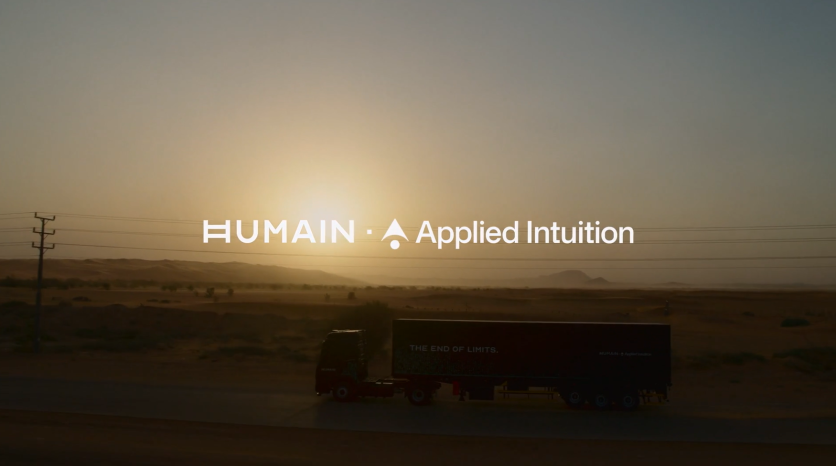
Saudi Arabia's state-backed AI company HUMAIN announced a partnership with Sunnyvale-based Applied Intuition on Monday to deploy thousands of self-driving trucks across the Kingdom's key freight corridors by 2030 — a deal the companies say will constitute the largest autonomous trucking network ever assembled — and the technical architecture at its center is a significant departure from the LiDAR-dependent stacks that have defined most North American L4 programs. The details were formalized in a joint August 31 press release from the two companies.
The announcement arrived on the first day of LEAP 2026, the fifth edition of Riyadh's major annual technology conference, alongside over $15 billion in investment commitments — including a separate $5 billion joint commitment between HUMAIN and AWS. Applied Intuition's deal was described by Arab News LEAP 2026 correspondents as the final announcement of a dense opening day.
What HUMAIN Is — and Why This Deal Is Different
HUMAIN was launched in May 2025 under the Saudi Public Investment Fund (PIF), the sovereign wealth fund managing approximately $940 billion in assets and chaired by Crown Prince Mohammed bin Salman. The company was designed as a full-stack AI operating company covering compute infrastructure, cloud services, advanced Arabic-language foundation models including ALLaM, and enterprise applications, all oriented around Saudi Arabia's stated goal of becoming a top-tier global AI power by 2030. A HUMAIN company profile confirms the PIF ownership structure and the Crown Prince's role as chair.
Until this announcement, HUMAIN's most visible initiatives had been digital: chip and cloud partnerships with Nvidia, AMD, AWS, Qualcomm, and xAI, and the development of its Arabic large language model. The Applied Intuition partnership represents HUMAIN's first major initiative specifically designated as a "physical AI" play — the company's term for AI deployed in real-world machines and systems rather than in data centers or software platforms.
The companies stated in their joint press release that the partnership would extend sovereign AI infrastructure "beyond data centers into real-world autonomous systems," framing it as the first major initiative under HUMAIN's physical AI strategy.
How the Self-Driving System Actually Works
The technical centerpiece of the Saudi deployment is Applied Intuition's Self-Driving System — known as SDS — and its design choices matter for understanding why this partnership is structured the way it is.
Unlike Aurora Innovation, which has built its commercial Texas operations around proprietary FirstLight LiDAR hardware capable of detecting objects at ranges up to 450 meters (1,476 feet) with a next-generation system targeting 1,000 meters (3,281 feet), Applied Intuition's SDS operates without LiDAR dependency entirely. The system uses production-grade cameras and radar sensors paired with onboard compute to interpret the driving environment in real time — and critically, it requires no pre-built high-definition maps of the roads it will operate on. This capability was confirmed in the company's Japan market expansion announcement released June 2026.
The underlying architecture is end-to-end (E2E) deep learning: rather than separating perception, planning, and vehicle control into distinct algorithmic modules that pass outputs sequentially, SDS integrates all three into a single neural network system. This architecture, now common in frontier AI research but less common in deployed commercial autonomy stacks, enables the system to adapt to edge cases that modular pipelines can struggle to handle — including unfamiliar road markings, unexpected obstacles, and variable lighting conditions.
What holds the system together across geographies is a closed data flywheel. Every mile driven by any vehicle running SDS feeds sensor data back into Applied Intuition's large-scale simulation infrastructure, where engineers can recreate real-world scenarios, validate model improvements, and push updated autonomy software back out to the fleet. The company says its fleet already operates across the United States, Europe, and Japan — including a commercial route with Isuzu Motors on Japanese roads, one of the world's most complex driving environments.
Read more: Driverless Trucks Now Run Walmart, PepsiCo Routes: Gatik Raises $200M to Scale
The camera-and-radar-only approach carries a tradeoff: without LiDAR's long-range precision, the system is more dependent on the quality and diversity of training data. That is precisely what the Saudi deployment is designed to generate at scale. A national fleet of autonomous trucks running diverse highway conditions, weather extremes, and load profiles would give Applied Intuition's simulation infrastructure a volume and variety of data that corridor-by-corridor US programs generate more slowly.
SDS is currently rated as SAE Level 4 — meaning the system handles all driving functions within a defined operational design domain, with no human driver required to remain alert or available to take over, though the system is currently constrained to specific operational conditions rather than operating in any environment under any circumstances (which would be Level 5). The SAE J3016 standard defines these automation levels, which are widely used as the industry reference.
Applied Intuition carries the designation along with a transparent white-box autonomy stack that gives original equipment manufacturers full transparency into the system's internal reasoning — a design choice that facilitates regulatory safety validation under standards including ISO 26262 and SOTIF.
Applied Intuition itself is among the most well-capitalized players in the physical AI field: it closed a $600 million Series F funding round co-led by BlackRock-managed funds and Kleiner Perkins in June 2025, establishing a $15 billion valuation. The company claims 18 of the world's top 20 automakers as customers and has extended its platform into automotive, trucking, mining, construction, agriculture, and defense.
Saudi Arabia's Regulatory Head Start
What the original announcement framing underplays is that Saudi Arabia has already done something the United States has not: legally cleared the path for fully driverless vehicle operations at the national level.
In April 2026, the Saudi Standards, Metrology and Quality Organization's (SASO) technical regulations for autonomous vehicles entered into force, establishing comprehensive performance requirements for autonomous driving systems and — critically — exempting fully autonomous vehicles from conventional driver-authorization provisions. A Gibson Dunn Saudi AV analysis confirmed the April 2026 effective date and the scope of the exemption. Saudi Arabia's Ministry of Interior confirmed in June 2026 that traditional driver authorization requirements will not apply to vehicles that operate without human intervention while in motion, with legal responsibility falling instead on the vehicle owner.
The Transport General Authority (TGA) had already been applying the framework in practice before April, through a controlled pilot with WeRide and Uber that completed more than 1,000 rides for public passengers in Riyadh by October 2025. An Al Tamimi Saudi AV review confirmed the TGA pilot details.
This regulatory posture is structurally different from what commercial operators face in North America. Aurora Innovation — which launched commercial driverless Texas trucking in May 2025, running between Dallas and Houston — operates under a separate arrangement with truck manufacturer PACCAR that still requires a non-driving human observer to ride in the cab. California, which has significant autonomous trucking activity, maintains legislative requirements for human presence in the vehicle. Saudi Arabia has eliminated both obstacles.
For HUMAIN and Applied Intuition, this means the 2030 deployment target is anchored in a jurisdiction that has already aligned its legal infrastructure with the technical capabilities being deployed — rather than one where regulatory permission must be negotiated route by route and state by state.
The Freight Network and the Challenge Ahead
Saudi Arabia's freight network runs through a well-established triangular corridor connecting Riyadh, Jeddah, and Dammam — routes that account for roughly 70% of the country's domestic road freight tonnage. The Kingdom operates approximately 73,000 kilometers (45,361 miles) of highways, and road transport accounts for close to 60% of total freight movement.
The technical environment is demanding. Extended desert highway stretches, extreme heat, windblown sand, and intense solar glare present sensor-fusion challenges that temperate, urban-focused testing environments do not replicate. Applied Intuition points to its mining work with Komatsu as relevant precedent: through that partnership, the company's Vehicle OS and autonomous systems have been deployed in environments defined by heat, dust, uneven terrain, and remote infrastructure.
The camera-and-radar-only architecture that distinguishes SDS from LiDAR-dependent competitors has its own implications in this environment. Optical cameras can be degraded by intense reflected sunlight and blowing sand in ways that LiDAR handles differently. The data flywheel architecture is designed to address this: as Saudi-specific conditions populate the training datasets, the model's performance in those conditions should improve continuously. Whether that flywheel can close the performance gap fast enough in the early phases of deployment — before the fleet has accumulated sufficient Saudi-road experience — is the engineering question the 2030 target implicitly bets it can.
Applied Intuition noted in its technical summary of the collaboration that deploying thousands of autonomous trucks into the Kingdom's freight corridors would allow goods to move more safely and more efficiently throughout the entire network, around the clock.
The Licensing Model, and Why It Can Scale Nationally
Applied Intuition's structural contribution to this partnership is not ownership or operation of vehicles — it is the provision of its end-to-end physical AI stack as a platform through a long-term commercial partnership. This licensing model is a meaningful structural difference from owner-operator programs like Aurora, where the autonomy company owns and operates its own trucks and manages its own routes.
The licensing approach allows Applied Intuition to pursue national-scale deployments — partnering with sovereign entities, fleet operators, or OEM partners who bring vehicles and local operating knowledge — in ways that an owner-operator program would find harder to replicate without direct capital investment in each market. It also means that the Saudi deployment's success depends substantially on HUMAIN's ability to assemble or attract the trucking operators, fleet partners, and logistics infrastructure needed to actually operate the trucks SDS will run.
Qasar Younis, co-founder and CEO of Applied Intuition, said at the LEAP 2026 formal press release that autonomous trucking is only the beginning of what national-scale physical AI deployment can enable: once the data, infrastructure, and expertise are in place, the intelligence can extend to everything that moves.
Future phases of the partnership, as laid out in the joint announcement, encompass robotaxis, port automation, mining, manufacturing, agriculture, and construction — a roadmap that positions the collaboration as a platform rather than a single-sector contract. Applied Intuition has opened a Riyadh office and has committed to building a local technical team capable of launching, operating, and scaling autonomous fleets in the Kingdom.
Where This Fits Competitively
The autonomous trucking field is actively contested. Aurora has surpassed 280,000 driverless miles on public roads with no safety incidents attributed to its system, operates commercial freight routes for McLane, Uber Freight, and Hirschbach Motor Lines per the Aurora and McLane partnership, and has announced plans to deploy hundreds of trucks with its next-generation hardware in late 2026. Waabi, Gatik, Kodiak, and others are advancing competing approaches across North American corridors.
Applied Intuition's pitch to HUMAIN and to Saudi Arabia is a different kind of proposition: not the most miles accumulated on a specific route, but a platform architecture designed to scale to a billion machines across any geography. The Saudi market is, in this framing, the first national-scale proof case — and the national regulatory and capital infrastructure makes it structurally suited to generate the scale of operational data that would validate the approach.
Read more: EvoCargo Publicly Debuts 300-Truck Driverless Fleet at Moscow Auto Festival
What the 2030 Deadline Actually Requires
Several elements remain unspecified in the public announcement. Applied Intuition and HUMAIN have not disclosed the specific number of trucks targeted for the initial deployment phase, nor the corridors prioritized first, nor the fleet partners who will provide and operate the vehicles. The engineering question of how SDS performs under sustained Saudi desert conditions will require real-world validation that has not yet been accumulated.
What the partnership has confirmed: Applied Intuition's SDS platform is already operating at Level 4 on commercial truck routes; Saudi Arabia's regulatory framework is already in place; HUMAIN's sovereign capital backing provides a scale of commitment that private-sector programs in the US have not matched; and the closed data flywheel architecture is expressly designed to improve performance as Saudi-specific operational data accumulates.
The partnership also comes at a moment when the broader autonomous trucking market has demonstrated, through Aurora's Texas commercial operations and Kodiak's private-road deliveries, that L4 freight is operationally achievable — not just technically plausible. The question for the Saudi deployment is whether it can demonstrate that the licensing-platform model, combined with sovereign-scale capital and a legally cleared regulatory environment, can compress the timeline from "technically achievable" to "nationally deployed."
"Most autonomy programs begin with a handful of vehicles or a single route," Younis said at the conference per Arab News LEAP reporting. "We're starting with the ambition to transform an entire country's freight network."
Frequently Asked Questions
How does Applied Intuition's Self-Driving System differ from LiDAR-based competitors like Aurora?
Applied Intuition's SDS relies entirely on production-grade cameras and radar sensors — it does not use LiDAR (Light Detection and Ranging), which Aurora and several other commercial programs use as their primary long-range sensing technology. SDS also requires no pre-built high-definition road maps. The tradeoff is that SDS depends more heavily on its data flywheel — a system where every real-world mile driven feeds sensor data back into simulation retraining — to build performance in new environments. Aurora's FirstLight LiDAR can currently detect objects at ranges up to 450 meters (1,476 feet), with its next-generation hardware targeting 1,000 meters (3,281 feet), which provides advantages in certain highway conditions. Applied Intuition argues that camera-and-radar systems are lower-cost, more widely deployable, and increasingly competitive as training data accumulates. More detail on the SDS architecture is available in the Applied Intuition SDS overview, while Aurora's FirstLight LiDAR specifications are detailed in the company's own technical documentation.
What is HUMAIN and who controls it?
HUMAIN is a Saudi Arabian AI company launched in May 2025 under the country's Public Investment Fund (PIF), the sovereign wealth fund managing approximately $940 billion in assets. Crown Prince Mohammed bin Salman chairs HUMAIN, which operates as a full-stack AI company covering data center infrastructure, cloud services, Arabic-language foundation models, and now — through the Applied Intuition deal — physical AI deployments. HUMAIN is the vehicle through which Saudi Arabia is pursuing its goal of becoming a top-tier global AI power as part of its Vision 2030 economic diversification initiative. A HUMAIN company profile covers the PIF ownership structure and the company's founding mandate.
Has Saudi Arabia actually made self-driving trucks legal to operate without a driver?
Yes. Saudi Arabia's comprehensive autonomous vehicle regulatory framework entered into force in April 2026 under technical regulations issued by the Saudi Standards, Metrology and Quality Organization (SASO). The framework explicitly exempts fully autonomous vehicles from conventional driver-authorization requirements, and the Saudi Ministry of Interior ruling confirmed in June 2026 that driver licensing rules do not apply to vehicles operating without human intervention. The Transport General Authority has already tested this framework through a WeRide and Uber pilot in Riyadh that served more than 1,000 public passengers. A Gibson Dunn AV framework analysis provides detailed context on the regulatory structure. This puts Saudi Arabia ahead of the United States, where state-by-state regulatory fragmentation and operator-specific human-presence requirements (such as PACCAR's observer arrangement with Aurora) continue to constrain fully driverless commercial operations.
How does HUMAIN's autonomous trucking plan compare to Aurora's US commercial operations?
Aurora launched the first commercial fully driverless truck service in the United States in May 2025, running between Dallas and Houston, and has since expanded to a second route (Fort Worth to El Paso, 966 km / 600 miles) and a commercial agreement with McLane. Aurora operates on an owner-operator model: the company owns its Aurora Driver hardware, operates its trucks, and earns revenue from freight hauls. Applied Intuition's model for Saudi Arabia is a platform-licensing approach — HUMAIN and its eventual fleet partners operate the vehicles while Applied Intuition provides the SDS software stack under a long-term commercial agreement. Aurora has accumulated more than 280,000 real-world driverless miles; Applied Intuition's Saudi-road data accumulation is starting now. Details on Aurora's commercial milestones are covered in the Aurora and McLane partnership announcement. The Saudi deployment aims for "thousands" of trucks by 2030, which would represent a fleet roughly an order of magnitude larger than Aurora's current and near-term projected operations.

-
 C114 Communication Network
 -
 Communication Home
