
 Search

Mercedes-benz.com
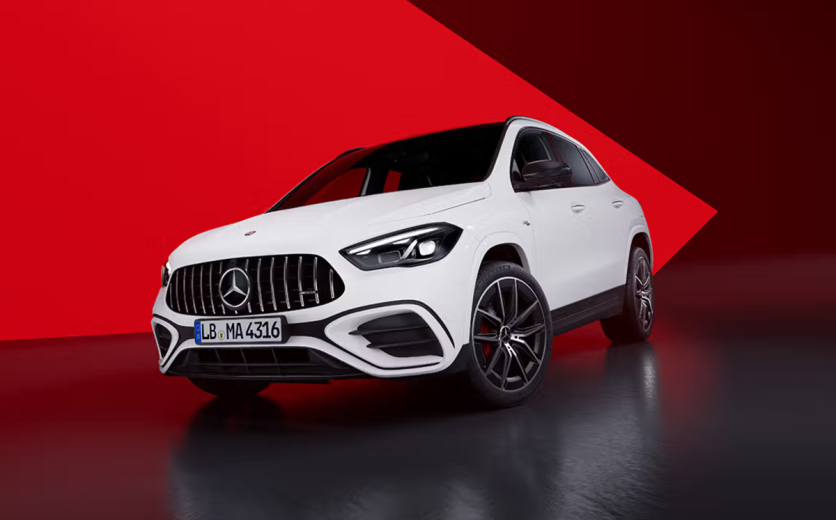
Mercedes-Benz is scheduled to reveal the third-generation GLA to the world this evening at its world premiere livestream at 7:30 PM Central European Summer Time (1:30 PM ET), completing the four-model compact family the company has been assembling since March 2025. The new model does something no prior GLA generation has done: it retires two separate nameplates at once, absorbing both the combustion-engined GLA and the battery-electric EQA into a single vehicle sold across nine powertrain configurations. For buyers considering the electric versions, the most consequential decision point is buried in the spec sheet — the GLA 250 EQ and the GLA 250+ EQ share the same physical 85 kWh battery pack, but the cheaper trim's usable capacity and peak charging speed are capped in software. At a 320 kW charger, a GLA 250 EQ owner will charge at 250 kW; a GLA 250+ EQ owner will charge at the full rate. The hardware is identical. The decision is a line of code. Exchange rate as of July 26, 2026; conversions are approximate.
MMA Platform Closes Its Four-Model Arc
The reveal tonight marks the end of a product offensive spanning four vehicles over roughly 16 months. The electric CLA sedan launched in March 2025, the CLA Shooting Brake followed in July 2025, and the GLB SUV debuted in December 2025. All three are built on Mercedes' MMA compact family — the Mercedes Modular Architecture, or MMA — a "skateboard" platform designed around an 800-volt electrical system but flexible enough to also accommodate a 48-volt mild-hybrid petrol powertrain using the same body structure.
The GLA is the fourth and final member of this compact MMA family. Its arrival closes a lineup that Mercedes has framed as the strategic foundation of its entry segment — the price range where first-time Mercedes buyers typically enter the brand.
Read more: Mercedes-Benz EV Sales Rose 50% in Q2, Fueled by a Record 26% European Share
EQA Nameplate Retires After Five Years
The original EQA, introduced in 2021, was Mercedes' first attempt at an entry-level battery-electric SUV. It was built on the MFA2 platform — the same architecture as the combustion GLA of the same generation — and was limited by that architecture's 400-volt electrical system to a peak DC charging speed of 100 kilowatts. Its best range figure was 490 km (304 miles) on the WLTP cycle.
The new GLA's electric variants inherit none of those constraints. The top electric trim — the GLA 350 4Matic EQ — carries the same 85 kWh nickel-manganese-cobalt battery as the GLA 250+, pairs it with dual motors producing a combined 354 PS (349 hp), and charges at up to 320 kW, according to MercedesBlog's premiere coverage. That is 3.2 times the peak charging rate of the EQA it replaces. For a driver stopping at a high-power DC station, the practical difference is charging 300 km (186 miles) of range in roughly 10 minutes rather than the 30-plus minutes the EQA required.
Nine Variants, Two Chemistries, One Platform
The new GLA's powertrain lineup spans four fully electric options and five mild-hybrid petrol variants, per pre-premiere specifications:
Fully Electric:
- GLA 200 EQ: 58 kWh lithium-iron-phosphate battery, 224 PS (221 hp), rear-wheel drive
- GLA 250 EQ: 85 kWh NMC battery (software-limited to 71 kWh usable), 272 PS (268 hp), rear-wheel drive
- GLA 250+ EQ: 85 kWh NMC battery (full capacity), 272 PS (268 hp), rear-wheel drive
- GLA 350 4Matic EQ: 85 kWh NMC battery, 354 PS combined (349 hp), dual-motor all-wheel drive
Mild-Hybrid Petrol:
- GLA 180: 136 PS (134 hp) plus 30 PS (30 hp) electric assist
- GLA 200: 163 PS (161 hp) plus 30 PS
- GLA 200 4Matic: 163 PS plus 30 PS, all-wheel drive
- GLA 220: 190 PS (187 hp) plus 30 PS
- GLA 220 4Matic: 190 PS plus 30 PS, all-wheel drive
The electric variants are expected to launch in Europe in autumn 2026, with the mild-hybrid petrol models following in spring 2027.
What the Battery Chemistry Difference Actually Means
The 58 kWh entry battery in the GLA 200 EQ uses lithium-iron-phosphate chemistry — the same cell type BYD uses across its lineup and that Mercedes sources from BYD for the entry-tier CLA, as detailed in battery architecture analysis. LFP is thermally stable, long-cycling, and cheaper to produce, but its energy density (450 Wh/l) is lower than the NMC alternative, which limits range per kilogram of battery.
The 85 kWh battery in the GLA 250 EQ and above uses a nickel-manganese-cobalt formulation with silicon-oxide anode technology, achieving an energy density of 680 Wh/l, according to MMA powertrain specifications. Mercedes engineers add silicon oxide to the graphite anode — a chemistry choice derived from research done for the VISION EQXX record-setting prototype — which compresses the same energy into a smaller, lighter cell. The 192-cell pack weighs approximately 496 kg (1,094 lbs) and is wired in a series configuration to achieve the 800-volt bus voltage the MMA platform requires.
How 800 Volts Makes 10-Minute Charging Possible
Most electric vehicles sold today run on 400-volt electrical architectures. Electrical power is the product of voltage and current (P = V × I), which means that delivering the same amount of power at 400 volts requires twice the electrical current compared to an 800-volt system. Higher current generates more heat. Managing that heat requires heavier cables, more complex thermal systems, and — critically — charging speed throttling to prevent the battery from overheating.
An 800-volt system sidesteps this constraint entirely. The Mercedes MMA platform's 800-volt architecture, whose electrical architecture descends directly from the VISION EQXX project and uses silicon-carbide power electronics, can accept 320 kW of charging power at half the current a 400-volt system would require at the same power level. The practical result is that the GLA 250+ EQ can, at a compatible high-power DC charger, add approximately 300 km (186 miles) of range in about 10 minutes. In real-world driving terms confirmed on the CLA — the production car that established MMA's real-world credentials before the GLA's arrival — owners have reported efficiency of roughly 4.8 miles per kWh on mixed roads in a comprehensive electrifying.com road test, translating to real-world range well above 400 km (249 miles) from the 85 kWh pack.
Why the GLA 250 EQ Charges Slower Than the Hardware Could
The most consequential detail in the new GLA's spec sheet is one that Mercedes does not advertise prominently. The GLA 250 EQ carries the same physical 85 kWh battery pack as the GLA 250+ EQ. The cell modules are identical. The pack structure is the same. But software limits the GLA 250 EQ to 71 kWh of usable capacity and 250 kW of peak DC charging speed — leaving 14 kWh of physical capacity and 70 kW of peak charging bandwidth inaccessible behind a firmware decision, per Mercedes' own pre-premiere spec release.
This is not new for MMA. The same structure applies to the CLA 250 and CLA 250+ — a documented pattern confirmed by MercedesBlog. Mercedes joins BMW, Tesla, and other automakers in using software tiers to differentiate hardware-identical products. The business logic is standard: building one battery pack instead of two reduces manufacturing complexity and lets Mercedes create price tiers without tooling separate configurations.
For a buyer, the consequence is specific: a GLA 250 EQ owner arriving at an Ionity 350 kW station will charge at 250 kW. A GLA 250+ EQ owner at the same station will charge at 320 kW. That 70 kW gap widens the 10–80% charge time by several minutes on every long-distance stop. Over the car's ownership life, the difference is not trivial. The upgrade path between the two trims — trading €10,000 or more in estimated price for the software unlock — is worth evaluating carefully by any buyer who uses public fast-charging regularly.
Mild-Hybrid Engine: Mercedes-Engineered, Chinese-Built
The five petrol-powered GLA variants use Mercedes' new M252 1.5-liter four-cylinder turbocharged engine, which was engineered by Mercedes-Benz and is manufactured at a facility in China by Aurobay, Geely's powertrain division, as documented in MercedesBlog's analysis of the M252. The engine is paired with a second-generation 48-volt mild-hybrid system that integrates a 30 PS (30 hp) electric motor directly into the eight-speed dual-clutch automatic transmission. That motor enables the car to recuperate braking energy, fill torque gaps during gear changes, and cruise briefly on electricity alone at low city speeds — but it cannot propel the vehicle on electric power independently. "Mild hybrid" in this context means fuel economy improvement in the 8–15% range in real-world use; it is not a plug-in system.
The engine's Chinese production provenance is a legitimate supply-chain transparency note for buyers who track origin-of-manufacture questions, and Mercedes has been open about the arrangement across its MMA compact lineup.
Design: Raked Roof Separates GLA from GLB
The new GLA is smaller than its sibling, the new GLB, and the roofline makes the difference visually apparent. The GLB, which measures 4,732 mm long (186.3 in) with a 2,889 mm wheelbase (113.7 in) and seats up to seven passengers, has a more upright rear profile suited to the third-row seating requirement. The GLA carries a more steeply raked tailgate inherited from prior generations, giving the five-seat-only model a sportier, more aerodynamic silhouette, according to MercedesBlog's design preview.
Based on pre-reveal reporting, the new GLA is expected to grow modestly from the outgoing model — from 4,412 mm (173.7 in) to approximately 4,500 mm (177.2 in) in length, and from a 2,729 mm (107.4 in) wheelbase to around 2,780 mm (109.4 in). Up front, the headlights are slightly longer and slimmer than the GLB's, joined by the same full-width light bar that links the lamps on both the CLA and GLB. The front grille features two horizontal slats with the three-pointed star positioned at center — closed off on EV variants, open for cooling on petrol models, as has been the case across the MMA family.
Cabin: Wall-to-Wall Screens Carry Over from CLA and GLB
Inside, the GLA is expected to mirror the interior treatment first introduced on the CLA. A pillar-to-pillar MBUX Superscreen spans the dashboard, combining a digital instrument cluster, a 14-inch central touchscreen, and an optional 14-inch front-passenger display within a single continuous glass panel, as previewed in pre-reveal coverage. The MBUX operating system that runs behind those screens is powered by MB.OS — Mercedes' proprietary chip-to-cloud vehicle platform, built on NVIDIA's Orin system-on-chip — and integrates AI voice assistants from both Google and Microsoft. Mercedes' connected-car platform, Mercedes Pleos, handles remote services, vehicle health monitoring, and over-the-air software update delivery — including updates to driver-assistance functions, a capability absent from the prior EQA generation.
Driver-assistance technology is expected to include Mercedes' MB.Drive suite, providing self-parking and hands-free semi-autonomous highway driving capability.
Production: Rastatt, Germany
The new GLA will be built at Mercedes' Rastatt plant in Baden-Württemberg, Germany — the same facility that has assembled the GLA for its entire history and where the final outgoing EQA models are currently being completed, according to electrive.com's Rastatt confirmation. Rastatt also currently produces the CLA and CLA Shooting Brake. Production of the new GLA is expected to begin shortly before the autumn 2026 European sales launch.
The plant is designed for an annual output of approximately 200,000 vehicles, and with the GLA joining the CLA on its production lines, Rastatt's two anchor models are expected to sustain three-shift production through at least 2028, when a next-generation MMA-based A-Class is currently planned to join the lineup.
What Buyers Should Expect to Pay
Pricing for the new GLA has not yet been officially confirmed by Mercedes-Benz. Based on pre-reveal reporting and the pricing structure of the new GLB, which starts at €53,455 (approximately $61,000 USD) for the entry electric variant and reaches €62,177 (approximately $70,849 USD) for the top electric trim, the new GLA's smaller size and slightly lower positioning suggest a likely electric price range of approximately €51,000 to €61,000 (approximately $58,000 to $69,500 USD) in Germany, per MercedesBlog's pricing estimates.
Mild-hybrid petrol variants, analogous to the GLB petrol range of €50,396 to €57,048 (approximately $57,425 to $65,005 USD), are estimated to fall between approximately €48,000 and €55,000 (approximately $54,695 to $62,671 USD). North American pricing and market timing have not been announced; the US market currently pays $41,500 for the outgoing GLA 250, and the new model is expected to carry a higher price at launch.
European order books are expected to open alongside the autumn 2026 production launch. For context, Mercedes' other MMA-platform models — particularly the electric CLA — have seen order backlogs extending into 2027, suggesting that buyers in key markets who want early delivery of the electric GLA should expect to act quickly.
Frequently Asked Questions
Does the new Mercedes GLA replace the EQA?
Yes. Mercedes is consolidating both the combustion GLA and the battery-electric EQA under a single third-generation GLA nameplate built on the MMA platform. The EQA name will disappear from the lineup. Buyers who previously would have chosen the EQA for its electric drivetrain now choose the GLA electric variant — specifically the GLA 200 EQ, GLA 250 EQ, GLA 250+ EQ, or GLA 350 4Matic EQ depending on battery size and power preference, as confirmed in MercedesBlog's premiere coverage.
How fast does the new GLA charge compared to the old EQA?
The outgoing EQA used a 400-volt electrical architecture and was limited to a peak DC charging speed of 100 kilowatts. The new GLA's MMA platform runs an 800-volt system, enabling peak DC charging of up to 320 kW on the GLA 250+ EQ and GLA 350 4Matic EQ — 3.2 times the EQA's maximum rate. At a compatible high-power DC charger, this translates to approximately 300 km (186 miles) of WLTP range added in roughly 10 minutes, compared to more than 30 minutes for the same range restoration in the outgoing EQA, according to published MMA powertrain specifications.
Is the GLA 250 EQ the same battery as the GLA 250+, and does it matter?
Yes — the GLA 250 EQ and GLA 250+ EQ use the same physical 85 kWh battery pack. Software restricts the GLA 250 EQ to 71 kWh of usable capacity and limits peak DC charging to 250 kW rather than 320 kW. For buyers who charge exclusively at home or at slower AC charging points, this distinction is minimal. For buyers who regularly use public DC fast-chargers on longer journeys, the 70 kW gap in peak charging speed meaningfully extends every charging stop. The price difference between the two trims represents, in practical terms, the cost of unlocking the battery you already physically own — a pattern documented in detail on the CLA platform.
What engine powers the petrol GLA, and where is it built?
The mild-hybrid petrol variants use the M252 1.5-liter turbocharged four-cylinder engine, which was engineered by Mercedes-Benz and is manufactured in China by Aurobay, Geely's powertrain division, as detailed in MercedesBlog's M252 engineering analysis. It is paired with a 30 PS electric motor integrated into the eight-speed dual-clutch automatic gearbox. This is the same engine used in the MMA-platform CLA and GLB mild-hybrid variants. The mild-hybrid system recovers braking energy and provides torque assist but cannot drive the vehicle on electricity alone.

-
 C114 Communication Network
 -
 Communication Home
