
 Search

Bmwusa.com
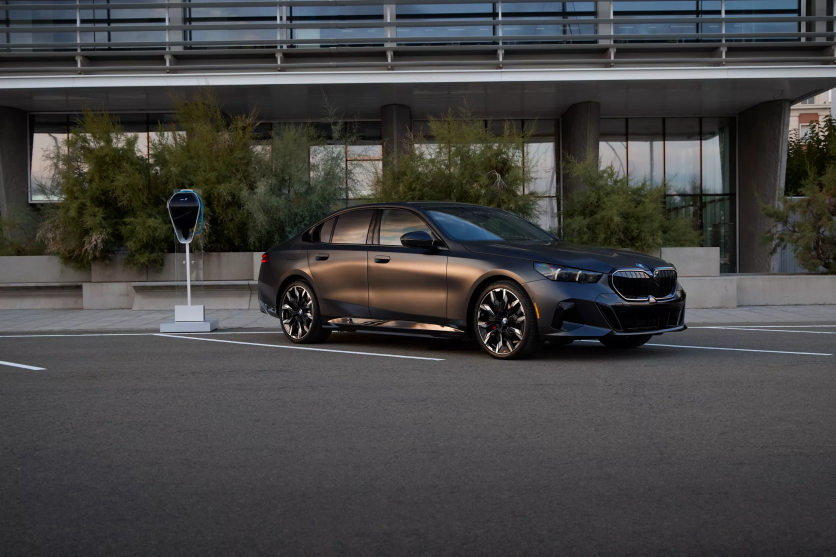
BMW's electric sedan just posted its best EPA numbers yet — and it did so without touching the battery. The 2027 BMW i5 eDrive40 received an official EPA range rating of 328 miles on 19-inch wheels, with a combined efficiency score of 116 MPGe, according to trade reporting published Monday. That represents an 18-mile, roughly 6% improvement over the 2026 model's 310-mile rating — all extracted from the same 84.3 kWh usable battery through incremental drivetrain refinement, not new hardware. The news arrives as the Tesla Model S — the luxury sedan the i5 has been chasing since 2023 — enters its final production year, with Tesla having confirmed in early 2026 that the Model S would end production in the second quarter of 2026.
The result positions the 2027 i5 as a buyer's most credible alternative in a segment that is, effectively, losing its dominant benchmark.
How BMW Squeezed Eighteen More Miles From an Unchanged Pack
The efficiency gains that produced the 2027 i5's 328-mile rating are the product of a two-stage engineering program. The foundation was laid in early 2025, when BMW introduced silicon-carbide semiconductor components into the i5's power electronics inverter, as confirmed in the BMW spring 2025 model update press release. Silicon-carbide inverters outperform conventional silicon-based designs in three specific ways: they sustain higher operating voltages without the thermal losses that degrade silicon, they reduce conversion losses when moving direct current from the battery to alternating current for the motor, and they tolerate the thermal cycling of real-world driving more efficiently over time. Paired with lower-rolling-resistance tires and optimized wheel bearings that reduce mechanical drag, those changes pushed the 2025/2026 eDrive40's range from 295 miles (on 19-inch wheels) to 310 miles — a jump of about 5%, per BMW's official announcement.
Read more: BMW i3 Electric Sedan Orders Open Today With 440-Mile Range Lead Over Tesla
The 2027 update builds on that hardware foundation with software calibration and drivetrain efficiency tuning — adjusting regenerative braking maps, thermal management parameters, and motor control algorithms to extract additional efficiency from the same physical components, as reported by InsideEVs. The result is a combined efficiency of 116 MPGe, up from 110 MPGe for the 2026 model on the same wheels. In the unit that EV owners find more operationally useful, the 2027 eDrive40 consumes approximately 29 kWh per 100 miles, compared with about 31 kWh per 100 miles for its predecessor.
At 116 MPGe, the i5 eDrive40 consumes the energy equivalent of one gallon of gasoline for every 116 miles traveled, using the EPA's 33.7 kWh-per-gallon equivalency standard. For a driver covering 15,000 miles a year at a national average electricity rate of around $0.17 per kWh, the difference between 31 kWh/100mi and 29 kWh/100mi works out to roughly $51 in annual savings — modest individually, but meaningful over the course of a lease or loan term.
Buyers who opt for larger wheels will see those numbers compress. The 2027 eDrive40 on 20-inch wheels drops to 299 miles; on 21-inch wheels, range falls to 262 miles — a 66-mile penalty for the largest available option, per InsideEVs' specs breakdown.
Does the 2027 i5 Have NACS? Every Trim, Every Spec, No Adapter Required
The longer-range number is significant, but for most buyers the more consequential update to the 2027 i5 is the native North American Charging Standard (NACS) port — now standard equipment across the entire U.S. lineup, as confirmed on BMW's U.S. product page. Where the 2024 and 2025 model years relied entirely on CCS1 (Combined Charging System) inlets, and 2026 models produced before March 2026 required an adapter to access Tesla Superchargers, the 2027 i5 carries a native SAE J3400 inlet from the factory.
SAE J3400 — the open standard that formalized NACS in September 2024 — is a five-pin connector that handles both AC Level 2 and DC fast charging through a single compact port. Unlike the CCS1 connector, which combines a J1772 AC inlet with two separate DC pins in a larger, bulkier assembly, NACS accomplishes both functions in a connector roughly half the size of CCS1, with a lighter cable and better ergonomics. BMW includes two bundled adapters with every 2027 i5: a J1772-to-NACS adapter for AC Level 2 sessions at legacy stations, and a CCS1-to-NACS adapter for DC fast charging at non-NACS-equipped sites.
As of July 2026, Tesla operates more than 37,000 Supercharger DC fast-charging stalls in the United States, representing the majority of all public DC fast-charging capacity in the country. More than two-thirds of those stalls are now open to non-Tesla vehicles. For 2027 i5 owners, all compatible Supercharger stalls are accessible without an adapter, without a mobile app workaround, and without any additional configuration.
BMW also enables Plug & Charge authentication — the ISO 15118 protocol that allows a vehicle to identify itself and handle billing directly with the charging station — at both IONNA and Tesla Supercharger locations. Pull up, plug in, and the session starts automatically.
DC fast-charging peak rate is 205 kW, which BMW says supports a 10%–80% charge in approximately 30 minutes under ideal conditions. BMW also states that a 10-minute top-up adds roughly 80 to 86 miles of range — enough to cover the gap between discovering a lower-than-expected state of charge and reaching the next planned stop.
BMW i5 vs. Tesla Model S: Range Gap Narrows, But on Whose Terms?
Comparing the 2027 i5 to the 2026 Tesla Model S is now an exercise in calibrated expectations, because the Model S is no longer a product Tesla plans to keep developing. Tesla confirmed in early 2026 that the Model S production ended in the second quarter of 2026, closing a 14-year production run. New buyers purchasing a Tesla Model S today are buying remaining inventory, not a continuing product line.
Against that benchmark, the numbers tell a specific story. The 2026 Model S Long Range AWD carries an EPA range of 410 miles on 19-inch wheels, a combined efficiency rating of 124 MPGe, and 670 horsepower from its dual-motor setup. The i5 eDrive40's 328-mile range trails the Model S by 82 miles — a gap that reflects 14 years of platform optimization, a larger battery, and a vehicle designed from the ground up around range as its primary engineering objective.
On efficiency, the comparison tightens. The Model S Long Range rates at 124 MPGe, noticeably ahead of the i5 eDrive40's 116 MPGe. The Plaid trim, however, trades efficiency for three-motor performance: its EPA combined rating comes in at 110 MPGe on 19-inch wheels, below the i5 eDrive40's figure. A buyer cross-shopping the i5 eDrive40 against the Plaid specifically — rather than the Long Range — finds the BMW ahead on efficiency.
The more direct comparison, for most buyers, is price. The 2027 BMW i5 eDrive40 starts at $68,550. The 2026 Tesla Model S launched at $94,990 — a gap exceeding $26,000 at original MSRP. With Model S production having ended and inventory limited, pricing for remaining stock varies. Neither the efficiency advantage of the i5 on Plaid cross-shopping, nor the price gap, fully compensates for the Model S's 82-mile range lead — but they reframe the choice considerably for buyers who do not need the Model S's outright range ceiling.
The Model S charges at up to 250 kW at Supercharger V3 hardware, compared with the i5 eDrive40's 205 kW peak. On 400-mile road trips, that charging speed difference can matter. On typical daily and medium-range use, it is unlikely to.
NACS Was Always Coming: Why Full Industry Adoption Took Three Years
The 2027 i5's native NACS port is the completion of a commitment BMW made in October 2023, when the BMW Group announced it would adopt the North American Charging Standard for its U.S. and Canadian EVs beginning in 2025. The announcement followed Ford (May 2023) and GM (June 2023) in a wave of industry adoption that effectively turned Tesla's proprietary connector into a public standard before SAE International had formally published it.
SAE's Technical Information Report for J3400 arrived in December 2023; the full Recommended Practice followed in September 2024. By the time SAE's formalization was complete, virtually every major automaker selling in North America — including GM, Rivian, Hyundai, Kia, Honda, Nissan, Mercedes-Benz, Volvo, Polestar, and now BMW across its full lineup — had committed to native NACS ports. As of early 2026, NACS DC fast chargers represented approximately 48% of all public DC fast-charging ports in the United States, according to Alternative Fuels Data Center data.
The transition from CCS1 to NACS as the North American standard resolves a structural problem that frustrated non-Tesla EV owners for years. CCS1 required a different cable, different hardware, and — at many legacy charging stations — slower software integration than NACS. The Plug & Charge capability that BMW enables for 2027 i5 owners depends on the NACS/ISO 15118 protocol, not CCS1. Native NACS is not merely a connector change; it is access to the authentication layer that makes charging frictionless.
Powertrain Lineup and Standard Equipment
BMW is offering the 2027 i5 in two configurations in the U.S. market. The eDrive40 is rear-wheel drive with a single rear-mounted electric motor producing 335 horsepower and 295 lb-ft of torque, with a 0–60 mph time of 5.4 seconds per BMW's official specification, starting at $68,550. The xDrive40 adds an additional front motor for 389 combined horsepower and an all-wheel-drive configuration, with a 4.9-second 0–60 time, at $71,550. The xDrive40 posts a lower EPA range figure because the additional motor carries an efficiency cost.
The high-performance i5 M60 — producing 593 horsepower from a dual-motor setup and reaching 60 mph in 3.7 seconds — continues as a 2026 model year carryover, per InsideEVs' specifications report. It already has the native NACS port installed.
Standard equipment on the eDrive40 includes a 12.3-inch instrument display, vegan leather upholstery, heated front seats, ambient lighting, and the 19-inch bi-color aerodynamic wheels that unlock the full 328-mile EPA range. A Level 2 full charge from a 240V outlet takes approximately 10 to 12 hours, per BMW's U.S. product page.
What Does the Range Number Cost You in Real Terms?
At 116 MPGe and 29 kWh per 100 miles, the 2027 i5 eDrive40 consumes just under 12 kWh per hour of typical combined driving. For a household charging at the U.S. residential average of approximately $0.17 per kWh, a full charge from near-empty to 84.3 kWh runs about $14.33. A 100-mile driving day costs roughly $4.93 in electricity — before any off-peak rate optimization or employer charging credits are applied.
The 18-mile gain over the 2026 model translates, practically, into one fewer Supercharger stop on a 600-mile route that previously required two stops of 30 minutes each. For frequent long-distance drivers, that arithmetic matters. For daily commuters within 100 miles round-trip — the majority of EV use cases — the difference between 310 miles and 328 miles has no real-world impact.
The case for the 2027 i5 is not range supremacy. It is the convergence of a strong-enough range figure, an energy-efficient drivetrain, seamless Supercharger access, and a price that starts more than $26,000 below an aging competitor in its final year of production.
Frequently Asked Questions
Why does the 2027 BMW i5 have more range if the battery size didn't change?
BMW achieved the efficiency gain through two mechanisms. The foundational change was the introduction of silicon-carbide semiconductor components in the inverter — the component that converts stored DC power from the battery into the AC power the motor uses. SiC-based inverters lose less energy as heat during that conversion than conventional silicon designs, and they tolerate a wider operating voltage range. The 2027 update layered software calibration — adjustments to regenerative braking, thermal management, and motor control logic — on top of that hardware. The same 84.3 kWh usable capacity delivers more miles because each kilowatt-hour is used more efficiently throughout the drive cycle.
Does the 2027 BMW i5 need an adapter to charge at Tesla Superchargers?
No. Every 2027 BMW i5 sold in the United States comes with a native NACS (SAE J3400) charge port, which connects directly to Tesla Supercharger hardware without an adapter. BMW does include two adapters in the box — one for AC Level 2 sessions at J1772-equipped stations and one for DC fast-charging at older CCS1 sites — to maintain compatibility with legacy charging infrastructure. Plug & Charge automatic authentication is enabled at IONNA and Tesla Supercharger stations.
How does the 2027 BMW i5 eDrive40 compare to the Tesla Model S on efficiency?
The 2027 i5 eDrive40 rates at 116 MPGe combined, consuming about 29 kWh per 100 miles. The 2026 Tesla Model S Long Range AWD rates at 124 MPGe, making it more efficient in direct comparison — and its 410-mile range leads the i5 by 82 miles. However, the Model S Plaid trim rates at 110 MPGe combined, below the i5 eDrive40's figure; buyers cross-shopping specifically against the Plaid will find the BMW more efficient. The Model S also starts at $94,990 — more than $26,000 above the i5 eDrive40 — in what is its final production year.
Is the Tesla Model S still being made?
Tesla announced in early 2026 that Model S production ended in the second quarter of 2026, closing a 14-year production run. New buyers purchasing a 2026 Model S are buying remaining inventory, not a continuing product line. Tesla has not announced a direct successor to the Model S in the traditional sedan format.

-
 C114 Communication Network
 -
 Communication Home
