
 Search

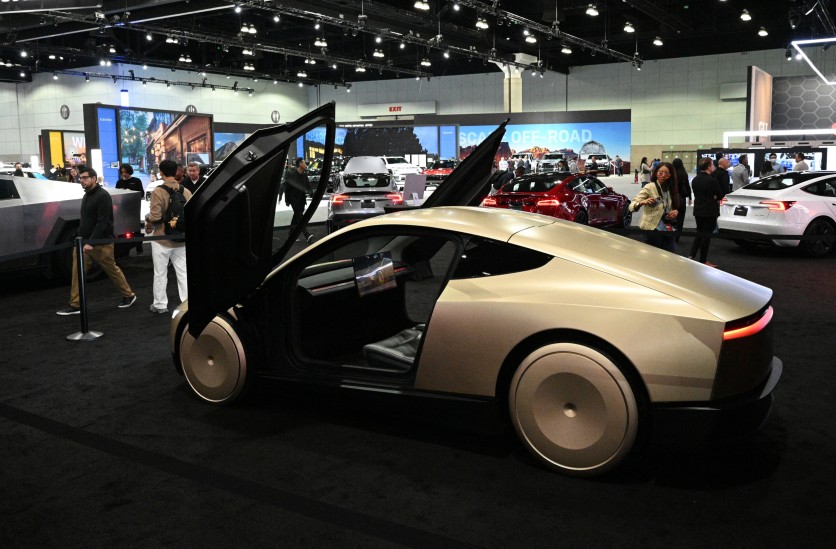
Tesla's Cybercab robotaxi is displayed during the AutoMobility LA 2024 auto show at the Los Angeles Convention Center in Los Angeles Robyn Beck/Getty Images
Tesla has filed for permission to run a commercial robotaxi service across Clark County, Nevada, requesting authorization to deploy up to 5,000 autonomous vehicles within twelve months of approval. The application — Docket 26-05015, filed June 5, 2026, with the Nevada Transportation Authority — covers Las Vegas, Harry Reid International Airport, and Henderson Executive Airport. The number on paper is not the story. The story is what is behind it: a company asking Nevada to certify a camera-only driving system as fully autonomous while federal regulators are simultaneously pursuing the last step before a potential recall of that same technology, specifically because cameras fail in sun glare and dust — the defining conditions of a desert city.
The protest deadline for the NTA filing is on or before July 5, 2026. Any person or organization with a direct and substantial interest in the outcome may file a formal protest with the Nevada Transportation Authority through that date.
What the Real Fleet Numbers Show
The application's 5,000-vehicle ceiling sits in jarring contrast to operational reality. Independent tracking data shows Tesla's active unsupervised fleet — vehicles carrying passengers without a human safety driver onboard — stood at approximately 20 cars as of late May 2026 across Austin, Dallas, and Houston. That figure had been declining since a peak near 25 in mid-April, not growing. Texas Department of Motor Vehicles filings published May 28 list 42 Tesla autonomous vehicles registered statewide.
For context: Zoox, which holds the only other Autonomous Vehicle Network Company permit in Nevada (AVNC 001), operates under a cap of just 65 vehicles in Las Vegas under a free-rides-only temporary authorization. Tesla is requesting authorization for a fleet 77 times larger than Zoox's current Nevada ceiling — despite never having carried a paying passenger in the state.
Waymo reported 3,067 robotaxis to federal safety regulators in December 2025 and now delivers more than 500,000 paid rides per week across more than ten U.S. cities. Tesla's 42 Texas registrations represent less than two percent of Waymo's fleet.
Read more: Tesla Robotaxi Trails Waymo 42 to 577 in Texas:Austin Map Masks 20-Car Fleet Until FSD v15 Rewrite
Why Nevada — and Why This Matters to Visitors and Investors
The business logic for targeting Clark County is evident. The Las Vegas metro draws tens of millions of visitors annually, operating a dense urban core with grid-style streets and around-the-clock demand. Harry Reid International Airport — one of the busiest single-terminal airports in the United States — generates persistent, high-density ride demand from a traveler base already accustomed to on-demand transport. Airport pickups represent the highest-utilization, highest-revenue corridor in ride-hailing.
Nevada also offers competitive urgency. Zoox, owned by Amazon, has been operating its purpose-built driverless vehicles on the Las Vegas Strip since September 2025, has carried more than 350,000 riders, and has driven approximately two million autonomous miles. By March 2026, Zoox expanded to cover the majority of Strip hotels, the Las Vegas Convention Center, T-Mobile Arena, and the Sphere. Motional, partnered with Uber, launched robotaxi service on the Strip in March 2026. Waymo, which began testing in Las Vegas in November 2025, plans to open its Las Vegas service to the public in summer 2026. Tesla is entering a market with multiple established competitors, none of which are asking Nevada regulators to accept an unproven scale ceiling.
For Tesla investors, the Nevada filing matters because the company's valuation is partially built around the prospect of a fleet robotaxi business generating revenue at scale. On the Q1 2026 earnings call, CEO Elon Musk acknowledged that robotaxi revenue would not be "super material" this year — a concession that sits uneasily beside a permit application projecting 5,000 vehicles within the first year of approval.
The Camera-Only Bet Nevada Regulators Must Evaluate
The central technical question buried in the permit application is the one Nevada regulators will face most directly: what does it mean for Tesla to self-certify its vehicles as Level 4 autonomous under Nevada's NRS Chapter 706B framework?
Under the SAE International automation scale, Level 4 designates a system that can handle all driving tasks without human intervention within a defined operational area, even if the system encounters a situation it cannot resolve — at that point, it stops safely rather than requesting human takeover. That is what Tesla is claiming for its Nevada deployment.
The same technology — Tesla's camera-only Full Self-Driving system, relying exclusively on eight cameras and a neural network without radar or lidar — is currently the subject of NHTSA Engineering Analysis EA26002, opened March 18, 2026. The investigation covers approximately 3.2 million Tesla vehicles. The agency's stated concern: FSD's degradation detection system may fail to identify when cameras are blinded by sun glare, fog, or airborne particulates, and may not warn drivers with sufficient time to respond. EA26002 is the step NHTSA takes immediately before issuing a recall demand.
Las Vegas receives approximately 294 sunny days per year. Sun glare along the east-west grid of the Las Vegas Strip is severe in morning and afternoon hours. Dust storms are a documented seasonal condition in Clark County.
Competitors that Nevada already permits take a different approach. Waymo's sixth-generation sensor suite combines 13 cameras with four lidar units and six radar arrays — a multi-modal system that constructs a 3D picture of surroundings redundant across sensing modalities, so the failure of any single sensor does not blind the vehicle. Zoox uses cameras, long-wave infrared sensors, lidar, and microphones. Tesla has no lidar and no radar. Musk has repeatedly called lidar a "fool's errand" and an "unnecessary" expense.
Professor Reza Hoseinnezhad of RMIT University, who studies autonomous systems, has argued that the camera-only approach is "fundamentally flawed" because it lacks the redundancy that camera-based AI systems need to handle edge cases safely — particularly in low-light or unusual visibility conditions.
Tesla's own public filings acknowledge the dependency. On May 28, 2026, Tesla self-certified its purpose-built Cybercab as SAE Level 4 under Texas's new autonomous vehicle framework — a certification that applies specifically to the Cybercab hardware. The standard FSD (Supervised) system, which SAE International itself classifies as Level 2 requiring an attentive driver, is the software stack driving the Model Y vehicles that constitute Tesla's current Robotaxi fleet. The NTA has not publicly stated how it will evaluate Tesla's Level 4 claim or whether it intends to conduct independent verification.
Read more: Tesla Robotaxi Crashes Blamed on Human Teleoperators: Backup System Failed Twice in NHTSA Data
Tesla's Safety Record and the Teleoperator Gap
Tesla's Austin Robotaxi operation logged 17 incidents between July 2025 and March 2026 in filings with NHTSA. Two of those incidents involved injuries. Among the crashes caused by the Tesla system itself, two are particularly significant: both occurred when a remote teleoperator assumed low-speed control of the vehicle and drove it into a fixed object. In July 2025, a teleoperator drove a Robotaxi up a curb and into a metal fence at 8 mph. In January 2026, a different teleoperator drove a vehicle into a construction barricade at 9 mph.
The teleoperator architecture is central to understanding what "Level 4 autonomous" means for Tesla's Robotaxi in practice. When Tesla's automated driving system encounters a situation it cannot resolve — a complex construction zone, an ambiguous intersection — it can request remote assistance. A human teleoperator then takes direct vehicle control over a cellular data link, steering and accelerating from a remote location, limited by policy to below 10 mph. The vehicle is not operating without human intervention in these moments. Whether Nevada's NTA will assess the teleoperator architecture as consistent with Level 4 classification is unclear from the public filing.
What Happens Before a Robotaxi Reaches a Las Vegas Street
Filing a permit application is not approval. The NTA must review Docket 26-05015, including portions Tesla has requested be kept confidential. The agency has not published a timeline for reviewing an application of this scale — it would be the largest autonomous vehicle commercial authorization request in Nevada's regulatory history by far.
Tesla filed infrastructure-related paperwork with Clark County on May 12, 2026, for a 36,000-square-foot Cybercab maintenance and car wash facility in Henderson — weeks before the NTA application became public — indicating that operational preparation has been underway for some time.
Scale at the level Tesla is requesting depends on FSD v15, a software rewrite that expands the driving model's neural network from approximately one billion parameters to roughly ten billion — a tenfold increase that Tesla engineers say is necessary before the fleet can grow aggressively. Musk has targeted v15 for late 2026 or early 2027. Until that update ships, the fleet is expected to remain small even as geofences and permit applications expand.
What a Las Vegas Visitor Is Actually Getting
If NTA approval comes before FSD v15 ships, Las Vegas visitors who attempt to hail a Tesla Robotaxi should expect very limited availability. The Austin metro — 245 square miles of approved service area — is currently served by roughly 20 unsupervised vehicles. Harry Reid International Airport is one of the busiest airports in the United States. The ratio of permit headroom to active fleet in any near-term Nevada launch is likely to resemble Austin's: a map that implies wide availability and a fleet too small to reliably serve it.
This is the gap between paper and pavement that the Nevada filing makes legible. Tesla's permit strategy is rational: secure the broadest possible authorization now, then fill it as software and hardware mature. But a visitor deciding whether to count on a Tesla Robotaxi for an airport connection in Las Vegas in 2026 should understand that the permit ceiling and the operational fleet are two very different numbers.
Frequently Asked Questions
When can I actually hail a Tesla Robotaxi in Las Vegas?
No launch date exists yet. Tesla's application is under review by the Nevada Transportation Authority and has not been approved as of June 16, 2026. Even after approval, Tesla has acknowledged it will not scale the fleet aggressively until FSD v15 ships — targeted for late 2026 or early 2027. Visitors in 2026 are far more likely to encounter Zoox vehicles (operating since September 2025 at 15 Strip locations) or Waymo vehicles, which plan to open Las Vegas public service in summer 2026.
Is Tesla's self-driving technology safe enough for a Level 4 designation in Nevada?
That is precisely the question the NTA must evaluate. Tesla self-certified its Robotaxi camera-only system as Level 4 autonomous under Nevada's framework. The same technology is under NHTSA Engineering Analysis EA26002, opened March 18, 2026, targeting approximately 3.2 million vehicles for potential recall based on the system's failure to detect reduced visibility — including sun glare, a common condition in Las Vegas. NHTSA's investigation is ongoing. Nevada's self-certification framework does not mandate independent technical verification by the state.
How does Tesla's approach differ from Waymo's and Zoox's sensor systems?
Tesla relies exclusively on eight cameras and an AI neural network — no radar, no lidar. Waymo's sixth-generation driver combines 13 cameras with four lidar units and six radar arrays, creating overlapping sensor coverage so the failure of any single sensor does not blind the system. Zoox uses cameras, lidar, long-wave infrared sensors, and microphones. The central tradeoff: sensor fusion costs more per vehicle and adds hardware complexity, but provides redundancy in conditions where cameras alone degrade — sun glare, fog, dust — the exact conditions named in NHTSA's current FSD investigation.
What is the July 5, 2026 deadline for the Tesla Nevada application?
Persons and organizations with a direct and substantial interest in Docket 26-05015 may file formal protests with the Nevada Transportation Authority on or before July 5, 2026. Note that July 5 falls on a Sunday; confirm with the NTA whether the effective deadline shifts to July 6. Protests must conform to the NTA's regulations and be filed at the Authority's office at 3300 W. Sahara Avenue, Suite 200, Las Vegas, Nevada.

-
 C114 Communication Network
 -
 Communication Home
