
 Search

Credit: Kia
Way back in 2019 when Kia introduced the first-generation Telluride, both the media and the car-buying public went nuts for it. Dealers struggled to keep the Telluride on their lots, and that’s before the insanity brought on by the COVID-19 pandemic a year later. Now, fast-forward six years, and there’s a new Telluride for the 2027 model year, and once again, Kia seems to have knocked it out of the park.
The 2027 Kia Telluride follows the same formula as the old one, but it has grown in every direction except engine cylinder count, and it looks a whole lot like the folks at Kia’s US design studio had “Greatest Hits of Range Rover” on repeat, which is a very good thing. Oh, and there’s finally a hybrid version.
Under the hood
The second-generation Telluride has fully ditched its old 3.8 L six-cylinder engine. In its place, it is now offering either a turbocharged 2.5 L four-cylinder gasoline engine that produces 274 hp (204 kW) and 311 lb-ft (422 Nm) of torque, or that same engine with a dual-motor hybrid system. The hybrid version produces a combined 329 hp (245 kW) and 339 lb-ft (460 Nm) while returning a claimed 35 mpg (6.7 L/100 km) combined.
At 199.2 inches (5,060 mm) long, 78.3 inches (1,989 mm) wide, and 69.9 inches (1,775 mm) tall, the three-row Telluride is not a small SUV.
Credit: Kia
As before, the Telluride is available with either front-wheel or all-wheel drive, with AWD being a $2,000 option on the middle S and EX trims, not available on the base LX trim, and standard on X-Line and up models, including the off-road-ish X-Pro.
Non-hybrid Tellurides come with an eight-speed automatic transmission as standard, while the hybrid version gets a six-speed automatic. All pretty standard Kia stuff, which is to say, totally adequate.
Get on the road
The decision to go to a turbocharged four-cylinder engine was, overall, a good one. The added torque is very welcome on freeway on-ramps and especially off-road (more on this later), but the downside is that, as is typical for Kia, the engine noise permeates the cabin under acceleration, and it’s not a great sound. I mention this because after a day of driving the Telluride, this is one of my two biggest complaints about it.
What’s the other? The steering feel. Now, before you start loudly groaning about a journalist whining about steering feel in a three-row SUV, know that I’m not talking about it in the driving pleasure, sports car sense. I’m talking about it in the “Wow, this feels unnaturally heavy, even outside of sport mode” sense. Though there has been a hardware change in the electric power steering system (Kia moved from a column-mounted steering motor to a rack-mounted unit), this seems like more of a calibration issue.
The torque is welcome, especially in the hybrid version.
Credit: Kia
Are either of these issues the end of the world? Not at all. Would I get used to both after a few weeks of owning the vehicle? Probably, but this is 2026, and cars are so good that nitpicking is all we’ve got left.
The rest of the driving experience is lovely. The Telluride packs a very compliant ride, and while it does tend to sway a little in the corners, I didn’t mind. A little sensation of speed is a good thing, and it never feels overly wallowy. The brakes are completely adequate for a three-row midsize SUV with this kind of power, so again, no complaints.
Off-road in a Kia?
The Telluride is an SUV, and Kia bills its X-Pro models as being off-road-capable, so naturally, in addition to the road route that we were given, Kia provided a surprisingly robust little off-road course to try on a working cattle ranch. Make no mistake, despite its Landy looks, the Telluride is no hardcore trail rig, but it doesn’t embarrass itself in the dirt either.
The Telluride X-Pro, getting its tires a little grassy.
Credit: Kia
The X-Pro trim offers more than just real tow hooks, a standard tow hitch, and more ground clearance (9.1 inches/231 mm in total). It also has the same 18-inch all-terrains we saw on the outgoing Telluride X-Pro, but with a totally redone suspension with actual hardware changes, not just calibration. The result is a great ride once you head off-piste.
While the Telluride X-Pro lacks any real locking diffs, it does have what Kia calls E-LSD. This is a brake-actuated system that seems to work pretty well even in trickier situations, like having wheels off the ground or on technical ascents and descents. Speaking of descents, Kia included hill descent control here, and it works well, without the need to adjust speed via the cruise buttons. Just accelerate to your desired downhill speed, then take your foot off the pedals. It’s pretty effective.
The X-Pro also offers terrain modes with Normal, Mud, Sand, and Snow. Each mode affects gearbox and throttle behavior as well as traction control. Are these going to get you through the Rubicon? Not even close. Are they going to save your butt on a muddy fire road or a snowy drive to Grandma’s house? Just maybe.
How’s it looking?
Now, where have I seen this before?
Credit: Kia
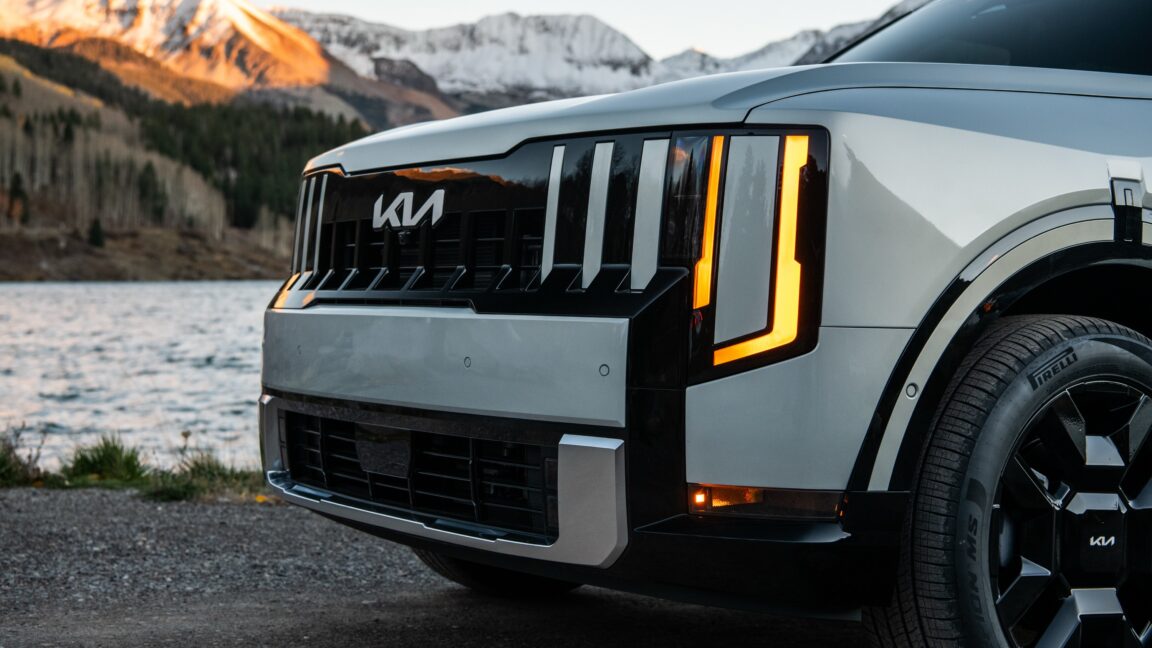
Although all the mechanical changes to the 2027 Telluride are nice, the thing that’s going to bring people into dealerships is the new styling. Of course, styling and design are subjective, but as good as the new Telluride looks in photos, it’s even better in person. Kia’s US design team absolutely nailed the proportions, and while I joke about it looking like a few generations of Range Rover put together, I genuinely mean that as a good thing.
The side profile gives notes of the 2003–2012 L322 Range Rover, while the taillights bring the current Rangie to mind. The nose? How about the Range Rover Classic. Of course, there are styling touches that are uniquely Telluride. For example: the character lines on the sides over the wheel wells. They almost pull down to meet the keyway detail on the wheel arch. It’s subtle but really makes the Telluride look purposeful.
The interior design is indicative of other modern Kia products. The huge dash and infotainment screen looks premium, and the new “engineered carbon” interior trim plays a lot better than many other carbon-fiber finishes at the Telluride’s price point. There’s also an engineered wood option on some trims that similarly punches above its weight class.
The seats are fantastic, with heating and cooling, and the driver can even get a massaging seat, depending on how high up the trim stack they’re willing to go. The materials overall feel very premium, and while it seemed a little polarizing among other journalists, I absolutely love the “squircle” steering wheel. It looks cool and feels great in the hand.
I’m less enamored with the column-mounted, twisty nub gearshift that we’ve seen in other Kias, including the EV9. Yes, it frees up console space, but it’s a little awkward to use, and I found myself bumping it with my leg from time to time. I am 6-foot 4-inches (2 m) tall, though, so your mileage may vary.
The second row is plenty roomy for kids or adults, and the third row was a bit cramped for me. But for normally sized humans, it’s usable. Ingress and egress from the third row is helped by the new electric tilt feature for the second-row chairs. Cargo room is ample at 48.7 cubic feet (1,379 L) with the third row dropped or 22.3 cubic feet (631 L) of space with the third row up—though that’s for internal combustion models. The hybrid Telluride sacrifices a few feet of cargo space, but it’s still plenty usable for those IKEA and Costco runs.
All mod cons
Being a new Kia, the Telluride’s technology—safety, convenience, and infotainment—is excellent and largely standard. Features like adaptive cruise control, active lane keep assist, and automatic emergency braking work to make Kia’s Highway Driving Assist system very nice to use in traffic, while the vehicle cameras make maneuvering in parking lots easy, thanks to their good resolution.
The infotainment system is standard Kia fare, with includes wireless Apple CarPlay and Android Auto. The stereo sounds good, if not great, and the dual wireless charging pads work well, though I wish Kia had included a dedicated A/C vent to prevent overheating, as other manufacturers have.
The original Telluride was a hugely important and hugely successful vehicle for Kia, and the 2027 model improves upon it in nearly every way. It’s stylish, comfortable, capable, well-equipped, and, in a world where seemingly everything is $50,000 or more, has a very reasonable starting price of $39,190 (plus a $1,545 destination fee), with AWD versions starting from $44,090. The hybrid Tellurides start at $46,490 for FWD and $48,490 for AWD. The Telluride is further proof that Kia no longer has to skate by on low price alone; it’s a serious contender that should make even near-luxury brands nervous.
The 2027 Kia Telluride is on sale now.

-
 C114 Communication Network
 -
 Communication Home
