
 Search

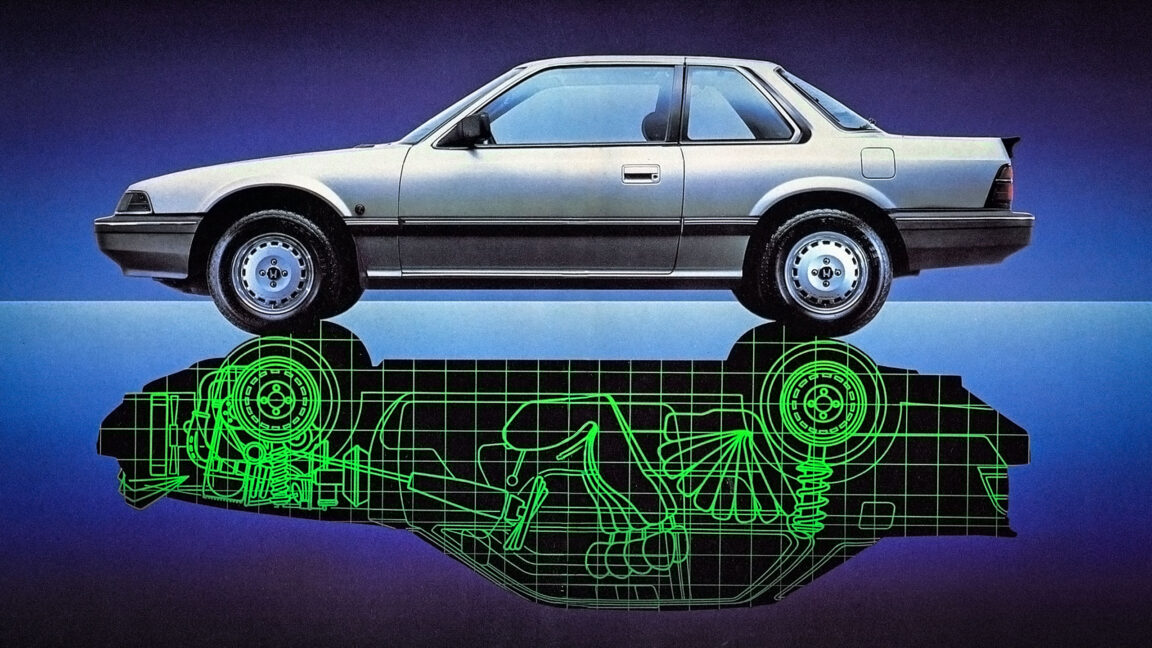
Credit: Honda
The Honda Prelude was never simply a car. It was an engineering thesis disguised as a coupe: compact, disciplined, and unapologetically technical. At its best, it distilled Honda’s faith in precision manufacturing and clever packaging into something accessible and aspirational.
Its return for 2026, after more than a quarter century away, isn’t nostalgia so much as institutional memory. The Prelude name carries expectations: balance over brute force, innovation over ornament, and a willingness to pursue mechanical elegance even when the market leans elsewhere.
And it’s worth remembering that the original Prelude emerged during a turbulent period for the industry. Constraint, not excess, shaped it, which may explain why it felt so deliberate from the start.
A time of economic turbulence
The Honda Prelude didn’t arrive during a champagne toast. It showed up in the middle of economic upheaval, when the global auto business stared nervously at its balance sheet and wondered whether the arithmetic still worked.
Honda’s first US headquarters in 1959.
Credit: Honda
The story began on August 15, 1971, when President Richard Nixon severed the dollar’s link to gold, effectively ending the Bretton Woods system that had anchored postwar commerce since 1944. By 1973, the dollar was formally devalued. Fixed exchange rates evaporate. The yen surges; Japanese exports become more expensive; corporate forecasts unravel.
Then came the oil shock. In October 1973, OPEC cut production, which sent energy prices sharply higher and injected fresh uncertainty into global demand. For Honda Motor Co., with roughly 60 percent of its sales tied to the United States, the math shifted overnight. A stronger yen squeezed margins. Higher fuel prices threatened volume, and Japan’s export machine suddenly looked exposed.
Something had to give.
At precisely this moment of instability, the company’s founders, Soichiro Honda and Takeo Fujisawa, stepped aside from the enterprise they had built from scratch. Honda was no longer a workshop operation; it employed 18,000 people and held 19.5 billion yen in capital. But scale offers no immunity; it merely increases the stakes.
Enter Kiyoshi Kawashima, then president of Honda R&D and senior managing director of Honda Motor Co. His New Honda Plan amounts to a corporate reset. Management structures would be modernized. Decision-making streamlined. And, crucially, Honda would expand globally rather than simply export into an increasingly volatile currency environment.
In a world of floating exchange rates and unpredictable oil prices, Honda chose reinvention over retreat. The Prelude would become one expression of that shift, proof that even in turmoil, discipline and design could travel.
Honda’s newest model
Honda’s American expansion started in 1959 with motorcycles. A decade later, the N600 arrived with two cylinders, modest size, and immense ambition. By 1973, as economic turbulence deepened, Honda introduced the Civic: a larger, four-cylinder, efficient, affordable hatchback perfectly calibrated for the moment. The even-larger Accord followed in 1976, positioned as Honda’s first true world car.
Both were powered by Honda’s CVCC engine, the first to meet the tough emissions standards of the 1970 US Clean Air Act without a catalytic converter. Its breakthrough was elegant engineering: a spark plug ignited a richer fuel mixture in a small prechamber, which then ignited a leaner mixture in the main cylinder, delivering cleaner combustion without costly add-ons. In an era defined by oil shocks and regulation, Honda didn’t lobby. It engineered its way forward.
And, having secured credibility with rational transport, it then did something faintly irrational. It built a sports coupe.
Launched in 1978, the first-generation Prelude was equal parts boxy and sleek; an Accord underneath, but tighter, shorter, and more intentional. Honda took the sedan’s suspension, brakes, and 1.8 L engine and fit them to a chassis with a wheelbase trimmed by 2.4 inches (60 mm). The output was modest: 72 hp (54 kW) and 94 lb-ft (127 Nm) of torque from a single-overhead-cam four-cylinder paired with a five-speed manual or a two-speed automatic (later upgraded to three), sending its power to the front wheels. Reaching 60 mph (97 km/h) took about 19 seconds, which is hardly exhilarating. And the Prelude carried a premium price despite delivering a driving experience that doesn’t justify it. Sales were meager, but Honda was just getting started.
The Prelude comes into its own
It isn’t until 1983 that Honda finally reimagined the Prelude as something more than a truncated Accord. It was a turning point that suggested the company was ready to treat the model not as a derivative, but as a distinct ambition. Now rated at 100 hp (75 kW), the car arrived wrapped in a sharp, wedge-shaped silhouette, proving to be a deliberate break from the excess it replaced, while its pop-up headlights became an essential element of its design. It was cleaner, more contemporary, and unmistakably forward-looking. More importantly, it laid the groundwork for what came next: the 1985 Prelude Si.
With a larger fuel-injected 2.0 L four-cylinder engine producing 110 hp (82 kW) and 114 lb-ft (155 Nm) of torque, the Si pushed the Prelude into more serious territory, trimming the 0–60 mph sprint into the nine-second range, a meaningful benchmark in the mid-1980s sport-compact calculus.
When the third-generation Prelude debuted for 1988, the styling suggested evolution rather than revolution, as it wore a carefully refined silhouette. But beneath the cautious redesigns, Honda was preparing a far more consequential statement.
This generation cemented the Prelude’s reputation as a technological outlier. It became the first car sold in the United States to offer four-wheel steering, an audacious bit of engineering that sounds exotic but functions with pure mechanical simplicity. At low speeds, the rear wheels turned in the opposite direction to the front wheels to tighten the car’s rotation; at higher speeds, they turned in the same direction, enhancing stability.
The power came from a single-overhead-cam 2.0 L four-cylinder that produced 109 hp (81 kW) and 111 lb-ft (150 Nm) of torque, and was paired with either a four-speed automatic or a five-speed manual. For drivers who sought something sharper, the Si’s 2.0 L dual-overhead-cam variant delivered 135 hp (101 kW) and 127 lb-ft (172 Nm) of torque, a figure that rose to 140 hp (104 kW) by 1990, reinforcing the Prelude’s gradual transformation from stylish coupe to legitimate sport compact contender, as the Honda Prelude Si 4WS became the Prelude’s flagship trim.
Continuing a proud tradition
Yet even the most devoted Prelude loyalist can tire of a familiar refrain. And so, when the fourth generation arrived in 1992, Honda didn’t abandon the long nose, short deck proportions. Instead, Honda reinterpreted it. The sharp creases and pop-up headlights were gone, replaced by fixed lighting and softer, almost liquefied sheet metal, as if the car had been left in the sun and allowed to melt into a more aerodynamic future. The more consequential shift came a year later.
Straight lines and pop up headlights were gone for gen 3, replaced by smooth curves.
Credit: Honda
In 1993, Honda introduced the Prelude VTEC, shorthand for Variable Valve Timing and Lift Electronic Control, a name that would soon enter the enthusiast lexicon. While the 1980 Alfa Romeo Spider 2000 was the first to offer variable-valve timing in the US market, Honda’s system went a step further. At higher revs, a more aggressive profile holds the valves open longer and wider to extract greater performance, while at lower rpm, the valves open more conservatively, prioritizing efficiency. Today, variable-valve timing is common across the industry. At the time, it felt revelatory, effectively delivering two engine personalities within a single powerplant. Following the audacity of four-wheel steering, VTEC further polished the Prelude’s identity as Honda’s rolling laboratory, a coupe that previewed the engineering future.
The base S model carried a 135 hp single-overhead-cam four-cylinder, very much in keeping with Honda’s disciplined approach. With the Si or SE, buyers were rewarded with a 2.3 L four-cylinder producing 160 hp (120 kW), giving the Prelude a sharper edge without sacrificing its daily civility. But the headline act was the VTEC model, the range-topping product of Honda’s engineering confidence. Its 2.2 L dual-overhead-cam four-cylinder delivered 190 hp (142 kW), a figure that placed the Prelude in sport-compact territory. It was the fullest realization of the car’s dual personality: civil at low revs, urgent when pushed.
Offered through 1996, this generation also marked the end of an experiment. Four-wheel steering, once the Prelude’s technological calling card, unceremoniously disappeared. It’s an omen of what is to come.
A final shot over the bow
When the fifth-generation Prelude arrived for 1997, its styling felt like a compromise between eras, a return to Honda’s earlier angular discipline, slightly softened to align with late-1990s tastes. It looked modern but cautious. And beneath the sheet metal, something had changed.
A 1998 Honda Prelude Type SH.
Credit: Honda
For the first time in years, the Prelude’s ambitions narrowed. There was a single engine: a 195 hp (145 kW) 2.2 L four-cylinder, paired with a five-speed manual or a four-speed automatic. The menu was simplified, perhaps strategically.
Four-wheel steering was gone. In its place came Type SH, fitted with Honda’s Active Torque Transfer System, or ATTS. It consisted of electromechanical clutches designed to send additional torque to the outside front wheel during a turn to sharpen turn-in and approach the balance of rear-wheel drive. Today, we call it torque vectoring. Then, it’s a costly, heavy experiment that proved too clever for its own good. Few buyers opted in. And so, the Prelude faded away.
In June 2001, after selling 826,082 Preludes in the United States, Honda ended production. The car peaked in 1986, when 79,841 examples found buyers. After that, demand slipped steadily, squeezed by competition from within, particularly the Accord Coupe, Civic Coupe, and Acura Integra, and by a market pivoting decisively toward sport-utility vehicles. By the first five months of 2001, just 3,500 Preludes were sold. The car that once served as Honda’s technological calling card exited quietly. It was less a failure than a casualty of shifting appetites, as its innovations were absorbed into the mainstream that it helped shape.
The Prelude’s second chance
And now, roughly 25 years later, Honda has revived the Prelude, less a sentimental callback than a calculated move in an auto industry that no longer resembles the one the Prelude left behind.
The auto industry, once defined by horsepower, styling cycles, and incremental engineering gains, is now shaped by software, batteries, and geopolitics. Tesla forced incumbents to think like tech companies. China emerged not just as a market, but as a manufacturing and innovation superpower. And governments, through emissions rules and subsidies, have become de facto product planners, pushing automakers toward electrification whether they are ready or not.
At the same time, the economics of making cars have grown more unforgiving. Development costs have soared. Margins are thinner. Scale matters more. Against this backdrop, reviving a legacy nameplate is no longer just a branding exercise. It’s a test of whether nostalgia can coexist with an industry that now runs on code, capital, and political risk. This explains the 2026 Honda Prelude.
Economics, not just nostalgia, fuel its return
With its in-house rivals long gone—the Accord Coupe was discontinued in 2017, and the Civic Coupe followed three years later—the Prelude returned first as a 2023 concept and now as a production car. In other words, Honda is reentering a segment it largely abandoned, now that the competitive clutter inside its own showroom has been cleared.
Underneath, the revival reflects a broader industry playbook: minimize investment while maximizing brand leverage. The Prelude rides on a shortened Civic platform, uses a Civic Hybrid drivetrain, and borrows suspension hardware from the Civic Type R. Honda has reengineered and retuned the components, but the strategy is clear: contain development costs, preserve margins, and spread R&D across as many units as possible.
The reborn Prelude.
Credit: Honda
Honda eliminated the previous Prelude after selling roughly 3,500 units. The new goal of 4,000 units annually suggests management is not betting on a coupe revival but that it’s testing the waters. In a US market dominated by high-margin SUVs and pickup trucks, the Prelude functions more like a brand halo with guardrails: a way to test whether nostalgia can deliver incremental profit without jeopardizing capital. In that sense, the car is less a throwback and more a case study in how legacy automakers now balance emotion with spreadsheets.
In that regard, the 2026 Honda Prelude continues to predict the future.

-
 C114 Communication Network
 -
 Communication Home
