
 Search

Credit: Subaru
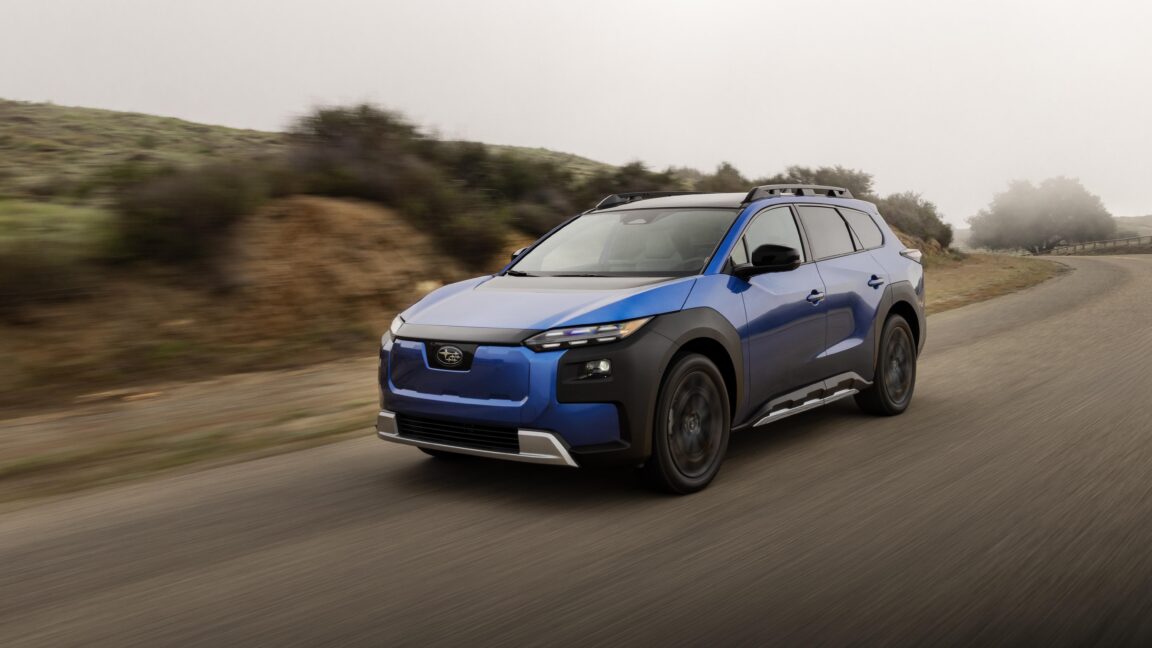
A new pair of EV siblings joins the Subaru lineup this year, each using a shared skateboard chassis developed in partnership with Toyota. Compared to the original Solterra and smaller Uncharted, the new Trailseeker bears more Subaru DNA despite riding on the same electric platform. And unlike the Solterra and Uncharted, the Trailseeker will be built for the American market alongside the Forester at the company’s Lafayette, Indiana, assembly line.
Styling alone helps the Trailseeker look the most Subaru-ish of the expanding electric lineup, with plenty of the plastic cladding you’d find in the Forester and Crosstrek. An optional two-tone paint job helps accentuate the more traditional station wagon profile, which is the most important part of the Trailseeker’s brief: providing a longer and higher rear canopy that Subaru purposefully stretched to hold a full-size dog crate.
Meanwhile, the standard dual-motor powertrain sticks with all-wheel drive only (the Uncharted has a front-wheel-drive option), and a class-leading 8.5 inches (216 mm) of ground clearance emphasizes its off-road capability. It offers 281 miles (452 km) of range out of a 74.7 kWh battery, with a starting price tag of $39,995.
The Trailseeker loses out on a few miles of range compared to the Uncharted due to the latter’s slightly more streamlined and futuristic design. The Trailseeker more closely resembles the Solterra, as the two models share everything from the nose to the C-pillar.
But Subaru managed to increase the adventurous cred by expanding the roofline without adding too much mass, resulting in a curb weight just shy of 4,400 pounds (1,995 kg). That’s about 300 pounds (136 kg) less than a Hyundai Ioniq 5 XRT, for example, which manages to get 259 miles (416 km) of range out of an 84 kWh battery. It’s almost 1,000 pounds (453 kg) lighter than a Honda Prologue AWD Touring, which has an EPA-estimated range of 294 miles (473 km) from an 85 kWh battery.
The electric Subaru and Toyota siblings give up some performance at the charging station, though, as the Trailseeker can only accept 150 kW of electrons. Subaru claims the area under the curve matters more and that battery preconditioning allows the Trailseeker to hold a higher charge rate for longer than the competition. (At the media drive program held in Southern California, the claimed 10–80 percent charge time of 28 minutes never came into play.)
Instead, Subaru built a small off-road course to test the Trailseekers alongside a fleet of Uncharteds, and the Trailseeker seemed more at home there than on the smaller urban runabout. The additional fractions of an inch of ground clearance may have mattered less than the more responsive all-wheel-drive system, which Subaru tuned independently of the rest of its chassis-mates to account for accelerator pedal inputs, steering angle, front-to-rear and left-right torque vectoring, and variable regen.
As rain fell on small, steep, and slippery obstacles, the Trailseeker appeared to need less time to deliver power, spinning the all-season Bridgestone tires less frequently despite a few hundred extra pounds of mass compared to the Uncharted. Activating X-Mode via the familiar center console switchgear enabled slightly more aggressive driving, though the tuning clearly prioritizes competency over all-out rally car shenanigans.
On the road, the dual motors’ peak 375 hp (280 kW) rating will likely matter more than any true off-roading ability. This Trailseeker might be the quickest Subaru ever, not just based on a 0–60 time of 4.4 seconds but also because of its responsiveness to any slight press of the accelerator pedal.
Winding roads revealed slightly more body roll than we saw in the Uncharted, despite both models feeling significantly lighter than the average electric crossover. Easy steering effort helps enhance a sense of nimbleness despite the added cargo volume in the back, though no true Subie fans will ever mistake a Trailseeker for an STI.
Instead, the comparisons to various Toyota models seemed almost unavoidable. The center touchscreen, minimalist gauge cluster sitting forward on the dash, dual smartphone charging pads, and gear selector knob all contrast with the rest of Subaru’s internal combustion and hybrid lineup. But of the EVs, the Trailseeker clearly embodies the Subaru ethos best—even if the name itself suffers from a bit of Baja Fresh syndrome. If you have to tell me the food is fresh…
Simply put, a max range estimate of 281 miles leaves anyone trying to get off the beaten path at the mercy of charging infrastructure. Any serious adventure will require plenty of planning. The standard NACS port, which allows access to all those Tesla Superchargers, should help assuage some range anxiety, but the idea of truly leaving the world behind in this EV seems somewhat unlikely.
The Trailseeker also comes in Stormtrooper spec.
Credit: Subaru
Instead of seeking out off-road trails, this EV seems best suited to parking at trailheads or paved campsites and then serving as a basecamp. You can pack up the trunk with gear, or better yet, load up the roof rails, a must-have for many Subaru owners. An optional plug in the trunk provides 1,500 W of vehicle-to-load output, and a “My Room” mode lets occupants stay in the car for extended periods with the power on while camping or charging.
At the very least, the Trailseeker can handle that level of escapism with a calm capability. Will the additional cargo capacity and power bump make up for the slightly higher price over an Uncharted? Subaru customers seem likely to accept that trade-off.

-
 C114 Communication Network
 -
 Communication Home
