
 Search

Credit: Smith Collection/Gado/Getty Images
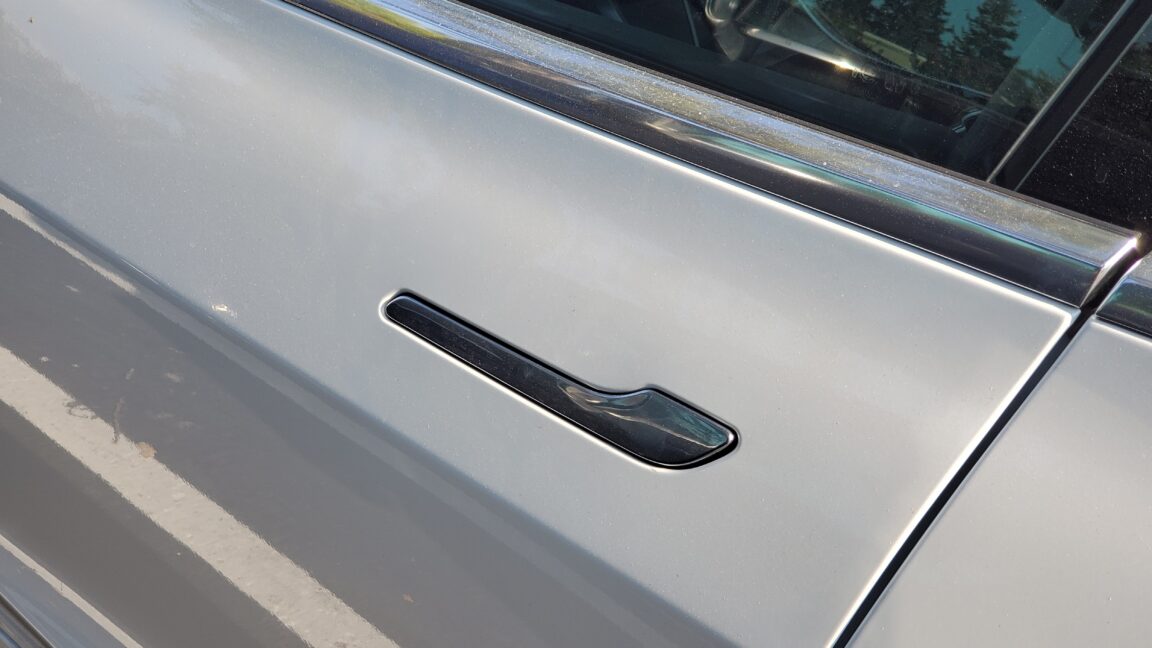
Flush door handles have been quite the automotive design trend of late. Stylists like them because they don’t add visual noise to the side of a car. And aerodynamicists like them because they make a vehicle more slippery through the air. When Tesla designed its Model S, it needed a car that was both desirable and as efficient as possible, so flush door handles were a no-brainer. Since then, as electric vehicles have proliferated, so too have flush door handles. But as of next year, China says no.
Just like pop-up headlights, despite the aesthetic and aerodynamic advantages, there are safety downsides. Tesla’s handles are an extreme example: In the event of a crash and a loss of 12 V power, there is no way for first responders to open the door from the outside, which has resulted in at least 15 deaths.
Those deaths prompted the National Highway Traffic Safety Administration to open an investigation last year, but China is being a little more proactive. It has been looking at whether retractable car door handles are safe since mid-2024, according to Bloomberg, and has concluded that no, they are not.
Here’s how you’re going to do it
The new Chinese regulations are incredibly specific. For all new models introduced after January 1, 2027, there must be a recessed space that’s at least 2.4 inches (6 cm) wide, 0.8 inches (2 cm) tall, and 1 inch (25 mm) deep for a hand to operate the handle, which can be semi-flush or simply a traditional door handle that we all know how to use.
The locking mechanism must be designed so that, in a crash that results in airbags deploying or a battery fire, doors on the non-impact side can be opened without tools. Chinese regulators are just as concerned that a vehicle’s occupants don’t get confused about how to open a door from the inside in an emergency. So each door must have mechanical releases where an occupant would expect to find them.
Again, Tesla is probably the worst offender—its front doors have always had mechanical handles, but for some model years, the rears could not be opened without tools.
For cars already approved by the Chinese government (which includes everything currently on sale), there’s a grace period. For existing designs, automakers have until January 1, 2029, to redesign their doors, and due to the specificity of the rules, that group of automakers is much larger than just Tesla. Xiaomi, which seems to be China’s most-hyped EV brand, will have to redesign some models, but BMW will, too—the rather good iX3 that will go on sale there soon will also need a redesign. The same goes for cars from Nio, Li Auto, and Xpeng.
And unless there are exemptions for low volume, I would imagine that most supercars from OEMs like Ferrari and McLaren will need new doors for the all-important Chinese market. Indeed, given China’s importance to the car industry, we should expect this ban’s impact to be widely felt on any model sold globally. The benefit should be clear: fewer car occupants dying after being trapped in their cars.

-
 C114 Communication Network
 -
 Communication Home
