
 Search

The Tesla Model S is at the end of its illustrious 14-year run — and what a dizzying ride it’s been.
In 2012, when Tesla made its first Model S deliveries to customers, Facebook acquired Instagram. Apple launched the iPhone 5 and iOS 6. Barack Obama sailed into his second term. Superstorm Sandy shredded New York City and highlighted the ominous threat of climate change. As the nation recovered from the 2008 financial crisis, cautious optimism flowed through the airwaves as medium-sized tech companies seemed positioned to solve the world’s most challenging problems. Early adopters were whimsical pioneers racing faster to the future, breaking things and iterating for good. So was the mood when the Model S came to market and quickly made Tesla the world’s most interesting car company.
The Roadster, first introduced in 2008, was an irreverent spinoff of a Lotus sports car. Tesla unveiled the Model S the following year, but by 2012 automotive analysts doubted its viability. Making and manufacturing a production car at scale was a daunting task, and the swirl of borrowed cash Tesla burned was dizzying. The industry had seen startup car companies come and go. The odds were stacked against the California startup.
That June, Tesla hosted a launch event at its Fremont, California, factory and hyped up its first customer deliveries under the guise of an investor relations meeting. The buzz was palpable. “In 20 years more than half of new cars manufactured will be fully electric,” Elon Musk said to journalists in attendance. “I feel actually quite safe in that bet. That’s a bet I will put money on.” Even if the predictions didn’t come to fruition, the characteristic bluster and fortitude was on full display — thrusting the Model S into the zeitgeist.
Automakers everywhere winced as Model S became the vehicle en vogue. Car dealers revolted as Tesla bypassed franchises and sold directly to consumers. The market for luxury EVs and the strategy to make a high-priced super car caught the European luxury automakers on the back foot. While the original Model S base price was $49,900 — including the $7,500 federal tax credit — movers, shakers, and the Tesla faithful forked over six figures for a fully loaded version and the lifestyle and vision it promised. Here was a gauzy view of the future: clean, green, and chic under the direction of chief designer Franz von Holzhausen. An ArtCenter transportation design graduate, von Holzhausen left a solid leadership role at Mazda to go all in on the digitized future. The Model S interior wiped away expensive gauges, buttons, and knobs in favor of the ubiquitous screen that came to dominate almost all modern cars.
“It was the first software-defined vehicle,” Paul Snyder, chair of the College for Creative Studies Transportation Design program, tells me. “One of the biggest shockwaves was the revenue that could be generated after the sale of the vehicle.”
Desirable design
It wasn’t just a high-priced EV, but the most creative, clever, and desirable car the industry had seen in decades.
For the exterior, Tesla took design cues from classic 1970s wedge designs, like that of the Bertone X1/9 and Triumph TR7, that tapered off on the front end. The design team came up with innovative ways to work with the form of a car that didn’t require a traditional grille. “That execution of the front end without a need for a grille was very influential,” Snyder says.
The design resonated as automakers scrambled to catch up to the Model S craze. “They were very clean and they had great proportions,” Snyder says. “The Model S is pretty wide relative to its length and height, which gave it a great stance. One quote I read from Franz was they were allowed to go into the vehicle with no constraints. All of these things together added to a wake-up call. They made an electric vehicle look very attractive. People were buying them in droves.”
By November 2012, the Model S earned accolades as the MotorTrend Car of the Year. “It was a unanimous pick for car of the year and the first electric car,” Ed Loh, who was editor-in-chief at MotorTrend, tells me. Loh presented the award to Musk, who hoisted it over his shoulders. “It introduced over-the-air updates for features that were far out in its lifespan, and other features that were unexpected, like Easter eggs. It delivered on an idea of a car that gets better over time, using the same chassis. It had hips and a fast windshield and was genius in the simplicity of its design. The Plaid put all super cars on notice.”
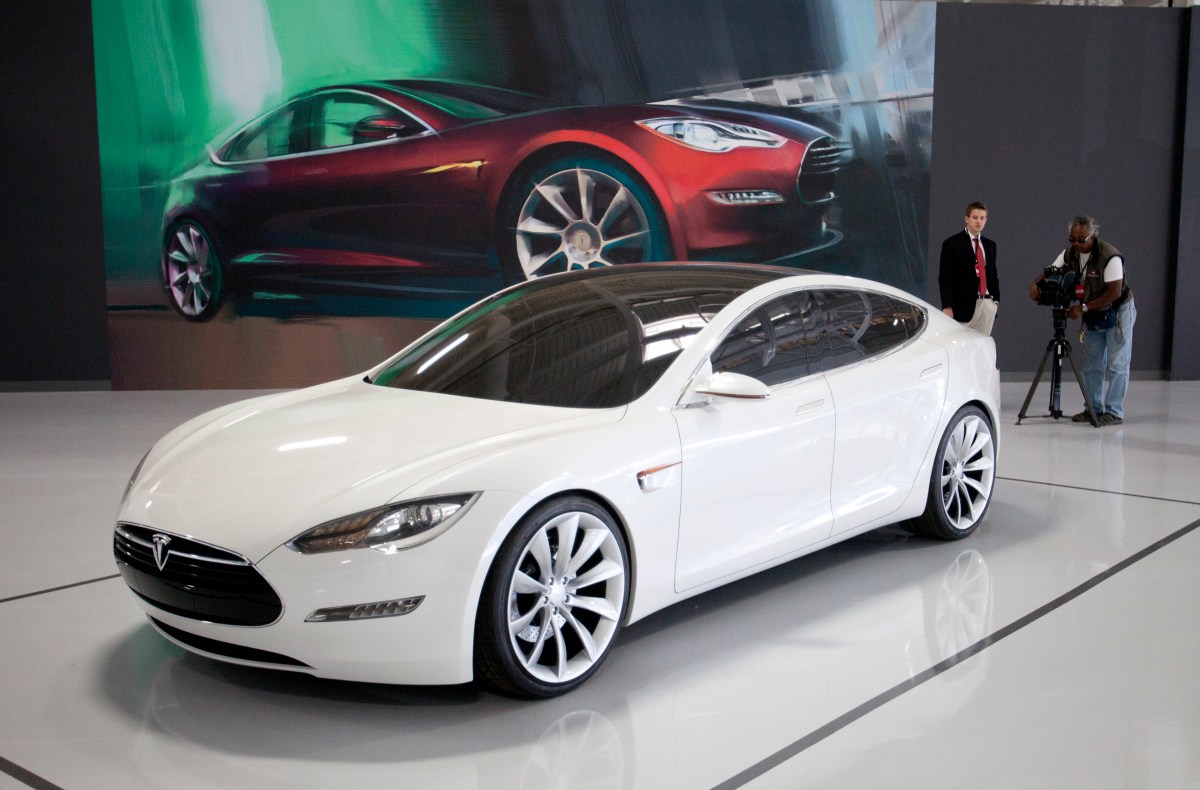
The Verge was early on Tesla. Chris Ziegler drove it in Fremont in 2013: “The Model S isn’t perfect. Far from it — and I think that Elon Musk would be the first to admit it,” he wrote. “But for a company only ten years old to produce an automobile good enough to convince a Detroit native that this might be the future of transportation? Well, that’s pretty amazing.”
Like Chris, I’m a Detroit native who grew up surrounded by engineers. I shared some of his trepidation, but was equally charmed when I reviewed the Model S in 2017. I drove the dream car version, the P100D priced at $165,000 that predated its current top-of-the line Plaid. In five years, Tesla smoothed out many of the car’s quirks. The Supercharger network gave Tesla the infrastructure it needed to make a Highway 101 road trip pleasant, so when I drove it from Fremont to Monterey, range wasn’t even a factor. It was equipped with second-generation Autopilot, a reminder of just how long the elusive self-driving future has been a topic of conversation.
The Model S was the car that made environmentalism luxurious, progressive, and cool and launched demand for EVs worldwide. “They were all over California,” Snyder says. “The association with doing something positive for the environment set a standard that scared the bejesus out of everyone in the business.”
It showed up in rap lyrics as a metaphor for futurism and rule breaking. Jaden Smith and 2Chainz wrote a half dozen tracks about Teslas. “I just drove the Tesla with both eyes closed,” raps 2Chainz on the 2017 Gucci Mane track “Both Eyes Closed.” A Tesla reference was tongue-in-cheek, and a little bit naughty.
Where Tesla has kept its edge is its software. We gave it high marks for its game-changing digital capabilities on our 2023 podcast The Tesla Shock Wave. Almost three years later, Tesla has the least friction in its software. And at the top of the heap, the Model S Plaid’s performance is nothing to sneeze at. A decade ago a production car that zoomed from 0 to 60mph in about two seconds would have seemed bonkers. The Model S made electric cars fun to drive fast.
The Model S ultimately laid the groundwork for what was in the pipeline, leading to the Model X (also soon to be discontinued), the Model 3, and eventually the Model Y, the global bestseller and Tesla’s arrival as a serious car company. If you couldn’t afford a Model S, the 3 was the next best thing. You didn’t even have to like cars to like Tesla. Whenever I mentioned my job as a car journalist, all anyone wanted to talk about was Tesla.
The fall of the Model S
In the years since I reviewed the Model S, Tesla has drifted away from its luxury core. It’s arguable that the competition has caught up. Rivian outsells the Model S in the premium category. Porsche, Lucid, and Rolls-Royce have swankier materials in their products.
As the Model S goes, so does the Model X SUV. The Model X was more polarizing, best known for those cool but clunky gullwing doors. Tesla last gave both the Model S and Model X a light touch-up last summer. In its update to the S, Tesla tweaked air intakes and wheels and brushed up its camera tech. These are the kinds of changes expected of a regular car company to zhuzh up an aging model, not the bold, beating heart of innovation.
As Tesla products wither, Musk seems to have lost interest in cars. When he announced the end of the Model S, he said it was because Tesla is becoming a robotics and AI company. Selling people on his vision will be an uphill battle when study after study shows that Americans are not interested in giving up the steering wheel for robotaxis. And Musk himself isn’t well positioned to convince the masses that Tesla is best suited to lead us into a better transportation system — or anything after his disastrous handling of DOGE and the recent controversies surrounding his AI bot Grok. His erratic, mystifying, and hateful behavior that caused many of his core customers to ditch their Teslas isn’t doing much for the company,
Remember Musk’s 2012 prediction, when he said half of all cars would be electrified in 20 years? Last year, Edmunds reported that of the roughly 292.3 million cars on the road in 2024, 1.4 percent of those were electric vehicles. After the elimination of the federal tax subsidy by the current federal government, which Musk worked with, that number doesn’t look primed to leap up in the near term. The EV industry will slog along buoyed by billions of dollars of investment and the competition in China. Change is happening, but at a slower, steadier drumbeat than Musk and other automotive CEOs hyped it up to be over the past decade.
What Tesla contributed over a decade ago through the Model S was to inject a desire for change into the auto industry. Snyder said he has seen Tesla’s impact on the transportation design program, with aspiring designers joining the program who were interested in mobility and not only traditional gasoline-powered sports cars.
“It’s impossible to not acknowledge its impact on the students,” he says. These students make up the next generation of transportation designers, responsible for bringing the next wave of EVs to market, albeit for other car companies.
Even if it won’t be the car to take us there, the Model S made its most important point long ago — that alternative vehicles could inspire change. In the same way the original iPhone transformed how we communicate, the Model S changed how we perceive the road ahead. The Model S made Tesla the most influential car company of the 21st century — so far.

-
 C114 Communication Network
 -
 Communication Home
