
 Search

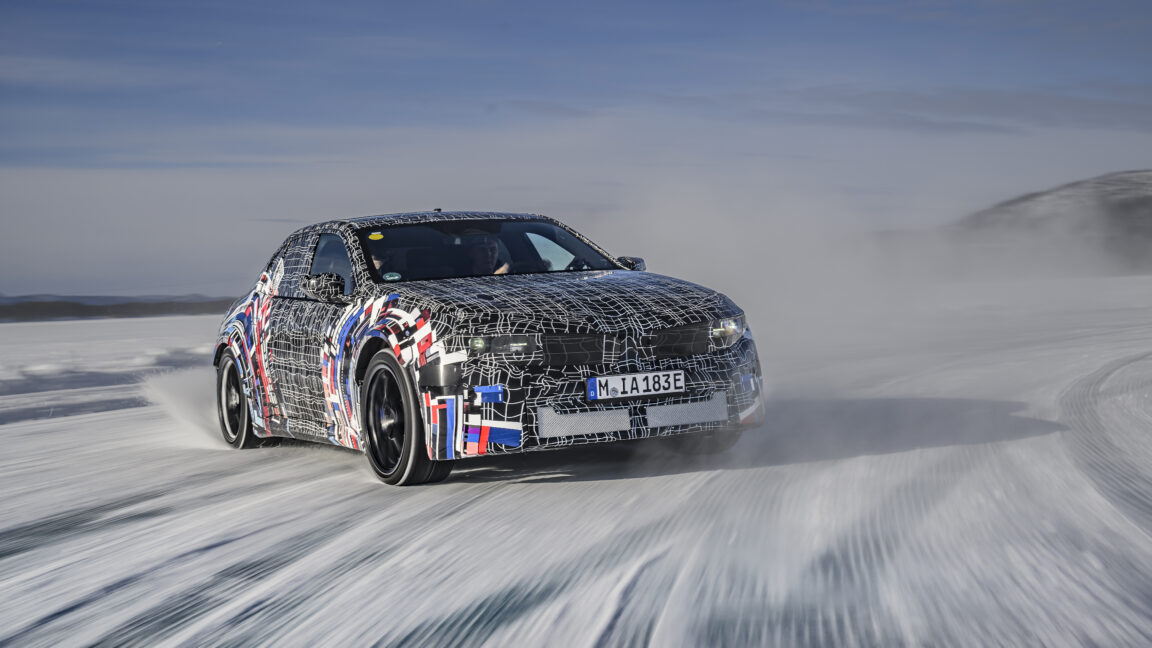
Credit: BMW
Late last year, we drove BMW’s new iX3. It’s the first of a series of electric BMWs to use a newly developed platform, known as the “Neue Klasse.” Later this year, we’ll see the first fully electric version of the 3 Series when the i3 sedan debuts. And next year, BMW enthusiasts will finally find out what the brand’s M division—which infuses motorsport into the vehicles like few others—can do with an EV.
There have been M-tuned EVs before now, more powerful variants of the i4, iX, and i7. And each time we’ve driven them, BMW has been at pains to point out that these weren’t true M cars, not like the M3 or M5. Honestly, they weren’t better than the cheaper, less powerful versions, something that won’t be allowed for next year’s performance EV, which might be called something like the iM3, assuming the naming convention remains logic-based.
“The next generation of models are set to establish a new benchmark in the high-performance vehicle segment,” says Franciscus van Meel, managing director of BMW M GmbH. “With the latest generation of Neue Klasse technology, we are taking the BMW M driving experience to a new level and will inspire our customers with outstanding, racetrack-ready driving dynamics for everyday use.”
Will it be the iM3? For now, BMW is calling this the M Neue Klasse.
Credit: BMW
Technology is the key to distinguishing the M EV from its more sedate siblings. The Neue Klasse platform hews to the software-defined vehicle trend, where a handful of powerful computers each control a wide array of functions, rather than dozens or hundreds of discrete electronic control units in black boxes each doing a single job. One computer handles infotainment, and another deals with automated driving and active safety systems. A third handles the relatively mundane but no less important job of climate control, plus the seats and doors and windows.
However, the important one here is called the Heart of Joy, which runs M-specific software, called BMW M Dynamic Performance Control. This offers an order of magnitude faster response in terms of the car’s electronic dynamic control compared to current M models, which is put to good use controlling the four electric motors that will propel the electric M.
BMW M has made M-specific front and rear drive units, each with a motor for each wheel arranged in parallel, with a gearbox on each side. On top of each drive unit are the power electronics that control it all. BMW was a little cagey with details when it briefed us on the electric M powertrain in Spain last November and wouldn’t elaborate on what kind of electric motor it’s using in the M drive units, but we suspect they’re permanent synchronous motors.
There’s also an M-specific high-voltage battery. Expect at least 100 kWh; the stock pack has 108.7 kWh net, but the cylindrical cells have been optimized for power delivery, and there’s new two-sided cooling and even a different cell layout within the pack. The cells look the same, according to Philip Guerrero, project lead for high-voltage batteries at BMW, but they have lower internal resistance and increased power density, despite using the same cell chemistry.
A performance EV with lightning-fast but precise control of each wheel does indeed sound tantalizing, and BMW told us it’s aiming at a new benchmark in driving dynamics on track as well as on the road. And it’s taking a page out of Hyundai’s book with the addition of a simulated gearshift mode. As we’ve seen in the Ioniq 5 N, using steering wheel paddles to alter the pedal mapping for lift-off regenerative braking and the throttle goes a long way to adding some engagement to a performance EV by replicating a transmission, especially if you implement it in a way that even lets you bounce off a “rev limiter” for more fidelity. For the people who think that sounds like no fun, take heart in the fact that as always, you can just choose not to turn that function on.
As we’ve noted in the past, the Neue Klasse is BMW’s most sustainable platform ever, and that, too, carries through to the M Neue Klasse. Instead of carbon fiber, it’s switching to a natural fiber alternative called Bcomp that emits 40 percent less carbon dioxide during the production process, while still offering a great strength-to-weight ratio.

-
 C114 Communication Network
 -
 Communication Home
