
 Search

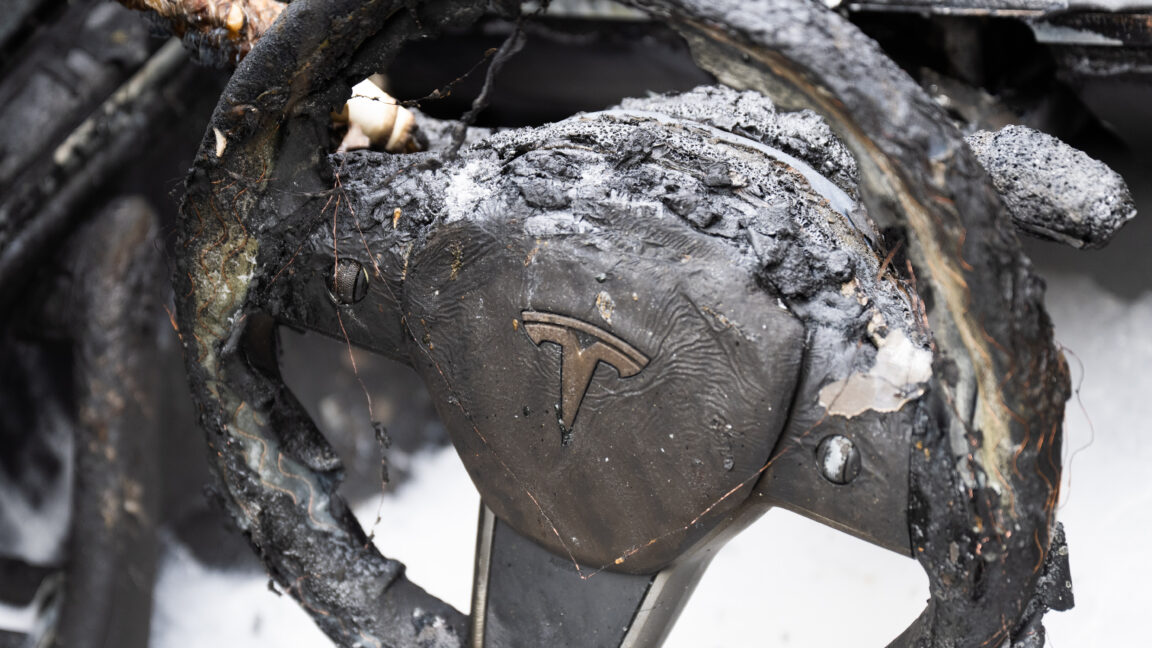
Credit: Christophe Gateau/picture alliance via Getty Images
Tesla published its final production and delivery numbers this morning, and they make for brutal reading. Sales were down almost 16 percent during the final three months of last year, meaning the company sold 77,343 fewer electric vehicles than it did during the same period in 2024.
For the entire year, the decline looks slightly better with a drop of 8.6 percent year on year. That means Tesla sold 1,636,129 cars in 2025, 153,097 fewer than it managed in 2024. Which in turn is more than it managed to shift in 2023.
Sales issues
Contributing factors to the poor sales are legion. The brand still relies on the Models 3 and Y to an overwhelming extent, and other than a mild cosmetic refresh, neither feels fresh or modern compared with competitors from Europe and Asia.
And Musk’s much-hyped Cybertruck—which was supposed to cost less than $40,000 and go into production in 2021, lest anyone forget—has been a disaster to eclipse the Edsel. Its failure has taken down another company initiative, Tesla’s “in-house battery cell.” It was initially designed specifically for the Cybertruck, although the CEO later claimed would be used for static storage as well as EVs. But apparently it has become the victim of a lack of demand. Last week, Electrek reported that Tesla’s South Korean battery material supplier L&F wrote down its $2.9 billion contract with Tesla to just $7,386. A drop of more than 99 percent.
The company’s owner has not dialed back his embrace of the far right, cratering sales in markets like California and Europe, where EV buyers often use their consciences to guide their wallets.
Safety issues
And the cars are getting a bad reputation. According to extensive reporting by Bloomberg’s Dana Hull, at least 15 people have burned to death in Teslas when the doors became inoperable after a crash, half of which occurred since late 2024. The National Highway Traffic Safety Administration opened an investigation into the topic earlier in 2025. China’s regulators have also taken particular issues with Tesla’s door handle design, which does not fail in a way that allows it to be opened in an emergency; from January 1st 2027, that design will be banned.
More bad publicity followed when some of the victims of Tesla crashes—which far outnumber those killed in Ford Pinto fires—won a $329 million judgement in a wrongful death lawsuit in August.
A robotaxi pilot program in Austin is notable mostly for the number of times the cars have crashed into things. A purported robotaxi pilot in San Francisco turned out to be nothing more than a conventional ride-hailing service—one that only uses Teslas—with a human driver behind the wheel. Who might be asleep.
Were Tesla any other car company, one would expect heads would be rolling. You’d also expect talk of a range of exciting new products to tempt customers back into the showrooms. Instead, Musk has fixated on AI, spending billions of Tesla’s resources with no benefit to the profit and loss sheet.
The terrible sales are no mystery, overall. What does remain a mystery is how the company’s stock manages to retain its value. At the time of writing, a share of Tesla still costs more than $440, giving it a market cap of $1.4 trillion.

-
 C114 Communication Network
 -
 Communication Home
