
 Search

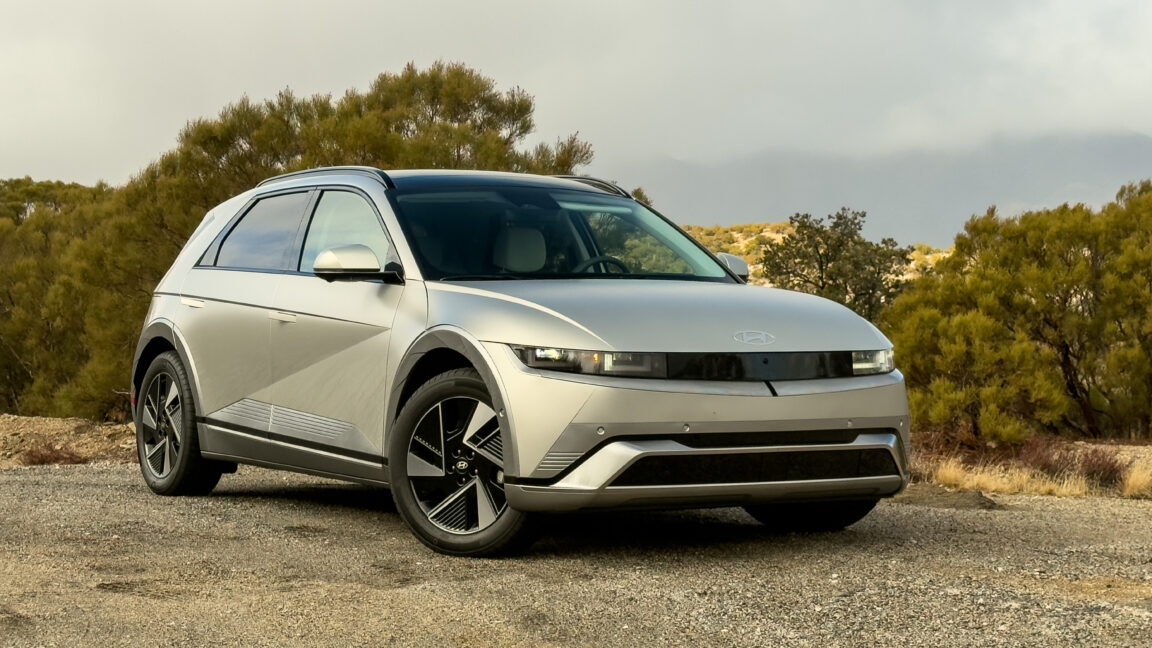
Credit: Jonathan Gitlin
PALM SPRINGS, Calif.—Can it really have been four(ish) years since we first drove the Hyundai Ioniq 5? With looks like a scaled-up hatchback from the 1980s, and one of the most advanced electric vehicle powertrains on the market, the Ioniq 5 was an instant hit with Ars and car buyers. Since then, Hyundai has begun building Ioniq 5s at its new plant in Georgia, and for model year 2025, it has made some tweaks that have turned a great EV into an even better one.
The Ioniq 5 was the first EV to use Hyundai's new E-GMP platform, designed for mid-to-large EVs with rear- or all-wheel drive. The powertrain uses an 800 V architecture, which endows it with a number of advantages, some obvious, like very fast DC fast charging, some less obvious, such as less mass (and expense) given over to high-voltage cabling. On the road, it proved highly efficient, not to mention stylish and practical.
The tweaks for model year 2025 are subtle as far as midlife upgrades go. There's a new wheel design, and some of the details at the front and rear bumper are more pronounced. The idea was to "accentuate the CUVness" of the car, according to Brad Arnold, head of exterior design at Hyundai Design—perhaps broadening the appeal to those who have no affection for late '80s hatchback vibes.
New batteries, more range
The new Ioniq 5 features a pair of new battery packs. The $42,500 SE standard range Ioniq 5 gets a bump from 58 kWh to 63 kWh, which gives it a range of 245 miles (394 km), up from 220 miles (354 km). All other versions now use an 84 kWh pack, up from 77.4 kWh in last year's model. For the most range, you'll want a rear-wheel-drive Ioniq 5 with this battery—318 miles (511 km) in either SE ($46,550), SEL ($49,500), or Limited ($54,200) trim.
For the all-wheel-drive SE ($50,500) and SEL ($53,000) trims—probably the ones most people will buy—range increases by a useful 30 miles (48 km) to 290 miles (467 km) on a full charge. The $58,100 AWD Limited gets less of a range boost and is rated at 269 miles (432 km). There's another all-wheel-drive version, the $55,400 Ioniq 5 XRT, but you can read about that one in our companion article.
Despite the larger batteries, fast charging is still very fast. With an 800 V-capable DC charger, both small and large batteries will go from 10 to 80 percent in 20 minutes. But as you'll note from the photo, this Ioniq 5 has a new party trick—the charging port is now of the NACS (J3400) style, as used by Tesla Superchargers. Using a CCS1 plug will require an adapter, which comes with the car.
Those Superchargers might be more numerous, but they aren't as capable as the 350 kW machines you might find at an Ionna or Rivian charging location, and so they're slower to use—24 minutes from 10–80 percent for the SE standard range, or 30 minutes from 10–80 percent for the larger-batteried cars. Faster charges are suposedly coming with Tesla's version 4 hardware.
We arrived at a (V3) Supercharger with a preconditioned battery at 45 percent, and the car almost immediately began charging at 126 kW, reporting 16 minutes to 80 percent and 48 minutes to 100 percent.
You can now manually precondition the battery for optimum charging, and I'm told that plug-and-charge functionality will come soon via an over-the-air software update. (Whether that applies to older CCS1 cars, too, I am not sure.) Until then, you'll need to download and use apps to initiate a charging session, including at a Tesla location.
AC charging is slower, as you might expect. Charging from 10–100 percent will take 5 hours 40 minutes for the small battery and 7 hours 20 minutes for the larger one. Hyundai is including a ChargePoint charger when you buy one (or a $400 charging credit).
A rear wiper!
There's also a new infotainment system with faster processors and more accurate GPS. We didn't encounter any bugs with it during our half-day with the car, and owners will no doubt enjoy the addition of USB-C ports (replacing USB-A) and the presence of wireless Apple CarPlay and Android Auto.
Hyundai has also fitted a rear windshield wiper—the aerodynamics over the rear window turned out not to be sufficient to keep that window clear of grime when the weather turns lousy.
Which it did during our test drive. Heavy rain in Palm Springs was tailing off as we left in the morning, although the combination of wet, diamond-cut highway surface and Michelin Primacy tires sounded almost as if the tires were slipping and losing grip. They weren't; it was just the sound being noticeable because the cabin is so quiet when cruising if you're not listening to the sound system.
The climb up Highway 74 into the San Bernardino National Forest brought another change of seasons, with conditions that went from damp and foggy to sleet, with some snow and slush on the ground. That provided a chance to switch from Sport to Snow mode, although even in the former the car never felt anything but stable and confidence-inspiring, even in low-grip situations.
In fact, it was a very pleasant couple of hours behind the wheel of the Ioniq 5 up to our coffee stop and driver change. It's not a car you want to cane at ten-tenths—that honor goes to the bonkers Ioniq 5 N we reviewed last summer. But it's enjoyable to steer down a winding road, or even to just drive to the shops.
The Korean automaker remains on a hot streak that few other OEMs in the industry have been able to rival. What was already an excellent EV is now that little bit better.

-
 C114 Communication Network
 -
 Communication Home
