
 Search

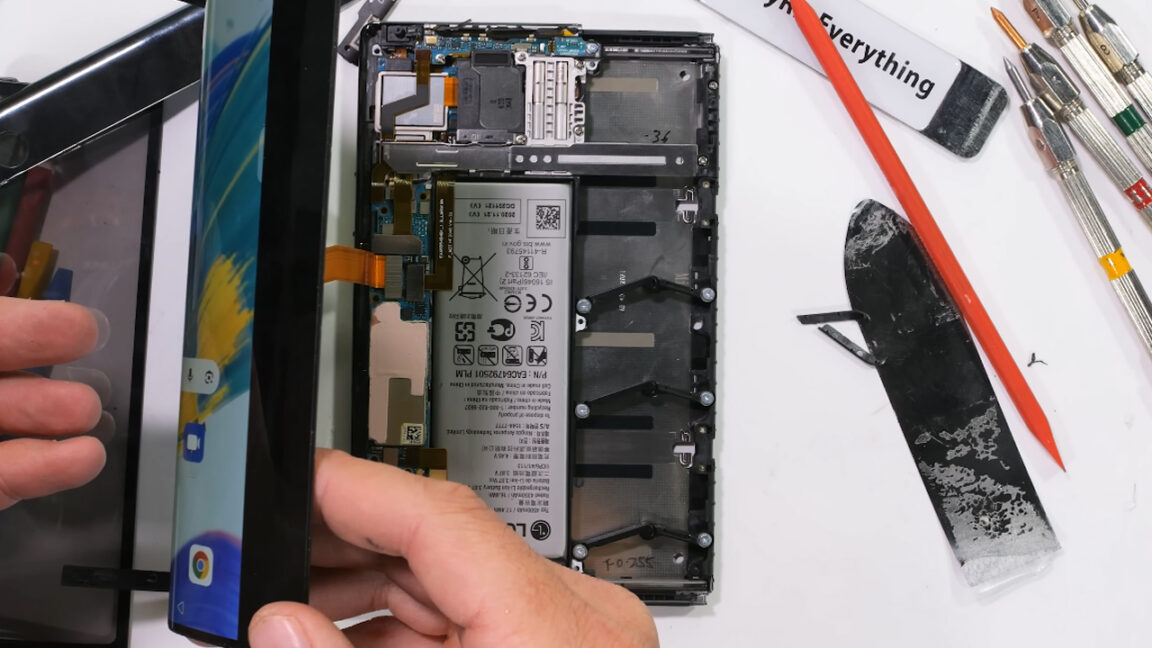
Credit: JerryRigEverything
LG was once a heavyweight in the smartphone industry, trading blows with hometown rival Samsung. However, as smartphone sales plateaued, the company struggled to stay competitive. In 2021, LG planned to make waves with a rollable phone, but it never moved beyond the teaser phase. Five years after LG threw in the towel on smartphones, the LG Rollable has appeared in a YouTube teardown that demonstrates why this form factor never took off.
The LG Rollable is just one of several rollable concept phones that appeared throughout the early 2020s. Flexible OLED screens had finally become affordable, leading to foldable phones like the Samsung Galaxy Z Fold. Although, “affordable” is relative here. Foldables were and still are very expensive devices. Based on what we can see of the complex inner workings of the LG Rollable, these devices may have commanded even higher prices.
Noted YouTube phone destroyer JerryRigEverything managed to snag a working prototype LG Rollable. It may even be the unit LG demoed at CES 2021. The device looks like a regular phone at first glance, but a quick swipe activates the motor, which unfurls additional screen real estate from around the back. This makes the viewable area about 40 percent larger without the added thickness of a foldable.
LG Rollable teardownThe device expands with the aid of two tiny motors, which are attached via straight teeth to an internal track. The screen assembly has zipper-like teeth that keep it locked into the frame as it moves. The motors make a surprising amount of noise when operating, so LG designed the phone to play a musical chime to hide the sound.
While the motor does the heavy lifting, the phone also has a lattice of articulating spring-loaded arms inside that keep the OLED panel even as the frame slides side to side. The battery and motherboard sit in a tray that allows the back of the phone to expand as the OLED rolls into view.
This is a prototype phone, featuring a chunky frame and visible screws. That helped Zack Nelson from JerryRigEverything successfully disassemble and reassemble the phone. So this little bit of mobile history was not destroyed, and the teardown gives us a good look at how LG was hoping to attract new customers before calling it quits.
LG’s last gasp
In 2020, LG’s mobile division was searching for a way to stand out. The company tried hand gestures, rotating screens, phone cases with secondary screens, and rehashing old hardware with more stylish exteriors—none of it worked. Maybe the Rollable would have stood out if it launched in 2021 as planned, but looking at how it’s built, it’s hard to see how it could have been a successful product.
There’s no doubt this piece of hardware is very cool. It’s overengineered to an impressive degree, particularly for LG. That may sound like a dig, but it’s not! This device demonstrates the kind of 2020 engineering chops we’d expect from the likes of Samsung. It doesn’t look like something designed by a company that was mere months away from killing its smartphone division.
The rollable uses two motors on a geared track to expand the frame.
Credit: JerryRigEverything
Okay, but there are problems with that kind of engineering. The complexity of the internals would have made the Rollable extremely expensive to manufacture, and it would have demanded a high price tag. Asking people to pay Galaxy Z money for an LG phone in 2021 was probably a non-starter.
Durability is also a big concern. There’s just a lot going on inside this phone, with multiple motors, springy arms, tracks, and a screen that has to loop around the back. Even unpowered hinges on foldable phones add an additional point of failure, and they do fail sometimes. It took Samsung a few tries to design a hinge that wouldn’t be defeated by dust, and a motorized phone would be even more vulnerable. It seems unlikely the LG Rollable could have survived daily use for multiple years.
As neat as this phone looks, no one ever pursued the form factor. LG wasn’t alone in demoing rollables back then. Motorola, Oppo, and others showed off similar hardware at press events and trade shows, presenting the rollable as the next evolution of foldables. Still, no one has released a rollable even as foldables continue to chug along. Were they too fragile? Too expensive? Too loud? Maybe it was a mix of all of the above, based on what we’ve now seen of the LG Rollable. Manufacturing this phone at scale would have been a major undertaking, so it’s not too surprising that LG just gave up rather than risk it.
Because LG never launched the Rollable, the Wing with its weird rotating screen went down in history as the company’s final smartphone release.

-
 C114 Communication Network
 -
 Communication Home
