
 Search

Tecno-mobile.com
When Marques Brownlee swiped upward to go home on the TECNO Next-Gen Bezelless Concept Phone during his early hands-on, his finger caught on something that, by every visual measure, should not have been there: a metal ridge rising just above the plane of the screen. That small friction point, confirmed at IFA 2026 ShowStoppers in Berlin on September 3, is the clearest evidence that TECNO has genuinely solved something — and has left one problem open for the next engineering team to close.
The concept phone eliminated what display engineers have called the "final millimeter": the 1mm to 2mm black border of inactive panel area, internal circuitry, and structural clearance that has persisted at the edge of every flagship smartphone for a decade, regardless of how aggressively manufacturers curved their glass or relocated their cameras. TECNO did not shrink that border. It hid it — through a rethinking of the basic sequence in which a display module is assembled into a chassis.
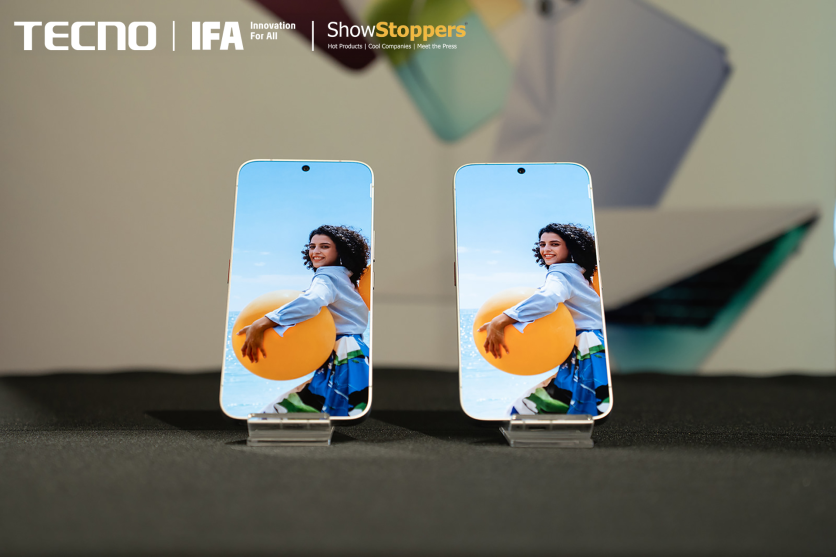
Multiple journalists given hands-on access at the ShowStoppers press session confirmed the visual effect is immediate and striking. According to Android Authority's Adamya Sharma, the result resembles a smartphone equivalent of an infinity pool — screen appearing to run directly into the metal frame without interruption. Comparison photos TECNO displayed alongside the iPhone 17 Pro show a difference in visible border that is measurable and immediately apparent to any viewer.
What the marketing materials and many early previews did not clearly flag: the effect is not an optical trick, but its mechanism creates a physical ridge. Understanding why requires understanding the three-part engineering approach.
Three Techniques Inside the Zero-Bezel Engineering
Dual Cover Glass Stack. Rather than a single piece of protective glass over the front of the device, TECNO uses two glass layers. The lower layer extends inward beneath the metal frame, sliding under the panel's inactive border area — the circuitry, safety clearances, and mounting hardware that form the black edge on every conventional smartphone. The outer glass layer sits above and conceals the entire assembly. TECNO's official engineering announcement describes this as achieving a true 0mm display border through structural re-engineering of the display architecture.
Inverted Rear Assembly. This is the structural departure from industry convention. Standard smartphone manufacturing inserts the display module from the front: the panel goes in, the frame closes over it, and whatever assembly gap remains at the edges becomes the visible bezel. TECNO reversed the direction. The display module is inserted from the rear of the chassis and pushed forward. This reversal allows the metal frame to sit fractionally above the screen surface — clamping over the top of the dual-glass stack and concealing the inactive panel edge from any straight-on viewing angle.
Front-Side Hot-Melt Bonding. A custom adhesive is applied between the extended outer glass edge and the phone's mid-frame from the front side, securing the cover glass and creating the flush visual transition between screen and metal that reviewers have praised.
The result, measured at the active pixel boundary, is zero microns of visible black border. The mechanism that achieves it, however, has a direct physical consequence.
The Raised Frame: The Trade-Off That Is Not in the Marketing
Because the metal frame sits above the screen — an architectural necessity of the inverted assembly approach — it creates a physical step at the screen edge. From straight on, this is invisible: the glass conceals it. But under use, it matters.
When Brownlee demonstrated the raised frame catch — swiping inward from the screen's edge to navigate back, or upward to go home — his finger encountered the raised metal rim. Android Authority's hands-on assessment noted that this can "quickly become irritating" for users who rely on Android's gesture navigation. A thick tempered-glass screen protector might bridge the step, but that introduces its own ergonomic trade-offs at an already-frameless edge.
The raised frame also raises questions about case compatibility. A conventional bezel provides a natural ledge for a case to grip without covering the display; the TECNO concept's raised metal rim leaves less room to protect the screen edge without overlapping the active area.
None of this diminishes what TECNO demonstrated. The raised frame is the difference between "proven at prototype scale" and "ready for production volume." It is also, notably, a different problem than the one Apple appears to be solving on its own timeline.
Apple's 2027 Route Is Architecturally Different
Apple's iPhone 20 Pro, reportedly still on track for a 2027 launch, is pursuing zero-bezel design through a different engineering strategy. Bloomberg's Mark Gurman August report confirmed that despite earlier analyst claims the all-glass design had been canceled, Apple's plans for a major iPhone 20 Pro redesign remain active — though in a revised form, with a metal structural frame carrying curved glass panels on front and back. Supply-chain reports from Korea's ET News, picked up by 9to5Mac, describe Apple's suppliers working with Samsung Display and LG Display on a "four-sided bending display technology" — a design where the glass bends around all four sides of the chassis, relocating the bezel to the device's sides rather than hiding it beneath an inverted stack. ET News Korea's supply-chain report indicates Apple's approach also includes an under-display camera, which would eliminate the punch-hole selfie cutout that still interrupts the TECNO concept's otherwise seamless front face.
Bloomberg's Mark Gurman clarified in August 2026 that an earlier Jefferies analyst report claiming Apple had abandoned the all-glass anniversary design was incorrect. The original plan — a chassis consisting primarily of two glass panels — was set aside because the configuration could not be manufactured at volume. Apple moved to a revised design using a metal structural frame with front and rear curved glass panels (internal prototypes designated V73 and V74). The zero-bezel goal appears to remain intact under the revised approach.
TECNO's method (hidden border via inverted rear insertion) and Apple's method (border relocated to sides via four-sided glass bend) both target the same viewer experience but solve it through fundamentally different architectures. The TECNO approach does not require new display panel sourcing from Samsung Display or LG Display — it is an assembly process innovation applied to existing flexible OLED panels. Apple's approach requires display-level innovation at the panel manufacturing stage.
Whether either approach is "better" depends on which trade-off is more acceptable: a raised frame at the edge (TECNO) or a visible curved seam at the sides (Apple).
What the Hands-On Spec Sheet Shows
The concept phone TECNO brought to IFA ShowStoppers is based on an existing production device, according to the company, present to prove the display concept rather than to compete on raw performance. Android Authority's hands-on spec report confirmed the specifications publicly disclosed by reviewers:
- Display: approximately 6.7 to 6.78 inches (TECNO press materials cite 6.78 inches; Android Authority's hands-on reported 6.7 inches), flexible OLED, 1.5K resolution, 144Hz refresh rate
- Processor: MediaTek Dimensity 7300e
- Battery: 6,000mAh — reviewers noted the phone is "remarkably light" given the battery size
- Software: Android 16
- Rear panel: holographic lenticular finish described as resembling butterfly wings, producing a 3D visual effect
- Front camera: punch-hole cutout (under-display camera technology not implemented)
- Side button: configurable One-Tap Button tied to TECNO's AI software platform
The lenticular rear finish drew nearly as much attention as the front face. Android Authority described the holographic effect as "arguably even more eye-catching" than the bezelless display itself.
IFA Context: TECNO's First In-Person ShowStoppers Appearance
TECNO's official IFA ShowStoppers release confirms the brand made its first-ever in-person appearance at ShowStoppers for the concept's debut, making it available for hands-on press examination at tables 501 and 503 in Hall 5.3, Berlin Messe.
The brand has used major European trade events to showcase engineering concepts regularly in recent years: a tri-fold concept (PHANTOM Ultimate G Fold) preceded IFA 2025, and an ultra-thin modular phone concept was shown at MWC 2026 in February. The bezelless concept is notable within that history because it is supported by a working mechanism — visible in multiple independent video reviews, including Brownlee's — rather than a rendered or non-functional prototype.
IFA's main consumer exhibition runs through September 8, 2026. The bezelless concept is also on display at TECNO's main IFA booth for the exhibition's duration.
TECNO's full IFA 2026 ShowStoppers lineup also included the MEGABOOK T15 360 Pro — a 15.6-inch (39.6 cm) convertible laptop with a 360-degree hinge, a 2.5K 120Hz display, an Intel Core Ultra processor with an integrated neural processing unit, and a 70Wh battery — alongside a co-branded hardware collection developed with Tonino Lamborghini.
What TECNO's China Headquarters Means for Any Future Consumer Device
TECNO is a brand of Transsion Holdings, headquartered in Shenzhen, China and listed on Shanghai's STAR Market. As a Chinese company, Transsion is subject to a set of legal obligations that apply regardless of where its devices are sold, where its servers are located, or what its privacy policy states.
China's National Intelligence Law (2017), Article 7: "All organizations and citizens shall support, assist, and cooperate with national intelligence efforts in accordance with law." This requirement applies to Transsion as a Chinese-headquartered company and to any data its devices collect or transmit, regardless of the user's country. China's National Intelligence Law text is publicly available in English translation.
China's Data Security Law (2021) and Cybersecurity Law (2017): These laws add data localization requirements and establish government access provisions for data held by Chinese companies. Collectively, they mean that a request from Chinese intelligence or security agencies for user data collected by a TECNO device carries a legal basis that Transsion cannot refuse by contractual means alone. China's data security obligations under the broader legislative framework are documented and publicly assessed by legal scholars and policy analysts across multiple jurisdictions.
What categories of data a smartphone collects: Location data, biometric data (if face unlock or fingerprint reader is used), voice recordings (if a smart assistant is active), browsing history, contacts, and usage patterns are all standard categories for a modern flagship smartphone. Any of these could be the subject of a government intelligence request.
Independent audit status: No independent security audit of TECNO's current flagship devices was found in available sources. This means there is no publicly available technical verification that the data transmission behavior of TECNO's current handsets matches the company's stated privacy practices. Buyers should treat that gap as a known unknown.
Prior documented incident: In 2020, security firm Secure-D (a division of Upstream) and BuzzFeed News documented pre-installed Triada and xHelper malware on Tecno W2 handsets — a lower-cost model — sold in Africa and Asia. The BuzzFeed News and Secure-D investigation found that Secure-D's protection systems blocked 844,000 malicious transactions connected to the pre-installed software across more than 200,000 unique devices in 19 countries between March and December 2019. Transsion stated the malware was installed by an unnamed vendor during the supply chain process and that the company had released an over-the-air patch. The company denied profiting from the malware.
Mitigations for privacy-conscious buyers of any future TECNO product: Network segmentation (routing the device through a separate VLAN or guest network), minimizing sign-in with sensitive accounts, auditing app permissions, and VPN use for traffic obfuscation each reduce exposure at the network layer. They do not address the underlying legal structure imposed by China's National Intelligence Law, which is a standing condition of the company's jurisdiction of incorporation, not a technical risk that can be patched.
Will This Be a Real Product?
TECNO has not announced a consumer launch date, a price, a target market, or a production model that will inherit the technology. The company describes the Next-Gen Bezelless Concept Phone explicitly as a "blueprint" — evidence that the engineering approach is viable, intended to signal the design direction for future devices.
The gap between prototype and production is not trivial. The raised-frame edge-gesture problem is a documented usability trade-off that would require either a software palm-rejection refinement (to make the gesture start point more forgiving), a subtle chassis redesign, or consumer acceptance of a different interaction model. Under-display camera integration — the step that would complete the seamless front face — would require a separate hardware development thread.
That said, the engineering credibility of the IFA ShowStoppers demonstration is real. Hands-on reviewers from multiple independent outlets — including Android Authority, Android Headlines, and others — confirmed the visual effect in person, on a working device. That places this in a different category from a concept render or a CGI teaser video. The mechanism has been shown to work. The remaining questions are about mass manufacturing, ergonomic refinement, and pricing at a tier where zero-bezel design is likely to command a premium.
Frequently Asked Questions
How does TECNO actually achieve a 0mm bezel if there are still components behind the screen?
The border exists — TECNO does not claim to have physically removed the inactive display area or its underlying electronics. What the dual-glass stack and inverted rear assembly achieve is concealment: the lower glass layer slides beneath the metal frame, hiding the inactive panel boundary from any straight-on viewing angle. The active pixels genuinely reach the visible edge of the glass; the inactive circuitry that would normally form the visible black border is hidden behind the outer glass, beneath the slightly raised metal rim. It is engineering misdirection in the best sense — the border is real, but the viewer cannot see it.
What is the raised frame catch and does it ruin the experience?
The inverted rear assembly requires the metal frame to sit fractionally above the screen surface — it is not an error but a structural consequence of how the display module is inserted. When users perform Android edge gestures (swiping in from the side to go back, or up to go home), their finger travels across the screen and meets this raised rim at the transition point. MKBHD's hands-on video demonstrated the catch clearly, and Android Authority flagged it as a potential irritant for heavy gesture-navigation users. It is not a catastrophic flaw — a thicker screen protector might reduce it — but it is the specific difference between "concept proven" and "ready for mass production."
Is the Apple iPhone 20 Pro going to achieve the same thing using the same technology?
No. Apple's reported approach uses a four-sided glass-bending technology developed with Samsung Display and LG Display, where the display panel itself curves around all four sides of the chassis. This relocates the bezel to the sides of the device rather than hiding it behind an inverted internal stack. Apple's approach also reportedly includes an under-display camera to eliminate the front punch-hole — which TECNO's concept does not. The two architectures reach the same visual result from the front but solve it at different levels of the device: TECNO's solution is an assembly process innovation; Apple's is a panel-level display engineering change.
Should I wait to buy a smartphone because zero-bezel is coming?
Not necessarily. TECNO has not announced a consumer device, a price, or a release date for this technology. Apple's iPhone 20 Pro with its redesigned form factor is expected in 2027. The raised-frame usability issue on the TECNO concept suggests the technology needs further refinement before it ships in a product people will use daily. If you need a flagship smartphone now, the current generation of devices with 90-95% screen-to-body ratios is excellent. Zero-bezel technology is real and closer than it appeared six months ago — but "real at prototype scale" and "available to buy" remain different milestones.

-
 C114 Communication Network
 -
 Communication Home
