
 Search

Mitsubishi-motors.com
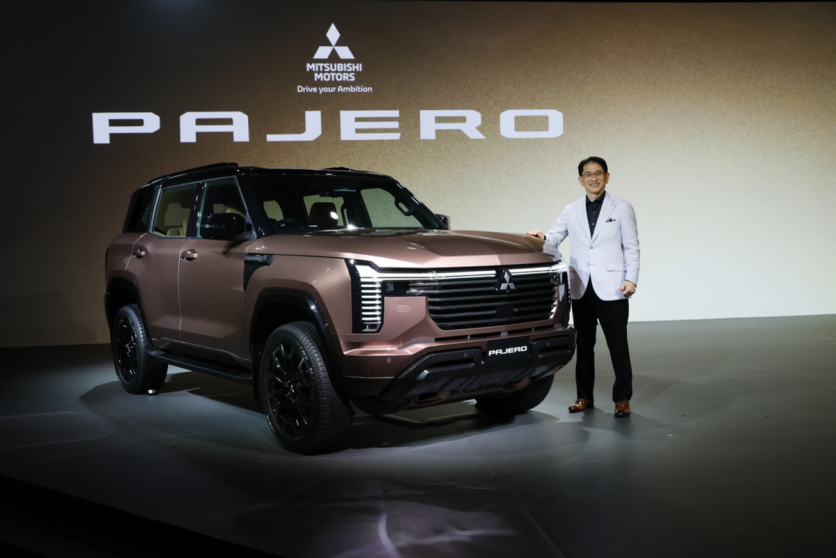
Mitsubishi's all-new Pajero made its global debut at a world premiere in Thailand on September 2, 2026, ending a five-year absence with a deliberate architectural reversal: where the third and fourth generations spent their final decades on a unibody platform, the fifth generation returns to a body-on-frame ladder frame — the same engineering philosophy that drove the nameplate to 12 Dakar Rally victories — and pairs it with a modern ADAS safety suite, over-the-air software updates, and a terrain control system designed to undercut the Toyota Land Cruiser 300 and Nissan Patrol in the off-road flagship segment.
Structural Reversal: Why the Ladder Frame Is the Real Story
The most consequential decision behind the all-new Pajero is one Mitsubishi never had to announce publicly: abandoning the unibody construction that defined the third and fourth generations of the nameplate in favor of a purpose-built, body-on-frame chassis. According to Mitsubishi Pajero's four-generation history, the nameplate used body-on-frame construction through its first two generations before switching to unibody in 1999 — a configuration that lasted until the model's discontinuation in 2021.
That reversal is not a minor engineering preference — it is a strategic concession that the prior generation drifted too far from the hardcore off-road buyer who made the Pajero a global institution in the first place. Ladder-frame construction, where the vehicle body is bolted to a separate rigid frame composed of longitudinal rails and cross-members, sacrifices some on-road ride compliance compared to unibody but provides meaningfully superior off-road flex, towing strength, and repairability. The Pajero's direct rivals — the Toyota Land Cruiser 300, the Nissan Patrol, and the Ford Everest — all use ladder-frame platforms for exactly this reason.
Mitsubishi is not starting from scratch. The fifth-generation Pajero is built on the Triton pickup truck platform, a chassis that underwent significant structural development before being adapted for the flagship SUV. Mitsubishi says it conducted Pajero-specific suspension development for the flagship SUV, separating the road character of the flagship SUV from the more utilitarian Triton. The rear suspension is a five-link live rear axle on coil springs — a more road-oriented setup than the Triton's leaf springs, chosen for the Pajero's balance of comfort and capability.
Super Select 4WD-II: The Technical Centerpiece
The all-new Pajero's four-wheel drive system is the mechanically significant piece that separates it from simpler off-road SUVs in its class. Mitsubishi's Super Select 4WD-II is not a basic part-time system that requires stopping the vehicle to engage — it is a full-time-capable architecture with four selectable modes and a center torque-sensing LSD that distributes 40 percent of driving force to the front axle and 60 percent to the rear during normal 4WD operation.
The four modes are: 2H (rear-wheel drive for fuel economy on sealed roads), 4H (full-time 4WD with center LSD active, usable on pavement at speeds up to approximately 100 km/h or 62 mph without risk of transmission wind-up), 4HLc (center differential locked for a fixed 50/50 front-rear split in demanding off-road conditions), and 4LLc (low-ratio gearing with locked center diff for rock crawling and steep grades).
That on-the-fly switching capability between 2H and 4H at highway speeds is the engineering tradeoff that defines the Super Select system's value proposition. Rival part-time systems require the driver to stop or slow to a crawl before engaging or disengaging 4WD — a meaningful inconvenience on the mixed-surface roads common in Australia, the Gulf, and Southeast Asia where Pajero buyers are most concentrated.
Building on the Super Select foundation, the Pajero features seven selectable terrain drive modes — Normal, Eco, Gravel, Snow, Mud, Sand, and Rock — tuned for the SUV's specific weight and suspension character. The top-specification variants are also expected to include Active Yaw Control (AYC), which applies light braking to the inside front wheel during cornering to sharpen directional accuracy on loose surfaces.
Safety Shield ADAS: Raising the Floor for Body-On-Frame SUVs
Historically, body-on-frame SUVs were the last class of vehicle to receive comprehensive active safety technology. The all-new Pajero changes that picture for the Mitsubishi lineup. Mitsubishi's updated Safety Shield suite — as featured on the new model — includes forward collision mitigation, which monitors the road ahead and intervenes with automatic braking when an imminent impact is detected and the driver has not responded.
Lane departure warning alerts the driver when the vehicle begins to drift across lane markings without an activated turn signal — directly relevant in the long-distance highway driving that defines ownership in markets such as outback Australia and the Gulf highway network. Blind-spot warning covers the lateral zones alongside and behind the vehicle that mirrors cannot reliably detect, providing an audio or visual alert when vehicles are approaching those zones during a lane-change maneuver. Together, these systems bring the Pajero's passive risk mitigation in line with what buyers of the Toyota LandCruiser Prado and Ford Everest expect as standard features in 2026.
These features are not merely consumer comfort items — they are relevant to ANCAP star-rating assessments in Australia and New Zealand, and to equivalent safety assessment programs in the Middle East. Without a functioning ADAS suite, a vehicle competing at the Pajero's expected price point of roughly A$60,000–A$65,000 (approximately $39,700–$43,000 USD) would face significant headwinds in markets where five-star safety ratings drive fleet and family purchase decisions.
Connected and Over-the-Air Ready
Inside, a large central infotainment display anchors the Pajero's cabin. Mitsubishi has confirmed the system supports over-the-air (OTA) software updates — the ability to revise infotainment software, map data, and ADAS calibration parameters via cellular connection without a dealership visit.
OTA capability carries particular practical weight for a vehicle with the Pajero's geographic spread. In markets where Pajeros serve buyers in remote or semi-rural regions — outback Queensland, rural Western Australia, inland Middle Eastern markets — the ability to receive a software improvement without driving to a dealership that may be hundreds of kilometers away is a genuine quality-of-life advantage. It also allows Mitsubishi to extend vehicle functionality post-purchase, a feature that buyers in this segment increasingly expect after years of Tesla and other EV makers demonstrating its value.
The infotainment system supports Android Auto and Apple CarPlay integration. Mitsubishi has also confirmed the return of the model's distinctive triple multi-meter instrument cluster — reimagined in digital form. The digital multi-meter display can display altitude, compass heading, ambient temperature, vehicle pitch and roll angles, and left-right torque distribution — information directly useful to drivers navigating challenging terrain rather than simply a visual signature.
Powertrain: Confirmed at Reveal
The fifth-generation Pajero is powered by a 2.4-litre turbodiesel four-cylinder adapted from the Triton's engine family, running a single variable-geometry turbocharger and producing approximately 150 kW (201 horsepower) and 480 Nm (354 lb-ft) of torque — with some markets receiving 470 Nm (346 lb-ft). The engine drives through a newly developed eight-speed automatic transmission, a step above the six-speed unit found in the Triton, matched to the Super Select 4WD-II system. Australian government homologation data confirmed the new Pajero will offer four trim grades — GLX, GLS, Exceed, and GSR — with GLS and Exceed offered in both five- and seven-seat configurations.
A plug-in hybrid variant has been publicly acknowledged by Mitsubishi, but is not expected to reach showrooms until approximately 2030 while a next-generation PHEV powertrain platform is developed.
Heritage Built In: The Dakar Dimension
Few vehicles carry motorsport credentials as specific as the Pajero's. The nameplate competed in the Dakar Rally from 1983, securing 12 overall victories — a record that remains unmatched in the car category. The run of seven consecutive wins from 2001 to 2007 stands as one of the most dominant records in any form of motorsport: in that period, a Mitsubishi Pajero Evolution finished first overall in the world's most demanding off-road race every single year, driven by campaigners including three celebrated Dakar champions — Stéphane Peterhansel, Hiroshi Masuoka, and Jutta Kleinschmidt.
That heritage is not merely promotional — it produced the technical foundations of the Super Select 4WD architecture. Each generation of competitive Pajero development fed real-world data on suspension flex, differential behavior under lateral load, and chassis fatigue back into the production vehicle engineering program. The digital Multi Meter's ability to display vehicle pitch and roll angles is a direct descendant of the instrumentation Dakar co-drivers used to monitor vehicle dynamics on special stages.
Mitsubishi also recently restored the 1985 Dakar-winning Pajero — its first rally victory — as part of the nameplate's 40th anniversary celebrations, signaling that the Dakar legacy is central to how the company is positioning the fifth-generation model.
Entering a Competitive Segment
The new Pajero will arrive in Australia before the end of 2026, where its primary rivals include the Toyota LandCruiser 300 Series (from approximately A$99,340 / ~$65,600 USD), the Nissan Y62 Patrol (from approximately A$95,600 / ~$63,100 USD), and the Toyota LandCruiser Prado (from A$73,200 / ~$48,300 USD).
Pre-reveal estimates put the new Pajero's entry price at A$60,000–A$65,000 (approximately $39,700–$43,000 USD), with that gap against the Land Cruiser representing a meaningful competitive advantage. Mitsubishi Australia's GM of Product Strategy Bruce Hampel previously confirmed the brand expected to sell through its remaining Pajero Sport stock before the full-fat Pajero arrived as its replacement — a sequencing that leaves the brand without a large 4WD until deliveries begin.
For buyers who previously owned a Pajero, or who have been in the Toyota Land Cruiser or Nissan Patrol market and found those vehicles' price trajectory disconnected from their needs, the fifth-generation model's combination of Super Select II 4WD, terrain modes, ADAS, and OTA capability at a projected price below the Prado represents a genuinely different option in a segment that has contracted dramatically since the early 2000s.
The choice to hold the world premiere in Thailand — rather than a major auto show — is equally deliberate. Thailand is not only the manufacturing home of the new Pajero at the Laem Chabang plant (which produces units for more than 120 countries) but also a key consumption market for Mitsubishi's pickup and SUV lineup. Debuting there signals that Mitsubishi's priority markets are Southeast Asia, Australia, the Middle East, and Africa — not Europe or North America, where the Pajero nameplate was sold under the Montero name and was discontinued in 2006.
Frequently Asked Questions
When does the new Mitsubishi Pajero go on sale, and where?
Mitsubishi has confirmed Australian deliveries before the end of 2026, with the Thai market expected first given the world premiere was held there. Southeast Asian and Middle Eastern markets are also priority regions. No confirmed on-sale date has been announced for North America — the Pajero was sold there under the Montero name, discontinued in 2006, and no North American return has been indicated.
How does Super Select 4WD-II work, and why does it matter for everyday driving?
Unlike simpler part-time 4WD systems that require stopping the vehicle to engage four-wheel drive, Mitsubishi's Super Select 4WD-II uses a center torque-sensing limited-slip differential to allow the driver to switch between rear-wheel drive and full-time 4WD mode at speeds up to approximately 100 km/h (62 mph). The system's four modes — 2H, 4H, 4HLc, and 4LLc — cover everything from fuel-efficient highway cruising to locked-differential rock crawling, and seven terrain presets optimize throttle, braking, and traction control for specific surface types without manual driver calibration.
How does the new Pajero compare to the Toyota Land Cruiser and Nissan Patrol?
All three vehicles use body-on-frame ladder-frame construction and serious off-road four-wheel drive hardware. The Land Cruiser 300 starts at approximately A$99,340 (~$65,600 USD) in Australia and the Y62 Patrol at approximately A$95,600 (~$63,100 USD), while the Pajero is expected to enter below A$65,000 (~$43,000 USD) — a meaningful price gap. The Pajero's Dakar Rally record of 12 victories gives it motorsport credentials neither rival can claim. A direct capability comparison awaits independent testing once vehicles reach market.
What is the significance of the Pajero returning to a body-on-frame platform?
The fourth-generation Pajero used a unibody monocoque platform — the same type of construction found in passenger cars, and a continuation of the third-generation's approach from 1999 onward (spanning 2006–2021) — which prioritized on-road ride comfort and interior refinement at the cost of some off-road capability and towing strength. The fifth generation's return to a ladder-frame platform signals Mitsubishi's intention to recompete directly with body-on-frame rivals like the Land Cruiser and Patrol for buyers who prioritize genuine off-road performance, towing capacity, and long-term structural durability. It is a strategic realignment as much as an engineering one.

-
 C114 Communication Network
 -
 Communication Home
