
 Search

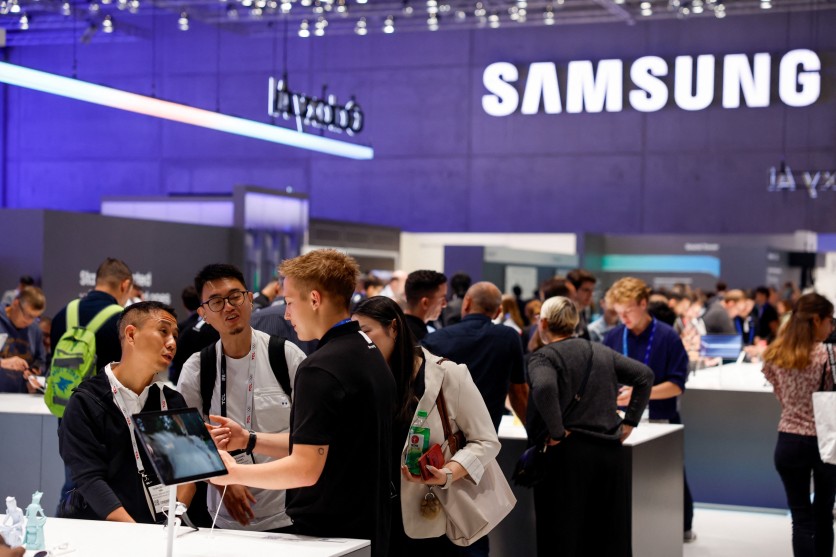
People visit the stand of South Korean electronics manufacturer Samsung at the IFA international trade show for consumer electronics and home appliances, are pictured on September 5, 2025 in Berlin. ODD ANDERSEN/AFP via Getty Images
Samsung's IFA 2026 presence is concentrated eight kilometers (5 miles) from Messe Berlin today — not on the exhibition floor where the company has shown up every year since 1991, but at Humboldt Carré in Berlin's Mitte district, in what is the most significant structural change to Samsung's trade show strategy in 35 years. The move extends a pattern Samsung established at CES 2026 in January, when it abandoned the Las Vegas Convention Center for a standalone gallery at the Wynn Hotel, and now applies it at IFA — the world's largest consumer electronics show — in a format IFA management has incorporated into its official programme.
What Samsung has exchanged is ambient visibility for targeted influence. For more than a decade, its 8,700-square-meter (93,600-square-foot) CityCube booth served as a passive comparison engine — retail buyers walking IFA's aisles were continuously exposed to Samsung's televisions, appliances, phones, and wearables in a single sweep, whether or not they had a scheduled meeting. At Humboldt Carré, those same buyers now need to want to be there. The tradeoff is real: Xiaomi, making its first-ever IFA appearance in Hall 6.2 with more than 380 products and an ecosystem spanning 1.16 billion connected devices worldwide, lands at the Messe floor Samsung vacated. LG Electronics is presenting its ThinQ Claw AI agent in Hall 18 — the European debut of a product Samsung's exit leaves room to dominate.
IFA Management CEO Leif Lindner framed the Humboldt Carré arrangement diplomatically. "IFA is increasingly evolving into a platform for the creator economy," Lindner said in the official IFA programme announcement. "Together with our partner Samsung, we are also extending IFA into downtown Berlin with their new exhibition concept." Samsung is simultaneously the main sponsor of IFA's new Creator Hub at Palais am Funkturm on the Messe grounds — a studio complex for influencers, streamers, and content creators designed to amplify the show's products to digital audiences throughout show week.
What Samsung Is Bringing Eight Kilometers From the Show Floor
Samsung has organized the Humboldt Carré space around the theme "Your Companion to AI Living" — a brand platform first unveiled at CES 2026 — and divided it into three zones. Samsung Electronics Europe CMO Benjamin Braun said at the showcase's opening that AI must deliver benefits people can "see and feel directly in their daily lives," a framing that positions the Humboldt Carré experience as a demonstration of that standard rather than a spec presentation, according to the Seoul Economic Daily.
The showcase runs September 2–6, 2026, and is open to holders of a valid IFA trade visitor pass from September 4 onward. During the September 2–3 pre-show days, access is by Samsung invitation only.
Odyssey G6 Sets World Refresh-Rate Record at the Show
Samsung's headline hardware at the showcase is the 27-inch Odyssey G6 (model G60H), the world's first gaming monitor to reach a 1,100Hz refresh rate. The monitor uses a Fast IPS LCD panel — not an OLED — with a native resolution of 2,560 × 1,440 (QHD) and a 1ms gray-to-gray response time.
At a refresh rate of 1,100Hz, the panel displays each frame for less than one millisecond — specifically 0.91 milliseconds — which is why Samsung requires its 1ms GtG specification to keep up with the frame budget. The catch is resolution: reaching 1,100Hz requires the monitor's Dual Mode to drop to HD (1,280 × 720, or 720p), a quarter of its native pixel count. Most competitive players will run it in its native QHD mode at up to 600Hz, where the panel delivers a meaningful upgrade over 360Hz predecessors without sacrificing image detail.
Hitting the headline figure in practice demands hardware most gaming rigs don't have. No consumer graphics card currently renders 1,100 genuine frames per second in any real-world game title, even in the lightest competitive shooters. The path to 1,100Hz runs through AI frame generation — specifically NVIDIA DLSS 4.5 on RTX 50-series cards, which synthesizes up to five AI-generated frames for every one the GPU actually renders, producing the feed rate the panel can use. Samsung has not published a specific minimum GPU requirement for the G6's 1,100Hz mode.
Read more: Odyssey G6 Breaks 1,100 Hz Barrier at Gamescom: Most Buyers Will Game at 600 Hz QHD
Samsung first showed this panel at CES 2026 with a 1,040Hz specification; by Gamescom 2026 on August 27, engineers had pushed the final launch figure to 1,100Hz. The 2027 Odyssey lineup also includes a 42-inch OLED G7, a 32-inch QD-OLED G8 with three operating modes (4K/360Hz, QHD/520Hz, FHD/680Hz), and the 49-inch OLED G9. The G6 is on track for a global launch in the second half of 2026; Samsung has not announced pricing.
Micro RGB TV and Vision AI Companion: A Different Backlighting Architecture
The Humboldt Carré's Entertainment Companion zone anchors around Samsung's Micro RGB television line, with European-market models on display alongside Vision AI Companion — the conversational AI interface built into the TV's Tizen operating system.
Micro RGB is structurally different from every prior LED television technology. Conventional LED televisions use blue LEDs with a phosphor coating to produce white light, then filter that light through a color panel. Samsung's Neo QLED Mini LED line adds a quantum dot sheet to improve color but still starts with blue LEDs. Micro RGB eliminates that starting point entirely: each backlight element is a red, green, or blue LED measuring under 100 micrometers in diameter, emitting its color independently. The result is per-zone color control that reaches 100% of the BT.2020 wide color gamut — the international standard for Ultra HD television broadcasting — verified by testing organization VDE.
Where Micro RGB sits competitively: it offers stronger color purity and higher peak brightness than OLED but weaker absolute black performance, because the LCD liquid crystal layer still sits between the backlights and the viewer. Hisense brands the same underlying concept as RGB-MiniLED (formerly TriChroma), with four models on the US market. LG, Sony, and TCL have each previewed competing implementations but have not shipped production models, according to Engadget's CES 2026 explainer.
Samsung's 130-inch R95H flagship model won the CES 2026 Innovation Awards Best of Innovation prize in January. The Humboldt Carré presentation focuses on European-market sizing in the 55-to-115-inch range, alongside the Vision AI Companion's dialogue-based content interface — which surfaces personalized recommendations and contextual information through conversation rather than passive scrolling.
Home Companion: Bespoke AI Appliances and Energy Management
Samsung's Home Companion zone presents a connected appliance lineup unified through the SmartThings ecosystem. The Bespoke AI Family Hub refrigerator uses AI Vision cameras to identify ingredients stored inside and recommend recipes accordingly; its touchscreen serves simultaneously as a real-time home energy dashboard covering all connected appliances.
The Bespoke AI Washing Machine on display — part of Samsung's WF90F/24 series — cuts energy consumption by up to 55% below Europe's Energy Efficiency Class A threshold under its Eco programme at IFA 2026, and by a further 70% when AI Energy Mode is active. A 7-inch display and full Bixby voice control allow hands-free operation.
Two new appliances are making their European showcase debut at Humboldt Carré: a combined induction cooktop and integrated extraction hood that eliminates the need for a separate overhead range hood — addressing both the space constraints of European kitchens and the coordination complexity of two separate systems — and a Bespoke AI Dishwasher that reduces power consumption by 20% below Europe's A-grade energy standard.
All four appliances connect through SmartThings into a single energy management interface, which Samsung is positioning as a lifestyle proposition as much as a technical specification.
Care Companion: Galaxy S26 FE Gets Early Hands-On Before September 4 Sale
The Care Companion zone bridges Samsung's mobile and wearable portfolio with the AI Living theme. The centerpiece is the Galaxy S26 FE, available for hands-on preview at Humboldt Carré before it goes on sale on September 4, 2026, at $699.99 in the United States and €799 (approximately $926 USD) in Europe.
The technical foundation is Samsung's Exynos 2500 — the company's first smartphone chip manufactured on a 3nm Gate-All-Around process. GAA is a fabrication advance over conventional FinFET transistors: it gives the chip's gate structure contact with the electron channel on four sides rather than three, improving power efficiency per clock cycle. The Exynos 2500 runs a 10-core tri-cluster configuration (one peak Cortex-X925 at 3.3 GHz for single-threaded loads, a performance cluster, an efficiency cluster, and two Cortex-A520 efficiency cores at 1.8 GHz) paired with an Xclipse 950 GPU built on AMD's RDNA 3 architecture, with hardware ray-tracing support.
The Galaxy S26 FE ships with a 6.7-inch Dynamic AMOLED 2X display at 120Hz, up to 1,900 nits of brightness, a 50MP main camera with OIS, 12MP ultrawide, and 8MP 3x telephoto, a 4,900mAh battery with 45W wired and 15W wireless charging, and IP68 water and dust resistance. It is the first device in the Galaxy S26 family to ship with One UI 9 and Android 17 pre-installed; other S26 models are receiving the One UI 9 stable update now. Samsung is committing to seven years of Android updates and seven years of security patches — the same long-term support as the rest of the Galaxy S26 line.
The 256GB model is priced at €899 (approximately $1,042 USD) in Europe; the 512GB model at €1,099 (approximately $1,273 USD). US pricing for the larger configurations has not been confirmed.
Read more: Samsung Sets August 27 for Galaxy S26 FE: Exynos Chip Complicates Value Case
Also in the Care Companion zone: the Galaxy Z Fold 8 Ultra, which at 4.1 mm (0.16 in) is the thinnest device in the Galaxy Z Fold series' history, announced at Samsung Unpacked in London in July 2026. The Galaxy Watch Ultra 2 and Galaxy Watch 9 round out the zone, emphasizing health monitoring AI including sleep coaching, activity tracking, and real-time wellness insights.
Who Benefits From Samsung's Empty Floor Space?
The competitive consequence of Samsung's move is already visible on the Messe Berlin exhibitor map. Xiaomi — whose "Human × Car × Home" ecosystem platform connects 1.16 billion IoT devices globally as of June 2026 — is making its first-ever IFA appearance in Hall 6.2, Booth 101, with more than 380 products spanning smartphones, smart home devices, electric vehicles, and robotics, including the CyberOne humanoid robot and three Xiaomi Auto models.
The brand's pitch to European retailers is backed by a €7.4 billion (approximately $8.58 billion USD) AI research and development commitment from 2026 to 2028, covering electric vehicles, robotics, and operating systems. Xiaomi ranked 232nd on the Fortune Global 500 in July 2026. It arrives at IFA's main hall with the kind of institutional credibility that benefits enormously from simply being in the room Samsung chose to leave.
LG Electronics, occupying Hall 18, is presenting ThinQ Claw — its AI agent capable of reading user intent through natural-language conversation — to European retail buyers for the first time. IFA CEO Leif Lindner said at a Seoul press conference in June that Samsung and LG "must persuade consumers why they should buy their products among numerous alternatives," per the Seoul Economic Daily, a characterization of the competitive pressure that Xiaomi's IFA debut makes structurally explicit.
The Yanko Design analysis put it plainly: reporters covering the Galaxy S26 FE launch on September 4 will be inside Messe Berlin's halls, standing next to Samsung's competitors, writing about a product made by the company that moved eight kilometers away. Whether the creator amplification from the Creator Hub sponsorship, and the B2B depth from Humboldt Carré's controlled environment, outweigh that structural cost is not a question IFA 2026 alone will answer.
Is This a New Trade Show Playbook or a One-Season Experiment?
Samsung executed the same off-site strategy at CES 2026 — abandoning the Las Vegas Convention Center for a Wynn Hotel gallery that press described as a "media and perception success," citing longer product engagement and better photography conditions. Doing it at both of the industry's two premier fall shows in the same calendar year shifts the question from "experiment" to "policy."
The trade show's structural function for a company like Samsung has historically been dual: a B2B conversation engine for the retail buyers who sign purchase orders, and a passive brand awareness platform for the journalists and general attendees who walk the floor. Samsung is betting it can separate those two functions — achieving the B2B outcome at Humboldt Carré and the awareness outcome through creator channels — and that the combination produces more return than the blunt instrument of a 93,600-square-foot booth.
The strongest argument against that bet is the comparison-ground function: when a buyer hasn't yet decided between Samsung's Neo QLED and LG's OLED offering, or between a Bespoke AI refrigerator and a Hisense model, standing in front of both is part of the decision process. That function now belongs entirely to Samsung's competitors.
How to Access the Humboldt Carré Showcase
Samsung's Humboldt Carré showcase runs from September 2 through September 6, 2026, at Humboldt Carré, Berlin Mitte — close to Friedrichstrasse S-Bahn station. During September 2 and 3 (IFA Media Days), access is by Samsung invitation. From September 4, the showcase is open to any holder of a valid IFA trade visitor pass. It is not open to general public visitors.
IFA Berlin 2026 runs September 4–8 at Messe Berlin (Messedamm 22, Berlin), with trade hours from 9:30 a.m. to 6:00 p.m. local and public hours from 10:00 a.m. (noon on Fridays) to 6:00 p.m. local. Samsung's presence at the Messe grounds is limited to the Creator Hub at Palais am Funkturm (stand PAF-101) and meeting rooms in CityCube Hall B (stand CCBB-R2).
Currency conversions are approximate, based on the exchange rate at time of publication.
Frequently Asked Questions
Why did Samsung leave its traditional Messe Berlin booth at IFA 2026?
Samsung has repositioned its trade show strategy around two goals that its traditional large public booth was not optimized for: focused business-to-business conversations with European retail buyers and distributors, and amplified reach through content creators. At Humboldt Carré, meetings are by appointment and crowd density is controlled, making each product demonstration longer and more detailed than is practical on a 93,600-square-foot public show floor. The Creator Hub sponsorship at Palais am Funkturm handles mass-audience reach through influencer and streaming channels. The risk is that Samsung is no longer present when buyers are making side-by-side comparisons with LG, Xiaomi, and Hisense on the Messe floor — a function trade shows provide that appointment venues cannot replicate.
What is the Samsung Odyssey G6's 1,100Hz refresh rate, and what does it actually require to use it?
A 1,100Hz refresh rate means the monitor updates the image 1,100 times per second, displaying each frame for less than one millisecond. At that speed, fast-moving objects in games have dramatically reduced motion blur compared to 240Hz or even 360Hz displays. The limitation is that the Odyssey G6 (G60H) only reaches 1,100Hz when its Dual Mode is set to HD resolution (1,280 × 720, or 720p) — the panel's native QHD resolution (2,560 × 1,440) tops out at 600Hz. More practically, producing 1,100 actual frames per second requires a system running AI frame generation (NVIDIA DLSS 4.5 on RTX 50-series hardware); no consumer GPU renders 1,100 native frames per second in any real game. Most competitive players will find the 600Hz QHD mode the more useful operating point.
How much does the Galaxy S26 FE cost, and when does it go on sale?
The Galaxy S26 FE goes on sale September 4, 2026. In the United States it starts at $699.99 for the 128GB model. In Europe, pricing starts at €799 (approximately $926 USD) for the 128GB configuration, €899 (approximately $1,042 USD) for 256GB, and €1,099 (approximately $1,273 USD) for 512GB. The phone ships with Samsung's Exynos 2500 processor (3nm Gate-All-Around process), a 6.7-inch 120Hz AMOLED display, 50MP triple camera system, 4,900mAh battery, and One UI 9 based on Android 17. Samsung is committing to seven years of Android upgrades and seven years of security updates.
What is Samsung's Creator Hub at IFA 2026, and does it replace the Messe Berlin booth?
The Creator Hub at Palais am Funkturm — which Samsung is sponsoring as the main sponsor for IFA 2026 — is a purpose-built studio complex for content creators: influencers, streamers, and podcasters who produce live content throughout show week. Samsung runs its own program inside the Hub, using it to promote its products through creator channels rather than through traditional trade-show foot traffic. It does not replace the Messe Berlin product exhibition; it replaces the brand-awareness function that foot traffic provided, routing it instead through creator audiences. Samsung's product exhibition, B2B meetings, and press briefings are at Humboldt Carré, not at the Creator Hub.

-
 C114 Communication Network
 -
 Communication Home
