
 Search

gettyimages.com
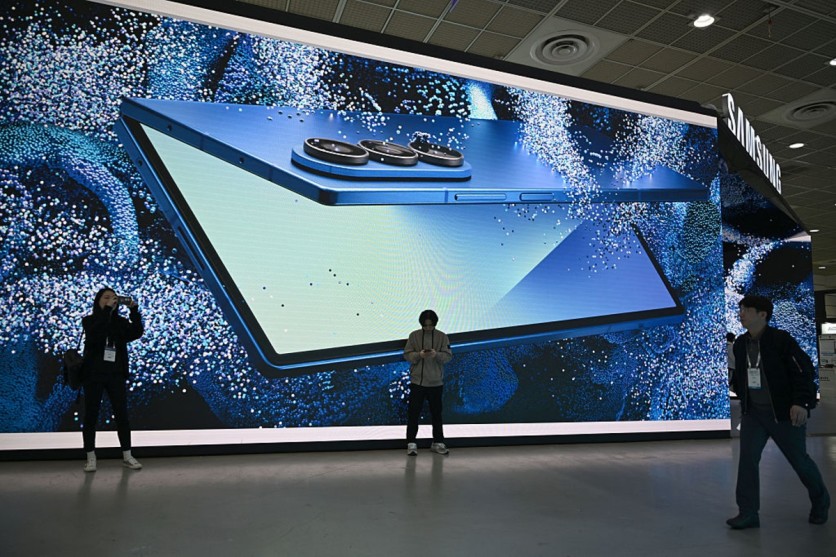
Samsung officially announced a new titanium-based foldable display architecture on July 15 — the day before buyers need to decide whether to reserve a device they haven't yet seen. The technology, called Flex Titanium, integrates two titanium-based components directly into the display panel structure and is set to debut across the Galaxy Z Fold 8 lineup at Galaxy Unpacked on July 22 in London, where Samsung will stream the event live beginning at 9 a.m. ET. It is Samsung's most consequential single-day foldable launch since 2019: three foldables, new smartwatches, and the commercial debut of Galaxy Glasses — all arriving as a global memory shortage has driven device prices to their highest level in the line's history.
Flex Titanium Tackles the Crease at the Display Level, Not Just the Hinge
The crease visible on every foldable phone released in the last seven years is not a hinge problem. It is a display-layer stress problem, and Samsung's new Flex Titanium technology is the first attempt to address it structurally inside the panel itself.
Samsung's Global Newsroom confirmed on July 15 that Flex Titanium integrates two titanium-based components into the foldable display structure: an ultra-thin titanium-alloy film positioned beneath the OLED panel, and a titanium plate beneath that, which supports the display when unfolded. A precision rolling process makes the alloy film roughly one-third the thickness of a human hair — a dimension that allows it to fit inside a slim foldable without adding bulk. The titanium plate uses advanced hole processing to bond more tightly to the display module, eliminating the air gaps in the support structure that have historically created weak spots under the panel.
The physics matter here. When a foldable phone closes and opens, stress accumulates simultaneously across every layer in the display stack: the ultra-thin glass on top, the OLED panel itself, the adhesive layers between them, and the structural support beneath. That stress concentrates at the hinge axis, and the result is the visible line that foldable buyers either accept or walk away from. Flex Titanium's titanium-alloy film distributes that stress more evenly across the panel surface rather than letting it concentrate at the fold. The plate below removes the air-gap weak points that have contributed to earlier models' documented delamination issues.
Samsung describes the technology as the product of seven generations of foldable engineering. Full confirmation of whether Flex Titanium applies to the Galaxy Z Flip 8 as well as the Fold series has not been established; Samsung's announcement framed it as technology for "the next generation of Galaxy foldable devices," but reporting from SammyFans suggests the Flip 8 may use a different display assembly.
The tougher display structure carries at least one tradeoff: Forbes noted that titanium-reinforced panels could mean higher out-of-warranty repair costs than previous-generation screens.
Read more: Samsung's Latest Flex Titanium Technology Innovates Foldable Phone Industry
Read more: Samsung Reportedly Thickens the Glass on Its Wide Foldable to Soften the Crease
Galaxy Z Fold 8: Shorter, Wider, and Built for Landscape-First Living
Samsung's main event in London is a structural redesign six years in the making. Official-looking renders and multiple independent leak sources describe the Galaxy Z Fold 8 as a "passport-style" device — wider, shorter, and built around a cover display of approximately 5.4 to 5.5 inches at a 16:10 aspect ratio and an inner display of 7.6 inches at a 4:3 ratio.
The case for the new proportions is specific: the 4:3 inner display presents landscape video content with meaningfully smaller black bars than the near-square display of prior Fold models, and the wider cover screen makes the device more usable as a phone when folded. The two persistent criticisms of book-style foldables — that the cover screen was too narrow to type on and that the inner display was awkward for media — both trace back to the same root cause: an aspect ratio optimized for a notebook-style device rather than a phone.
Leaked dimensions place the Fold 8 at 123.9 × 81.9 × 9.7mm folded and 123.9 × 161.4 × 4.5mm unfolded, with a weight of approximately 201 grams. Both displays are expected to be Dynamic AMOLED panels supporting up to 120Hz refresh rates with HDR10+ support. Underneath, all variants are expected to run the Snapdragon 8 Elite Gen 5 for Galaxy with 12GB of RAM and storage options up to 1TB.
The camera configuration reflects a deliberate split between the two Fold models. The standard Fold 8 is reported to use a dual-camera setup — a 50MP primary sensor and a 50MP ultrawide — rather than the three-camera system on its predecessor and the Fold 8 Ultra. Samsung appears to have concentrated serious camera hardware on the Ultra model, creating a market split between buyers prioritizing the new form factor and those prioritizing imaging capability. The Fold 8 is expected to carry an IP48 rating, with the cover display protected by Gorilla Glass Victus 2. Starting price leaks, which remain unconfirmed, have ranged from approximately $1,899 to $1,999 for the base configuration.
Galaxy Z Fold 8 Ultra: The Camera Flagship Catches Up
While the standard Fold 8 bets everything on its wider shape, the Ultra retains the traditional taller proportions and concentrates the imaging hardware that the wide model trades away.
The Fold 8 Ultra is expected to feature a 200MP primary camera with optical image stabilization — matching the Galaxy S Ultra camera tier for the first time in the Fold line's history — alongside a 50MP ultrawide and a 10MP telephoto with 3× optical zoom. Battery capacity is reported to rise to approximately 5,000 mAh, up from 4,400 mAh in the Galaxy Z Fold 7, with charging speeds expected to reach 45W wired, ending the four-year run of the Fold line's 25W ceiling. The Ultra suffix aligns the device with Samsung's S series naming convention and positions it as a direct counter to Apple's anticipated foldable iPhone, which multiple supply-chain reports expect in September 2026 in the $2,000 to $2,500 range.
Pricing leaks for the Fold 8 Ultra have placed the base 256GB configuration at $1,999 to $2,099 — sources conflict on the precise figure — with higher storage tiers stepping up from there. The price increase over the Fold 7's $1,999 launch price reflects the most significant mobile DRAM pricing cycle in the industry's recorded history: an 89% quarter-over-quarter surge in LPDDR5X memory prices in Q2 2026, driven by chipmakers reallocating wafer capacity toward high-bandwidth memory for AI accelerators. Gartner projects no meaningful relief before late 2027. For buyers weighing whether to wait, that timeline is the operative data point.
FCC regulatory filings and Bluetooth SIG certification records have confirmed the Fold 8 Ultra's hardware is on schedule for the July 22 launch.
Read more: Samsung Unpacked July 22 in London: Foldables, Glasses, and Rising Prices
Read more: Galaxy Z Fold 8 Starts at $1,899: Memory Shortage Makes Waiting Cost More
Galaxy Z Flip 8: A Refined Device That Could Be the Last of Its Kind
The Galaxy Z Flip 8 is shaping up to be the most polished clamshell Samsung has built — and, according to two independent sources, possibly the last one.
Hardware changes are real but incremental. The Flip 8 is expected to measure around 13.2mm folded and 6.6mm unfolded, weighing approximately 180 grams — 8 grams lighter than the Flip 7. A redesigned hinge is reported to reduce the crease that has defined the Flip line since 2020, with 12GB of RAM across 256GB and 512GB storage configurations and no 1TB option. Chip allocation follows a regional pattern: Snapdragon 8 Elite Gen 5 for the US, Canada, Australia, Japan, and South Africa; Exynos 2600 for Europe and South Korea. Unconfirmed pricing leaks range from approximately $1,099 to $1,200 in the US.
The larger story is the category's future. Two independent sources — an anonymous Weibo report from May 2026 and a follow-up from X leaker @fireuniverse8 in late June — both claimed the Flip 8 will be Samsung's final clamshell, with the company reportedly shifting production resources toward the Galaxy Z Fold family. Tipster Ice Universe echoed the conclusion in a post on July 9, describing the Flip 8 as "likely Samsung's last small folding product." Supply-chain data cited by multiple outlets shows Flip 8 being built at lower volumes than either Fold 8 model, and no supplier orders for a Flip 9 have been reported. Samsung has not commented on its product roadmap beyond the July 22 event, and none of these claims are confirmed. But the Fold 7 outselling the Flip 7 in South Korea pre-orders earlier this year signals that Samsung's own market data may be pointing the same direction as the leakers.
If the Flip 8 is indeed a final act, it would mark the second major Samsung smartphone line to be discontinued, after the Galaxy Note.
Galaxy Glasses: Samsung and Google's Answer to the Second Screen
The device most likely to generate the broadest interest at Unpacked may not be a phone.
Samsung's Galaxy Glasses — co-designed with eyewear brands Gentle Monster and Warby Parker — run Google's Android XR platform with Gemini AI built in, and were formally previewed at Google I/O 2026 on May 20. The first commercially available model is audio-only: no display, no AR overlay. The glasses carry cameras, microphones, and speakers, functioning as a companion device that offloads computation to the paired smartphone via Bluetooth and Wi-Fi. That architecture is what keeps them light enough to wear like regular glasses while enabling capabilities like turn-by-turn navigation, real-time speech translation, notification readouts, and visual queries through Gemini — all without requiring the phone to leave a pocket.
Gentle Monster contributes a bolder, fashion-forward frame design; Warby Parker provides a more conventional glasses profile. Both collections have confirmed prescription lens support, and both brands showed off frames at Google I/O 2026. The practical differentiator from Meta's Ray-Ban glasses — which start at $299 and run Meta AI — is the Gemini integration: multimodal, multilingual, with confirmed Google Maps support and deeper Android ecosystem connectivity.
Supply-chain reporting and brand-side leaks point to a price range of $379 to $499 for the audio-only frames in the US, though Samsung has not confirmed pricing. The Galaxy Glasses are not included in the Galaxy Reserve pre-reservation program, leaving their Unpacked appearance unconfirmed, though a fall 2026 US commercial launch has been indicated by Google. A second, display-equipped model is separately rumored for 2027.
How to Watch — and What to Reserve Before July 22
Galaxy Unpacked streams live on July 22 beginning at 9 a.m. ET (2 p.m. BST) through Samsung Newsroom, Samsung.com, and the company's official YouTube channel.
Samsung's Galaxy Reserve program is open now. Reserving any upcoming Galaxy device through Samsung.com unlocks a $30 Samsung credit redeemable during the pre-order period, plus an entry into a sweepstakes for one of ten $500 Samsung gift cards. Combined with trade-in savings, total benefits can reach up to $1,230, per Samsung's own promotion language. The reservation offer expires July 19 — three days before the event — and the pre-order window is expected to open immediately after the keynote on July 22.
Competitive Clock: Apple, Motorola, and the Six-Day Window
Samsung's London showcase lands at a precise moment in the foldable market's history. Six days from now, Samsung will have officially answered the question the industry has debated for three years: what does a foldable look like when it's designed for how people actually hold their phones, rather than optimized for the engineering constraints of a hinge?
Apple's anticipated first foldable iPhone — multiple supply-chain reports place it in September 2026 at $2,000 to $2,500 — is expected to use a similar wider, shorter form factor. Samsung's July 22 launch positions its devices on retail shelves approximately two months before Apple's announcement, and the Galaxy Reserve program means pre-orders may open the same day as Unpacked.
On the clamshell side, Motorola has been consistently aggressive on Razr pricing and carrier distribution, and stands to benefit most if Samsung steps back from the Flip category after this generation. Google's long-rumored Pixel Flip has not materialized. The foldable market — still well under 2% of global smartphone volume — is about to see its most concentrated competitive pressure in the category's short history.
Frequently Asked Questions
What is Flex Titanium, and why does it matter for foldable phones?
Flex Titanium is a new foldable display architecture Samsung announced on July 15. It places a titanium-alloy film beneath the OLED panel and a titanium plate below that, working together to distribute bending stress more evenly across the display and eliminate air gaps that have historically made the fold axis a structural weak point. Earlier foldable phone engineering treated the crease primarily as a hinge problem. Flex Titanium treats it as a display-layer problem. Samsung says the technology enables a slimmer panel without sacrificing durability, and it is expected to debut in the Galaxy Z Fold 8 series on July 22. Whether it applies to the Galaxy Z Flip 8 has not been confirmed.
What is the difference between the Galaxy Z Fold 8 and the Galaxy Z Fold 8 Ultra?
The Galaxy Z Fold 8 is a new, wider form factor — shorter and broader than any previous Fold, with a 4:3 inner display ratio better suited to landscape video and a cover screen approximately 5.4 to 5.5 inches wide. It is expected to have a dual-camera system (two 50MP sensors). The Galaxy Z Fold 8 Ultra retains the traditional taller aspect ratio and is expected to offer the more powerful imaging system: a 200MP primary camera, 50MP ultrawide, and 10MP telephoto with 3× optical zoom, plus a larger battery (approximately 5,000 mAh) and 45W wired charging. Both are expected to run the Snapdragon 8 Elite Gen 5. Leaked pricing puts the wide Fold 8 starting around $1,899 to $1,999 and the Ultra starting around $1,999 to $2,099 — none of these figures are official until July 22.
Is the Galaxy Z Flip 8 really Samsung's last flip phone?
It may be, though Samsung has not confirmed it. Two independent sources — a Weibo leaker in May 2026 and X tipster @fireuniverse8 in late June — both claimed Samsung plans to discontinue the Z Flip line after this generation, citing internal production data and the absence of any confirmed Flip 9 supplier orders. Credible tipster Ice Universe also described the Flip 8 as "likely Samsung's last small folding product" on July 9. Samsung has made no official statement on its future product roadmap, and the Z Flip 7 was reportedly more popular than earlier Flip models. If the rumor holds, however, the Flip 8 would be worth buying for its own merits rather than waiting — a Flip 9 may not exist.
When do Samsung Galaxy Unpacked pre-orders open, and how much can I save?
Galaxy Unpacked takes place July 22 at 9 a.m. ET, streaming on Samsung Newsroom, Samsung.com, and YouTube. Pre-orders are expected to open the same day, immediately following the keynote. Reserving now through Samsung's Galaxy Reserve program secures a $30 Samsung credit redeemable at pre-order, plus sweepstakes entry for one of ten $500 Samsung gift cards. Combined with trade-in savings (historically $400 to $700 for prior-generation Fold devices in promotional condition), total savings can reach up to $1,230. The Galaxy Reserve offer expires July 19 — three days before Unpacked.

-
 C114 Communication Network
 -
 Communication Home
