
 Search

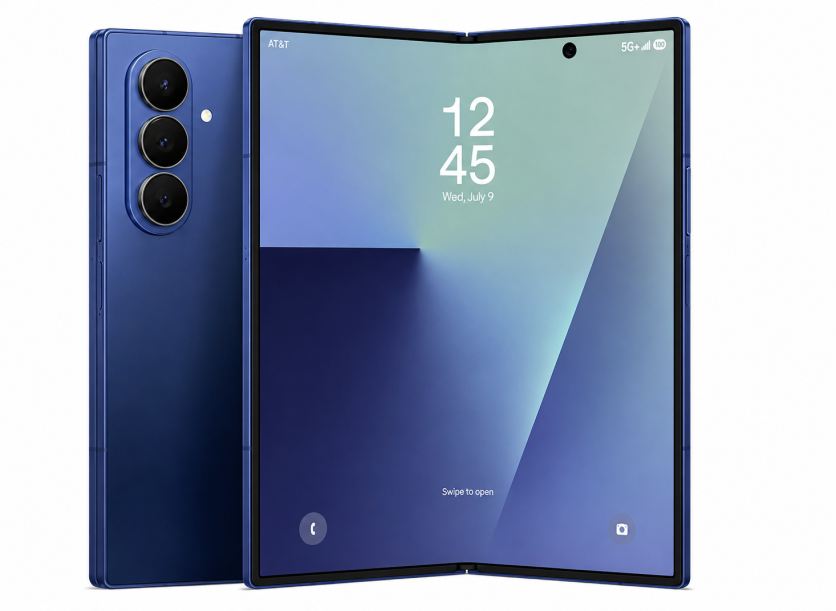
Galaxy Z Fold 7 Samsung.com
For anyone weighing whether to buy a foldable phone before the Galaxy Z Fold 8 launches next week or wait for Apple's foldable iPhone in the fall, Samsung Display just added a third option to the calculus: wait for 2028. On Wednesday, the company did something it has never done in its history — it opened the doors of its South Korea headquarters to journalists — and what was inside was a direct answer to the question of what comes after foldable screens. Samsung Display's first journalist access
Two slidable phone concepts and a near-zero-bezel OLED panel were on display, each at a different point on the readiness spectrum. The slidable concepts are engineering demonstrations with honest timelines attached. The near-zero-bezel panel is the closest to a shipping product. Together, they represent the clearest public preview yet of Samsung Display's roadmap through the end of the decade — timed precisely one week before the Galaxy Z Fold 8 Unpacked event and roughly two months before Apple's anticipated foldable iPhone reveal.
Read more: Samsung Display to Expand a Gen-6 OLED Line in Asan for Apple's Foldable and Future iPhones
Two Slidable Concepts, One Entirely New Category
The first concept, called the Flex Slidable, presents as a compact 4.7-inch slab in its closed state — slim enough to drop in a pocket without thought. Pulling one end causes a hidden section of the OLED panel to emerge from the housing, expanding the screen to 7.2 inches. Flex Slidable's full expansion range That expansion takes the device from phone-sized to near-tablet territory, with no hinge, no crease, and no fold line. During the demonstration, the extension mechanism was deliberately slow — an engineering placeholder that would be replaced by a button-triggered actuator in any production version.
The second concept, the Flex Hybrid, reaches the same 7.2-inch target by a different means: it combines foldable and slidable technologies in a single chassis. The left side of the display folds; the right side slides. According to Samsung Display, this makes the Flex Hybrid the first mobile device to integrate both technologies, a claim that describes exactly the engineering ambition and exactly the engineering challenge involved. Samsung's first hybrid foldable-slidable concept Two different types of mechanical stress act simultaneously on adjacent sections of the same flexible panel, a problem that neither foldable nor slidable engineering has had to solve in isolation.
For a reader currently using a foldable phone, the practical difference between a foldable and a slidable is significant: the foldable's crease — the persistent mark left at the fold line after tens of thousands of open-and-close cycles — is structurally impossible in a slidable design, because there is no single bend point where stress concentrates. The display rolls continuously around internal guide rollers, distributing stress across a longer arc rather than concentrating it at one axis.
What Makes a Slidable Phone So Hard to Build
Samsung Display executive vice president Byung Duk Yang, who leads the Core Component Technology Team, was direct with reporters about the difficulty. "It's not easy, the slidable form factor," he told Tom's Guide. "I know many people are very interested in slidable and stretchable phones. But I'm an engineer, and from the engineer point of view there are many obstacles we have to overcome." Yang's remarks to Tom's Guide
The obstacles Yang referenced are specific. A foldable phone's moving part is a hinge — a passive mechanical joint that rotates around a fixed axis. A slidable phone's moving part is a motor-driven rail system: a powered actuator, a geared mechanism, and a track along which the display housing travels. Every component must maintain precise tolerances so the screen emerges and retracts without catching, snagging, or creating uneven tension on the flexible panel. The battery, which cannot be placed in the path of the moving tray, must be routed around the mechanism — a three-dimensional puzzle that conventional smartphone packaging has not had to solve. Electrical connections to the display must flex and return through thousands of extension cycles without degrading.
The durability standard is what makes this timeline honest rather than pessimistic. At the press day, Samsung Display showed a miniature durability lab where foldable displays are stress-tested to 500,000 open-and-close cycles — the benchmark the company uses before certifying a panel for commercial use. Samsung's 500,000-cycle durability test No equivalent standard exists for slidable mechanisms, because no one has built a commercial slidable phone. Reaching that bar for a motorized rail system is, in Yang's words, not easy. Supply chain reports from Korean industry sources suggest Samsung's mobile division is targeting the first half of 2028 for its first commercial slidable device — a timeline that aligns with Yang's measured language about readiness. Samsung slidable phone 2028 reports
Multiple companies have tried and failed to reach consumers with this form factor. LG demonstrated a functional rollable phone at CES 2021, then discontinued the entire product when it exited the smartphone market that year. Oppo, Motorola, and Tecno each pursued similar concepts without shipping. Samsung is not repeating their path; it is proceeding more slowly, and that caution is itself part of the story.
How Samsung Is Making Bezels Nearly Disappear
While the slidable concepts drew the most attention, the near-zero-bezel panel demonstrated at the press day may be the development with the nearest commercial timeline. The 6.8-inch OLED panel Samsung displayed has a top border measuring just 0.4mm and left, right, and bottom borders of 0.6mm each — dimensions that place the bezels below the threshold of easy visual detection. Samsung positioned the small panel directly behind a tablet-sized display, and observers struggled to locate where one screen ended and the other began.
Achieving that result required solving an engineering problem that has constrained display design for years: where to put the driver circuitry. Every OLED panel requires a display driver integrated circuit (IC) that sends signals to each row and column of pixels. Traditionally, this IC is mounted near the panel edge using Chip-on-Glass (COG) or Chip-on-Film (COF) methods, and its physical footprint sets the minimum width of the side or bottom border. Samsung's solution moves the driver IC further away from the visible edge using Samsung's Y-OCTA on-cell technology — the company's on-cell touch technology, which integrates the touch sensing layer directly into the OLED panel rather than using a separate film layer — and then routes the connection tail by bending the flexible substrate beneath the display stack entirely, concealing it behind the panel rather than letting it occupy border space.
The result is what Samsung calls a 40% reduction in bezel width compared to phones currently on the market. The remaining gap to a true zero-bezel panel is an engineering boundary rather than a conceptual one: the thin-film encapsulation layer that seals organic OLED materials from moisture and oxygen must maintain a minimum perimeter to prevent degradation, and that minimum currently establishes the floor. Yield risk concentrates at the corners, where mechanical stress during manufacturing is highest. Samsung's demonstration of a functional panel at this specification suggests meaningful progress on the yield problem, though the company has not disclosed production volumes or commercial timelines for this design.
Apple is separately reported to be developing a near-zero-bezel design for a future iPhone, using a technique called four-sided bending OLED in which all four panel edges are curved back behind the housing. Whether Samsung Display's bezel reduction approach feeds directly into that development — given the company's exclusive supply agreement with Apple — is not publicly confirmed.
Read more: Samsung and LG Display Start OLED Production for Apple Premium Lineup as BOE Is Shut Out
Why Samsung Display Is Showing This Now
The timing of Wednesday's event is not accidental. Samsung Display held no equivalent press access in its previous history — the company's R&D work has operated behind closed doors since its founding as an independent subsidiary in 2012. Opening its headquarters to journalists the week before its parent company's most important annual product launch, and roughly eight weeks before Apple is expected to announce a foldable iPhone that Samsung Display supplies the panels for, is a deliberate market signal.
Samsung Display controls approximately 41.7% of global AMOLED smartphone panel shipments as of the first quarter of 2026, according to CINNO Research Q1 2026 AMOLED data, and 48% of global OLED revenue for the full year 2025 per UBI Research — a revenue share that substantially exceeds its volume share and reflects the company's dominance in premium, high-margin segments. Those numbers are under pressure. Chinese manufacturers collectively crossed the 50% mark in smartphone AMOLED panel shipments in Q1 2026 for the first time, with BOE's Q1 2026 market share surge pushing its share alone to 20.1% after a 17.7% year-over-year gain, and Chinese panel yield rates on flexible AMOLED lines have risen to approximately 85% — closing a quality gap that was 30 percentage points wide as recently as 2023.
Against that backdrop, demonstrating an R&D pipeline that runs through 2028 and beyond serves a specific purpose: Samsung Display is differentiating on roadmap depth, not current shipment volume. A company that is showing what comes after foldables while its rivals are still catching up on foldables is making a claim about future market position that market share statistics alone cannot make.
The commercial bridge between now and 2028 is already funded. Samsung Display signed Samsung Display's Apple exclusive agreement — a three-year exclusive supply deal to provide foldable OLED panels for Apple's first foldable iPhone, with mass production having started at its Asan and Vietnam facilities in June 2026. Initial production covers approximately three million panels for the 2026 launch. That agreement locks Samsung Display into the most strategically important new product in the smartphone market for at least three generations — securing revenue while the engineering work on next-generation form factors continues.
What Foldable Buyers Should Know Before July 22
Samsung's next Galaxy Unpacked event is confirmed for July 22, 2026, in London, where the Galaxy Z Fold 8, Galaxy Z Fold 8 Wide, and Galaxy Z Flip 8 are expected to launch alongside Samsung Galaxy Glasses and the Galaxy Watch 9 series. The Fold 8 lineup will feature Samsung's Flex Titanium announcement — a titanium-alloy film that is roughly one-third the thickness of a human hair but 20 times stiffer than the polymer film it replaces, providing substantially more stable support beneath the OLED panel when unfolded while retaining the flexibility to fold repeatedly.
For anyone actively shopping, Wednesday's press day creates a specific decision frame. A current foldable phone is a mature, commercially proven product. A slidable phone is a concept with honest engineering obstacles and a realistic but unconfirmed 2028 timeline. A near-zero-bezel panel is closer to shipping but has no announced product attached. None of what was shown at Samsung Display's headquarters on July 15 is available to buy; all of it represents genuine progress toward something that will be. Whether that progress changes the calculation for a 2026 foldable purchase is a question each buyer must weigh for themselves — but Samsung Display has now made the timeline explicit, and the answer is approximately two years away.
Frequently Asked Questions
What is the difference between a slidable and a foldable display?
A foldable display bends at a single point — a hinge axis — causing a crease to develop at that line over time. A slidable display instead rolls around internal guide rollers as it extends from the housing, distributing stress across a longer arc rather than concentrating it at one point. The result is no crease, but the engineering challenge is different: instead of a passive hinge, a slidable requires a motorized rail mechanism, precise tolerances, and a battery routing solution that works around the moving parts.
When will Samsung release a slidable phone?
Samsung Display has not confirmed a commercial timeline. Supply chain reports from Korean industry sources point to the first half of 2028 as the target window for Samsung's mobile division to introduce a commercial slidable device, a timeline consistent with the measured language Samsung Display's engineering leadership used at the July 15 press day. These reports are from unnamed sources and should be treated as credible industry signals, not official commitments.
How does Samsung achieve near-zero bezels on OLED panels?
The primary engineering move is relocating the display driver integrated circuit away from the visible panel edge. Samsung uses Y-OCTA, its on-cell touch technology, to eliminate a separate touch digitizer layer, freeing up packaging space. The connection tail that links the panel to the driver IC is bent entirely beneath the display stack using Chip-on-Film technology, concealing it behind the housing rather than occupying border real estate. The remaining non-emissive perimeter is governed by the thin-film encapsulation layer that seals organic OLED materials — currently the hard floor on how thin a border can get.
Does what Samsung showed at its press day affect whether I should buy a foldable phone now?
Samsung Display showed that slidable phones face genuine engineering obstacles that make a 2028 commercial timeline realistic rather than pessimistic. If you specifically want to avoid the foldable crease, a 2028 slidable may be worth waiting for — if the engineering challenges are resolved on schedule. If you need a large-screen phone in 2026, the Galaxy Z Fold 8 (launching July 22) and the forthcoming Apple foldable iPhone (expected in September) are the available options. The near-zero-bezel panel Samsung demonstrated has no announced product timeline at all. No form factor shown on July 15 is purchasable today.

-
 C114 Communication Network
 -
 Communication Home
