
 Search

Asus.com
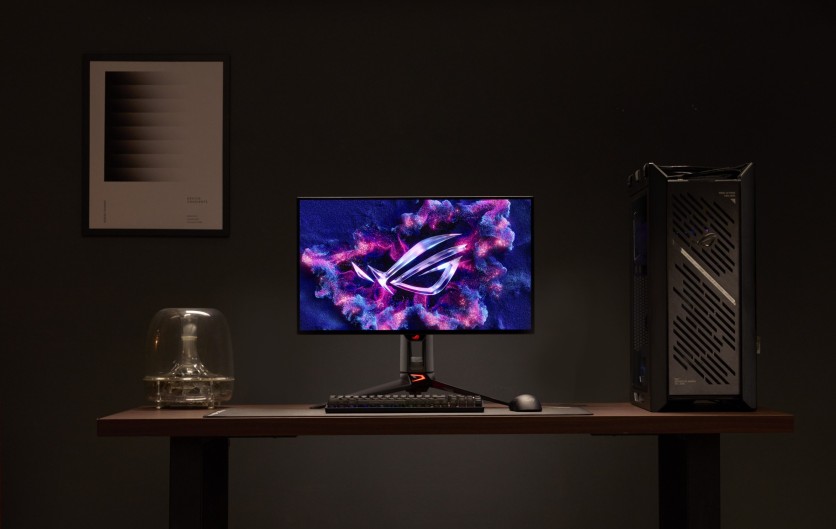
ASUS Republic of Gamers has put its two flagship True Tandem RGB OLED gaming monitors on sale today — the 26.5-inch ROG Swift OLED PG27UCWM and the 31.5-inch PG32UCWM — marking the first time this panel generation has shipped in monitors purpose-built for gaming, according to the official launch announcement. Both displays reach 1,000 nits of peak HDR brightness, offer a hardware hotkey for switching between 4K at 240Hz and full-HD at 480Hz, and carry a gallium nitride power supply that ASUS says reduces waste heat by roughly 35 percent. Pricing has not been published as of today's launch announcement.
Before committing, buyers should know that the underlying LG Display 4-stack architecture brings a documented trade-off: at very low luminance levels — the kind found in dark game scenes and desktop dark modes — the Tandem WOLED panel's digital-to-analog converter produces micro-current variation that can appear as visible banding. Independent display experts at TFTCentral and Rtings.com tested this issue on earlier monitors using the same panel generation, and both LG Display and ASUS have acknowledged the issue in writing.
What True Tandem RGB OLED Is — and How It Gets to 1,000 Nits
Standard gaming OLED panels — whether the white-subpixel WOLED type from LG Display or the quantum-dot QD-OLED type from Samsung Display — rely on a single emissive layer stack. That single stack has to produce all the light the display outputs, which limits both peak brightness and the panel's long-term lifespan, since running one stack hard stresses it continuously.
Tandem OLED solves the brightness problem by stacking multiple emissive layers vertically inside the same panel, connected by a charge-generating layer that couples the stacks electrically while letting each emit independently. Because the light-generating work is distributed across four layers rather than one, each stack runs at a lower current density to hit the same luminance level. The result is proportionally less heat, less per-layer stress, and a brightness ceiling that was out of reach for single-stack OLEDs.
The PG27UCWM and PG32UCWM use LG Display's latest Tandem WOLED architecture in a configuration ASUS markets as "True Tandem RGB OLED," as detailed in the company's availability announcement. The key distinction from older WOLED panels — which add a white subpixel alongside red, green, and blue — is that these monitors use a pure RGB stripe pixel layout with no white subpixel at all. Removing the white subpixel has two practical consequences: text rendering improves because the RGB stripe arrangement eliminates the color fringing that QD-OLED's triangular subpixel layout produces on fine UI elements, and the color volume available at peak brightness expands by up to 27 percent compared to previous WOLED designs.
Peak brightness arrives at 1,000 nits — enough for genuine HDR tone-mapping headroom — alongside a 1,500,000:1 contrast ratio, 99% DCI-P3 color coverage, factory-calibrated Delta E under 2, true 10-bit color output, and Dolby Vision certification, per the official specifications.
Dual Mode: Which Setting Is This Monitor Actually For?
Both monitors ship with what ASUS calls Dual Mode — a hotkey toggle between two operating states. In 4K@240Hz mode, the panel runs at full 3840×2160 resolution with a 240Hz ceiling, drawing on DisplayPort 2.1a UHBR20's full 80 Gbps of bandwidth. In FHD@480Hz mode, the panel drops to 1920×1080 and pushes its refresh ceiling to 480Hz — a configuration aimed at competitive players in fast-paced titles where sub-frame motion clarity matters more than pixel count.
The 480Hz ceiling at FHD puts these panels among the fastest OLED displays currently available to consumers at this size and resolution combination. For context, the PG27AQWP-W — ASUS's competing Tandem WOLED monitor at 1440p/540Hz — launched at $1,099 earlier in 2026.
One practical note on the 480Hz mode: the gray-banding characteristic described below is more pronounced at higher refresh rates due to the shorter per-frame pixel charging window, which makes near-black current control harder for the panel's driver circuitry.
Read more: ASUS ROG Strix OLED XG34WCDMTG Review: Why This 240Hz 34-Inch OLED Monitor Is Turning Heads
GaNFET Power Supply: Why Gallium Nitride Changes the Longevity Equation
The PG27UCWM and PG32UCWM replace the conventional silicon MOSFET-based power supply found in previous ROG OLED monitors with a gallium nitride field-effect transistor (GaNFET) design. The reason this matters for an OLED monitor — rather than just a charger — comes down to heat.
Gallium nitride is a wide-bandgap semiconductor: its electrons can handle higher voltages and jump between states faster than silicon's can. Faster switching means the power supply's transformer, inductors, and capacitors can be built smaller at the same wattage. Lower losses in the switching transistors mean less energy becomes waste heat. ASUS's measurements put waste heat reduction at roughly 35 percent, vent temperature reduction at 10 percent, and overall panel lifespan improvement at an estimated 25 percent compared to the silicon-based PSU in previous-generation monitors.
ASUS's own ROG blog further specifies "up to 30% higher efficiency" for the GaNFET design compared to previous PSU solutions. These figures are ASUS-stated and await independent verification through third-party testing.
OLED panels degrade through both electrical stress and heat. By reducing vent temperature, the GaNFET PSU addresses the thermal half of that equation — a less common engineering focus in a category where most longevity work targets pixel-level burn-in management rather than the power supply itself.
What to Know Before You Buy: The Gray-Banding Trade-Off
Since Tandem WOLED monitors began shipping in Q4 2025, a documented uniformity issue has affected some units at very low luminance levels. Display reviewer Simon Baker at TFTCentral, working with independent confirmation from Rtings.com, Monitors Unboxed, PCmonitors.info, and HDTVtest, characterized the issue through direct technical engagement with ASUS and LG Display.
The root cause: Tandem WOLED panels operate their display driver (DAC) at extremely small currents when rendering near-black content — shades below roughly 1 nit of luminance. At this level, a fixed micro-current variation between the driver's channels becomes proportionally large. LG Display's own measurements show that at 8 gray (approximately 0.26 nits), the variation between minimum and maximum current across channels is about 31 percent — enough to be visible as horizontal or vertical banding in solid dark areas. At 32 gray (approximately 4.82 nits), the same absolute variation represents just 1.25 percent and is imperceptible.
LG Display acknowledged the limitation directly, stating that this behavior reflects a known physical characteristic of current Tandem OLED technology at very low gray-level driving, rather than a panel abnormality or quality defect. ASUS confirmed that a firmware-only fix is unlikely, indicating that the probability of resolving this physical phenomenon purely via firmware is extremely low.
The issue is more pronounced on Tandem WOLED panels than on earlier-generation WOLED or on QD-OLED panels, and it worsens with higher refresh rates — so the FHD@480Hz mode is the higher-risk configuration for this particular characteristic. Both manufacturers report that manufacturing quality control improvements are underway, with Gigabyte confirming that the vertical banding situation has been significantly improved compared to earlier batches in newer production runs.
Practical guidance for prospective buyers: the banding is most visible in controlled test patterns at under 1 nit — a condition more common in desktop dark mode and dark-scene gameplay than in typical use. Running a panel refresh cycle when the monitor arrives, allowing a bedding-in period before testing, and evaluating the specific sample against real-world usage rather than standardized test patterns are the steps both ASUS and TFTCentral recommend before pursuing a return or replacement.
AI Agent Controls and Connectivity
The PG27UCWM and PG32UCWM include ASUS Display Control CLI and Agent Skill software, allowing compatible AI agents to query and adjust monitor settings through natural-language requests, per the launch announcement. A single request can coordinate multiple settings across one or more monitors — switching to FHD@480Hz and activating FPS mode for competitive play, or setting a specific color temperature and brightness profile for evening viewing. The CLI runs locally; the agent translates intent into a sequence of supported hardware-level commands.
Connectivity includes two HDMI 2.1 inputs, DisplayPort 2.1a UHBR20 (full 80 Gbps), USB-C with 90W Power Delivery for laptop users, and a 3.5mm headphone output, according to the official specifications.
Burn-In Protection: What OLED Care Pro Adds
ASUS bundles Enhanced OLED Care Pro across both models, built around an upgraded Neo Proximity Sensor that detects user presence at five adjustable sensitivity levels, as detailed in the launch announcement. The Auto Away timer — configurable from 1 to 15 minutes — activates a back-image display when the monitor detects user absence, reducing static-pixel exposure. All OLED Care settings are managed through the ASUS DisplayWidget Center application.
The burn-in protection suite addresses the other half of long-term OLED degradation: differential pixel wear from prolonged static content. Together with the GaNFET thermal design, ASUS's approach treats both the electrical and thermal causes of OLED aging within the same product.
Specs
| Specification | PG27UCWM | PG32UCWM |
|---|---|---|
Panel Size (actual) | 26.5 in | 31.5 in |
Panel Type | True Tandem RGB OLED | True Tandem RGB OLED |
Resolution (High-Res Mode) | 3840×2160 (4K) | 3840×2160 (4K) |
Refresh Rate (High-Res Mode) | 240Hz | 240Hz |
Resolution (High-Speed Mode) | 1920×1080 (FHD) | 1920×1080 (FHD) |
Refresh Rate (High-Speed Mode) | 480Hz | 480Hz |
Peak Brightness | 1,000 nits (HDR peak) | 1,000 nits (HDR peak) |
Contrast Ratio | 1,500,000:1 (typ.) | 1,500,000:1 (typ.) |
Response Time | 0.03ms (GTG) | 0.03ms (GTG) |
Color Coverage | 99% DCI-P3 | 99% DCI-P3 |
Color Depth | 10-bit (1.07B colors) | 10-bit (1.07B colors) |
Color Accuracy | Delta E<2 (factory calibrated) | Delta E<2 (factory calibrated) |
Surface Coating | TrueBlack Glossy | TrueBlack Glossy |
HDR Certification | Dolby Vision / DisplayHDR 400 True Black | Dolby Vision / DisplayHDR 400 True Black |
Adaptive Sync | G-SYNC compatible / FreeSync Premium Pro | G-SYNC compatible / FreeSync Premium Pro |
Connectivity | 2× HDMI 2.1, 1× DP 2.1a UHBR20, 1× USB-C (90W PD) | 2× HDMI 2.1, 1× DP 2.1a UHBR20, 1× USB-C (90W PD) |
Burn-In Protection | Enhanced OLED Care Pro, Neo Proximity Sensor | Enhanced OLED Care Pro, Neo Proximity Sensor |
Power Supply | GaNFET-based | GaNFET-based |
Price | Not yet published | Not yet published |
Both monitors are available for purchase as of July 15, 2026, but ASUS has not published official pricing through its retail channels. Pricing is expected to appear through authorized retailers in the days following launch. For context, ASUS's ROG Swift PG27AQWP-W — a 27-inch 1440p Tandem WOLED monitor at 540Hz — launched earlier in 2026 at $1,099.99; these 4K Tandem RGB OLED models are positioned above that tier.
Read more: ROG Xbox Ally X20 Debuts at Computex 2026: First OLED, AR Glasses Bundle, $2K+ Price Tag Likely
Frequently Asked Questions
What is True Tandem RGB OLED, and how is it different from QD-OLED and standard WOLED?
True Tandem RGB OLED stacks four emissive layers inside a single panel, connected by a charge-generating layer between each stack. Each layer contributes to total light output, letting the panel reach 1,000 nits at peak HDR brightness while keeping per-layer current density low — which reduces heat and extends lifespan. The "RGB" designation means the pixel layout uses only red, green, and blue subpixels with no white subpixel, unlike standard WOLED panels (which add a white subpixel for brightness and can produce color fringing). QD-OLED panels from Samsung Display use a triangular or diamond-shaped subpixel arrangement layered over a blue emissive base — effective for brightness and color, but also prone to fringing on fine text. The RGB stripe layout on these ASUS monitors sidesteps both issues.
What is the gray-banding issue on Tandem WOLED panels, and does it affect the PG27UCWM and PG32UCWM?
Gray banding appears as faint horizontal or vertical stripes in very dark content — most visible in solid near-black areas below 1 nit of luminance, such as desktop dark modes or night scenes in games. It stems from the 4-stack structure's digital-to-analog converter operating at extremely small currents in that brightness range, creating proportionally large variation between driver channels. LG Display characterizes this as a known physical characteristic of current Tandem OLED technology, not a defect. The issue affects Tandem WOLED panels generally — which is the underlying panel type in the PG27UCWM and PG32UCWM — and is more pronounced at higher refresh rates, making FHD@480Hz mode the configuration where it is most likely to be visible. Independent reviewers at TFTCentral and Rtings.com have tested and documented this. Running a panel refresh cycle on arrival and allowing a break-in period before evaluating the sample can help; ASUS offers RMA support for buyers who find the issue unacceptable in real-world use.
Do these monitors support HDR, and what certification do they carry?
Yes. Both the PG27UCWM and PG32UCWM carry Dolby Vision certification and comply with the VESA DisplayHDR 400 True Black standard — a certification that requires verified true-black performance alongside HDR brightness, distinct from the standard DisplayHDR 400 tier applied to LCD monitors. True 10-bit color output provides access to over one billion color values, and factory calibration ensures Delta E under 2 out of the box. The 99% DCI-P3 color gamut covers virtually all cinema-standard content.
When will pricing be announced, and where can I buy these monitors?
ASUS has confirmed retail availability as of July 15, 2026, but has not yet published official MSRP for either model. Pricing is expected to appear through ASUS's authorized retail partners in the days following today's announcement. The PG27UCWM at 26.5 inches and the PG32UCWM at 31.5 inches represent the company's current flagship gaming monitor tier — above the $1,099.99 Tandem WOLED 1440p/540Hz model released earlier in 2026.

-
 C114 Communication Network
 -
 Communication Home
