
 Search

Makera
Walking past the Makera booth at CES 2026, the first thing you notice isn't the smell of sawdust or the high-pitched whine of a typical workshop. Instead, it's a row of sleek, enclosed machines that look more like high-end kitchen appliances than industrial mills. For its third year at the show, Makera has moved beyond just making "smart" tools; they are attempting to do for CNC milling what the smartphone did for photography: make the complex invisible.
The Z1: Industrial Rigidity in a Desktop Frame
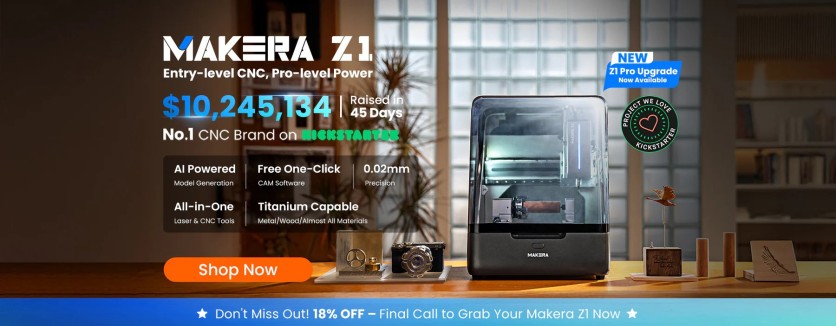
The star of the show is the Makera Z1, an entry-level desktop CNC that managed to raise over $10 million during its Kickstarter campaign. While most budget machines rely on flexible aluminum extrusions, the Z1 is built around a one-piece cast aluminum frame, providing the "industrial grade" rigidity needed for precision work on everything from hardwoods to non-ferrous metals like aluminum and brass.
Makera
"We just close out the Kickstarter campaign that mad, more than $10 million raised more than 7000 backers," Jason, a Makera representative, shared during a floor demonstration. "Folks are able to see the new machine get hands-on with it... and make some cool stuff right here with them."
The machine features a 150W closed-loop spindle that maintains torque under load and an integrated "AeroDust" collection system that cools the tool while simultaneously vacuuming away debris. This focus on a clean, quiet, and enclosed environment is what makes the Z1 particularly attractive to "apartment-dwelling makers" or educators who want professional results without a dedicated shop space.
Software as the "Cheat Code": Makera Studio and AI Craft
Hardware is only half the battle in CNC; the true barrier has always been the software. At CES 2026, Makera launched Makera Studio and its AI tool, AI Craft, to specifically address this "steep learning curve."
"We have an AI tool called AI Craft... that will design a specific model for CNC," Jason explained. "Users don't even need to have any CAD experience or CAM experience. Our AI tools will generate the model, tell you what tools you need, and generate the code to actually manufacture it for you."
This "Text to Relief" workflow allows a user to simply type a concept or upload a 2D photo, which the AI then converts into a 3D relief model with optimized toolpaths. By abstracting away complex settings like feed rates and spindle speeds through a "Smart Machining Wizard," Makera is essentially providing a "cheat code" for newcomers to create complex 3D objects like jewelry, PCBs, or custom chess pieces within minutes.
A Positively Critical Take: Accessibility vs. Automation
From a critical perspective, the Z1 represents a calculated trade-off. To keep the price point under $1,000, Makera utilized Acme lead screws instead of the ball screws found in their more expensive Carvera Air model. While this ensures high stiffness, it does result in slower rapid speeds. Additionally, unlike the flagship Carvera, the Z1 lacks a fully automatic tool changer (ATC), opting instead for a manual "quick change" lever system.
However, these omissions seem intentional. By focusing on "Smart features" like auto leveling, a built-in monitoring camera, and the intuitive AI software, Makera is betting that beginners value ease of use and price over the raw speed of a fully automated industrial machine.
Looking Toward 2027: The Intuitive Leap
As the company looks toward next year, the focus remains firmly on the software ecosystem.
"I assume there's going to be a lot of big leaps and bounds in the software," Jason noted regarding their 2027 vision. "It's going to get even more intuitive. It's going to get even easier, even more capable for our user... we definitely continuing to look at how we can improve our products."
The message at the Makera booth this year was clear: the era of the "intimidating" CNC is over. By lowering the barrier to entry with AI-driven modeling and affordable, rigid hardware, Makera is turning "serious creation" into something as accessible as 3D printing, one cast aluminum frame at a time.

-
 C114 Communication Network
 -
 Communication Home
