
 Search


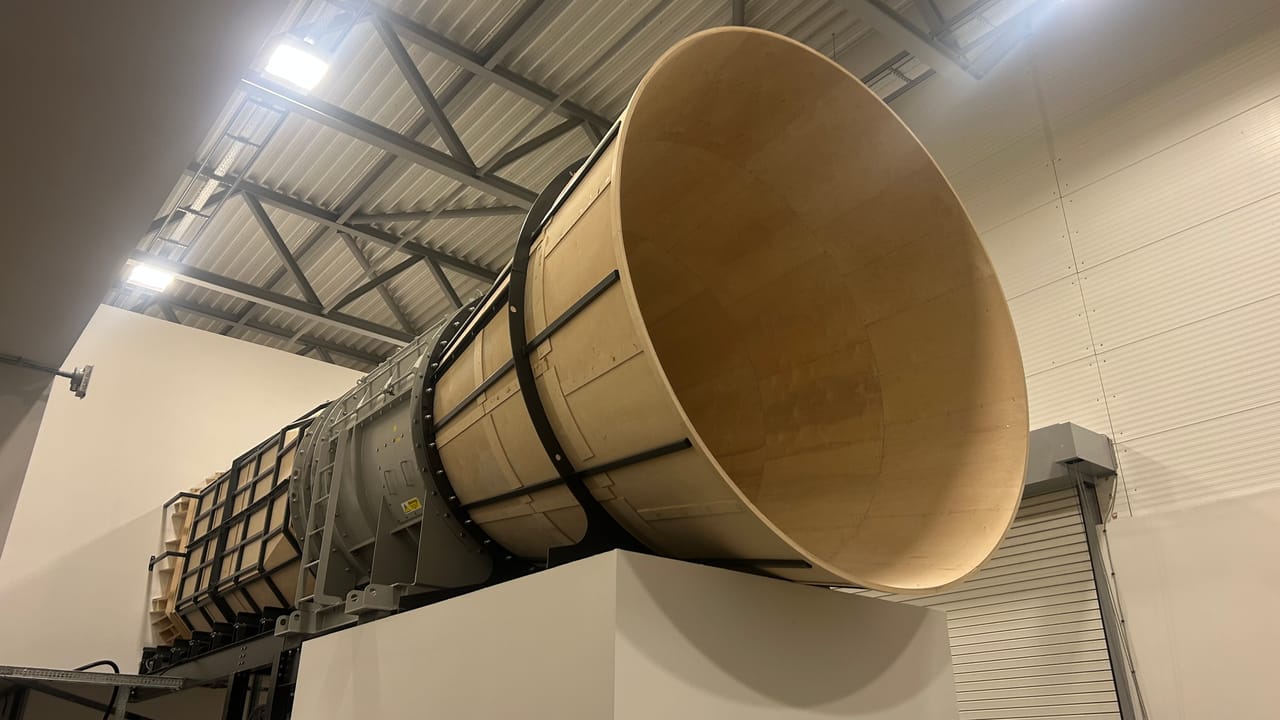
Virgin Media O2 is using a wind tunnel (pictured) at the University of Manchester to measure the impact of weather on mast equipment.(Source: Iain Morris/Light Reading)
The huge fan blades of the wind tunnel at the University of Manchester would normally blow air at an elite cyclist pedaling on a stationary yet tiltable bike. More recently, the object in the wind's path has been a set of radios and antennas held together by a steel frame. Researchers crawl along with sensor-tipped poles to measure the invisible forces swirling around the equipment. At the sides of the tunnel, executives and reporters watch curiously as the wind blows harder and the temperature drops. Just what is going on?
The windy project came out of attempts by Virgin Media O2 (VMO2) to construct basestations more efficiently and relieve pressure on the masts from which they hang. Ordinarily, a telco would have to assemble parts on the ground or while dangling from a tower. "They'd hang the new antennas on, and they'd hang the radios on, and then in the wind and the rain they'd cable about 200 connections on the tower," said Rob Joyce, VMO2's director of mobile access engineering. His experience told him that whole process could be improved.
During a previous stint working for Nokia in Australia, Joyce got to know Michael Symes, the co-founder of an engineering company called Vecta. It is the inventor of the ExoFlex, the steel frame being pummeled by artificially generated winds in Manchester. Basestation parts can be securely fastened to it before the assembled unit is dispatched to a mast.
"The radios go to the Vecta facilities, the antennas come to the Vecta facilities, and on a single ExoFlex frame we bolt the radios on in a controlled manner," said Joyce. "Everything is cabled up in a factory in controlled conditions, and then this whole unit is shipped to site."
Before the ExoFlex came along, swapping out a site would take VMO2 between four and seven days, according to Joyce. Using Vecta's product has already allowed him to cut that installation time to just a day and save money. But Joyce is also confident that the ExoFlex takes pressure off the supporting tower, partly by reducing the "sail area" that is affected by wind. If masts do not have to be reinforced, VMO2 should be able to pay less to mast providers such as Cornerstone, its joint venture with VodafoneThree, for continued use.
"What we want to show them is that the actual sail area, as we call it – the wind load of this structure – is much less than for the traditional way you used to charge us, and that actually we'll pay you for the number of radios and the frequency bands, but because the wind load is now less you don't need to strengthen that tower," said Joyce.
Yet the initial reaction of the tower companies to those claims was less positive. "We have a CAD model of that new structure," said Joyce. "We've proven it in the model. We've shown it to Cornerstone and they're going, 'Well, that's a model. Do we really want to put it on our towers and see them fall over?'"
The winds of change
Enter the University of Manchester. As the home of one of the UK's largest wind tunnels, it has worked for years with the country's Olympic cyclists to study the effect of wind flows on performance. Blasting air at industrial equipment is something new for its team of researchers, but the science is the same. By creating what look like heat maps to show areas most buffeted by winds, the university hopes to furnish VMO2 with real-world data it can use to back up its case.
The tunnel can generate air flows of more than 20 meters per second, equal to about 45mph. Although much higher speeds would occur during a bad storm, the laws of aerodynamics mean the data can be used to calculate what the impact would be in those conditions, said Dr. Mostafa Nabawy, an expert in aerospace engineering at the University of Manchester.
Out in the open, natural wind is also far more unpredictable, even temperamental, changing direction or surging without notice. While the university cannot replicate that behavior in a lab, the important thing is being able to establish a control or baseline from which it can extrapolate, said Nabawy. "It's a good job people can't see air, because they would be scared," he told guests. Even in the controlled environment of the tunnel, the complex movements of air around the ExoFlex and its radios look like a tangle of colored wires on a display.
The data produced and the tower companies' reaction to it could be extremely important to VMO2. The operator previously allocated £700 million (US$920 million) to mobile network investment this year after spending the same amount in 2025. Joyce estimates that BT, the telecom incumbent, spends about £900 million ($1.2 billion) each year in the same area, while VodafoneThree has pledged to invest roughly £1.1 billion ($1.44 billion) annually in capital expenditure.
"I've got the least amount of budget," Joyce told Light Reading. He could also be squeezed after VMO2 this month said it would try to save about £800 million ($1.05 billion) in annual spending by 2029. Thousands of jobs will be cut. "Innovation is the only way that we're going to do more now with less money," said Joyce. He also emphasized that VMO2 is not asking tower companies to drop prices. "We're just avoiding costs."
Innovation does not seem like an exaggerated claim in this case. No other UK telco has done anything like it before, according to Joyce, and Vecta has no customers in Europe besides VMO2, said Symes after the wind tunnel's fan blades had stopped turning. How the affair plays out could determine whether opportunities emerge for his company at other telcos in the region. The results from Manchester might even influence the future design of the ExoFlex, Symes acknowledged. Before then, both he and Joyce will be waiting to see if a wind tunnel can blow some good fortune their way.

-
 C114 Communication Network
-
 Communication Home
