
 Search

(Source: Walter Cicchetti/Getty Images)
SpaceX's plan to build a hybrid satellite-terrestrial wireless network took additional shape Thursday (October 8) with its proposed deal to acquire 100% of Grain Management's portfolio of 800MHz spectrum. That'll give SpaceX up to 14MHz of paired spectrum in the 800MHz band.
Financial terms were not disclosed, though speculation is that SpaceX will be paying in the neighborhood of $8 billion. But the transaction, which requires FCC approval, is poised to provide SpaceX with critical lowband, long-range spectrum that can penetrate walls and rooftops, effectively filling a big gap in its spectrum holdings and its ambition to reach customers via satellite and terrestrial networks. SpaceX's ability to someday roll out a terrestrial network, particularly in the lowband, has been a major question amid the reluctance of AT&T, Verizon and T-Mobile to sign SpaceX/Starlink to an MVNO deal.
Stocks for the Big Three dropped in the wake of Thursday's announcement. In Friday morning trading, AT&T was down 6.44%, T-Mobile shares were down nearly 10%, and Verizon shares had dropped 5.7%.
But the potential of a terrestrial, low-band buildout from SpaceX was a boon for the tower stocks, with SBA Communications shares up 7.19% at last check Friday, with American Tower up 8.46% and Crown Castle up a healthy 14.76%.
Are the spectrum stars aligning for SpaceX?
Grain Management acquired the 800MHz portfolio from T-Mobile in August 2026 in exchange for $2.9 billion in cash and Grain's 600MHz spectrum, which provided T-Mobile with a way to reinforce the reach of its 5G signals in parts of the US.
Roger Entner, analyst and founder of Recon Analytics, predicted several weeks ago that it made sense for Grain's 800MHz portfolio to go to SpaceX: "Grain is not a terminal buyer for the 800MHz it acquired from @TMobile. In my view, it ends up with @Starlink as the foundation of a terrestrial voice layer," he wrote on X on August 12.
Notably, the SpaceX-Grain transaction was announced the day after the FCC proposed to auction 25MHz of midband spectrum in the 1675MHz-1695MHz and 2020MHz-2025MHz bands for fixed and mobile use, or a possible hybrid.
It's not clear if SpaceX will bid in that auction, but Entner told Light Reading the bands fit well with some of Starlink's existing spectrum as well as Ligado's spectrum, which could become an acquisition target.
No matter how that plays out, the pieces are there, says Entner, who remains convinced that SpaceX will make good on its pledge to build out terrestrial networks that can work in tandem with its space-based networks.
"It's going to happen. It's not an if; it's a when," Entner said.
SpaceX and Elon Musk are also saying as much, holding that the approach underway will enable the company to provide a hybrid network capable of delivering service indoors, outdoors and in areas not reached by cellular terrestrial networks. The Grain deal also comes soon after the FCC approved SpaceX's plan to build a next-generation direct-to-device (D2D) network comprising 15,000 satellites.
"This prime low-band spectrum addresses one of the key remaining technical gaps that will pave the way for Starlink Mobile to become a major mobile carrier in the US," the company said in this blog post, noting that Grain's spectrum will help to complement Starlink Mobile's global 2GHz spectrum.
"Once we receive final FCC approval, Starlink Mobile will deploy a flexible architecture combining our satellite-to-mobile constellation in space with an advanced terrestrial deployment that can seamlessly connect devices everywhere ... Critically, most existing mobile devices already support this underused band," the blog post added.
"This is the last critical piece of the spectrum puzzle needed for SpaceX to provide complete phone coverage in America," Musk said of the proposed Grain deal in a post on X.
'T-Mobile's layer cake on steroids'
Though the FCC opened up Grain's 800MHz spectrum for satellite use, LightShed Partners analyst Walt Piecyk believes it will be used terrestrially to complement SpaceX's coming next-generation satellite network and its larger 2GHz holdings.
"We doubt SpaceX will bother putting this spectrum in its satellites," he said in a blog post (registration required). "Low-band frequencies require massive antennas, which are not ideal for satellites produced at scale. Instead, we expect the 800MHz spectrum to primarily become the base layer of a terrestrial network, complemented by an even larger and likely unparalleled layer of capacity from its next-generation satellite network."
This approach "is T-Mobile's layer cake on steroids," Piecyk said in a reference to T-Mobile's diverse use of spectrum bands to deliver reach and capacity.
But is it enough? Some say no
MoffettNathanson also has held in recent reports that it is "likely" SpaceX would move to acquire Grain's lowband spectrum. While that's a necessary piece of SpaceX's spectrum puzzle, MoffettNathanson analyst Craig Moffett doesn't believe it's enough to put SpaceX in position to compete head on with the Big Three. He still holds that SpaceX will need to cut an MVNO deal to become a viable competitor to AT&T, Verizon and T-Mobile, and that SpaceX's ongoing spectrum spree is one way to bring them to the negotiation table.
"To be sure, SpaceX management is correct in noting that low-band spectrum is necessary for coverage and in-building penetration. But SpaceX is still far from having the assets needed to offer a service that would be competitive with the services offered by the Big Three carriers," Moffett explained Friday in an emailed research note. "Our conclusion then, and now, was that Starlink's only path to creating a viable competitor to the Big Three carriers would be to secure an MVNO agreement from one of the three of them."
New Street Research shares this skepticism, noting that SpaceX will "significantly lag" the Big Three on low-band spectrum. Additionally, the low-band spectrum being acquired by SpaceX are not currently compatible with its V1 or V2 direct-to-device satellites, they added.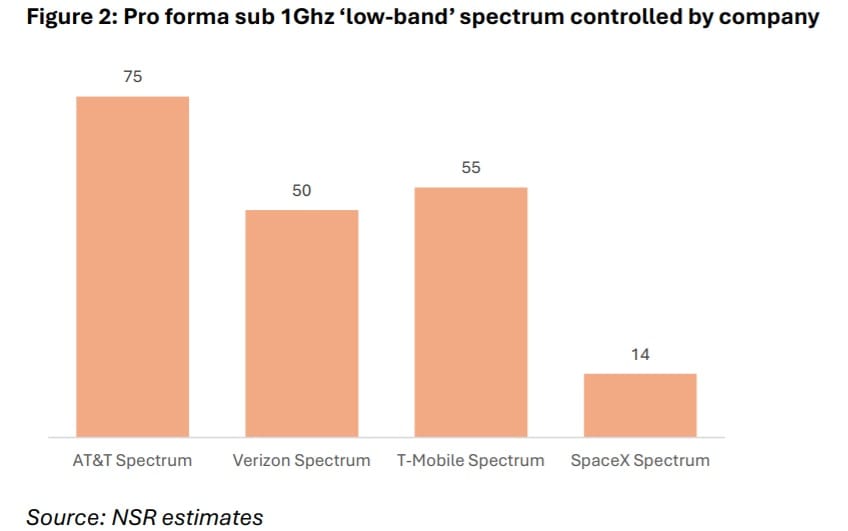
Will SpaceX size up Dish Wireless' assets?
LightShed's Piecyk reiterated his position that SpaceX should try to acquire the legacy Dish Wireless network, which is inching toward an auction, with EchoStar serving as the stalking horse.
"Stepping into the Dish bankruptcy to pick up those radios looks like a cheap no-brainer," the analyst explained. "So far, SpaceX hasn't shown its face. To be fair, this is a relatively minor decision in the context of SpaceX's much larger plans and frankly small relative to EchoStar's overall value opportunity."
SpaceX targets 'standards-based' approach
In its public interest statement on the proposed Grain transaction that is seeking an expedited approval from the FCC, SpaceX said it intends to tap into this "underused paired, broadband-ready, low-band spectrum" to support its evolving hybrid satellite-terrestrial architecture.
On the terrestrial side, SpaceX said it will "operate standards-based advanced wireless equipment," relying on radios feeding antennas on towers, rooftops and other structures. "SpaceX will engineer this overlay to meet the Grain Approval Order's construction benchmarks," the company said.
SpaceX thinks the FCC should quickly approve the transaction, arguing that it will help to drive more mobile competition, and that SpaceX has a proven track record when it comes deploying systems and services, noting that it beat deployment milestones for its first-generation satellite broadband system.
Transferring control of the Grain licenses to SpaceX "places them with an operator that can satisfy either set of benchmarks and that will put every license to productive use," the company said. The transaction, SpaceX added, "will increase competition in the mobile services market."
Don't expect much static from the FCC. "Given the current administration's pro-space predilection, we expect it to be fairly straightforward though SpaceX will need to give evidence of its planned deployment," reckoned the New Street Research analysts.
Editor's note: The story has been updated with commentary from New Street Research.

-
 C114 Communication Network
 -
 Communication Home
