
 Search

(Source: AT&T FirstNet)
At the recent Vision 2026: FirstNet Users Summit, hosted by the Public Safety Broadband Technology Association (PSBTA), there was a big US map on display for attendees to stick pins in the places where they need coverage and submit written requests.
The activity was a first for the PSBTA's annual event, which attracted around 430 people from public safety, and illustrated that network coverage remains the biggest issue for many first responders when they rely on 4G and 5G to communicate wherever an emergency takes them.
The group plans to share this user input with the First Responder Network Authority (FirstNet Authority) as well as AT&T, said Richard Carrizzo, president of PSBTA.
The effort would add to the work the FirstNet Authority already does with public safety organizations to collect data to determine where its contractor, AT&T, should build coverage. "They have their own way. We're just providing a different type of data," said Carrizzo, who served on the FirstNet Authority board of directors for six years after retiring from a 30-year career as fire chief in the Kansas City area.
He would like to see the FirstNet Authority hold more data gathering sessions across the country and find other ways to collect data "to come up with a strategic plan to share with AT&T ... and come together to get better coverage."
"Coverage will probably always be an issue in the states and on the islands. And I get it. The carriers have got to make business decisions. They're not going to put a tower where there's only a few people," he said. "But [it's] how do these two entities work together on ensuring coverage that makes sense financially on both sides and best meets public safety needs."
Matt Walsh, assistant VP for FirstNet and NG911 products at AT&T, who was also at the event, said the map with pins was an "innovative way" to engage with public safety users. At last year's event, in a session about user requirements, he recalled an attendee stood up and said he wanted three things: "coverage, coverage and coverage."
350 sites in the works
The FirstNet Authority allocated $1.1 billion of its fiscal 2027 budget, which starts this month, for network improvements and approved 220 new cell sites in rural areas for AT&T to build based on public safety input. There are now 350 FirstNet sites in development. These will add to 1,000 sites completed in 2025.
A few hundred looks like a drop in the ocean for a country with nearly half a million cell sites. But Walsh said it is "a tremendous investment." The 350 sites, funded by the public-private partnership, are incremental to AT&T's commercial build, which also benefits FirstNet users. Likewise, the FirstNet sites benefit AT&T's consumer and business customers when not prioritized for first responders.
A recent example is a new 5G site in Horseshoe Beach, Florida, a small coastal town. "We likely would have never been able to have the business justification to go build there. But because of this process and the feedback from public safety, we launched a tower in that location that probably never would have been built," said Walsh.
For Ken Rehbehn, analyst with CritComm Insights, the FirstNet picture is mixed. "[FirstNet Authority] have significantly undershot what they could have accomplished in the years since the legislation was created. But you cannot deny the value of FirstNet being established and resetting the competitive picture in the US to give public safety agencies the priority they need," he said.
Creating FirstNet ensured public safety communications has "quality of service, priority and pre-emption" and it encouraged competitors to respond, giving first responders more options for coverage and resilience, he explained.
Mobile satellite could fill gaps, like T-Satellite
AT&T is looking to emerging mobile satellite direct-to-device (D2D) capabilities to help fill network coverage gaps but does not expect to launch services until next year. If FirstNet users want satellite connectivity to their smartphones, their only option is T-Mobile's T-Satellite service.
T-Satellite, via an exclusive Starlink tie-up, has been available for more than a year for consumers as well as with T-Priority, T-Mobile's service for first responders provided as a network slice on its 5G standalone (5G SA) network.
Rehbehn said "public safety folks in rural US are very pleased with the capabilities" of T-Satellite.
The carrier does not disclose number of customers for T-Priority or T-Satellite, or how much D2D traffic is used by first responders compared to consumers. However, T-Mobile indicated that usage is very low and mostly in national parks.
AT&T and Verizon took a different route and partnered with AST SpaceMobile on an initiative that aims to deliver mobile broadband D2D, unlike T-Satellite, which is mostly texting and some light data.
AT&T is trialing D2D and has built four ground gateways to support services. Commercial availability depends on AST SpaceMobile getting more satellites into orbit, which is behind schedule. The satellite operator expects to have 45 satellites in orbit in early 2027, but it has so far launched 13. It has previously said that about 25 satellites would be needed to support intermittent coverage in the US.
The carrier also joined forces with T-Mobile and Verizon in a satellite D2D joint venture aimed at eliminating "coverage dead zones." While they will work together for rural coverage, each carrier's existing satellite partnerships will remain in place.
Supplementing coverage for FirstNet users has long been part of the plan for AT&T's D2D strategy.
"Public safety is really excited about satellite ... We definitely see satellite as something that's going to be able to provide that connectivity – voice, data access – to the network where it's not available today," said AT&T's Walsh.
At the FirstNet Users Summit, a session on satellites was "heavily attended," which showed users are interested in learning more about what would be "a viable tool" in their toolbox, said Carrizzo.
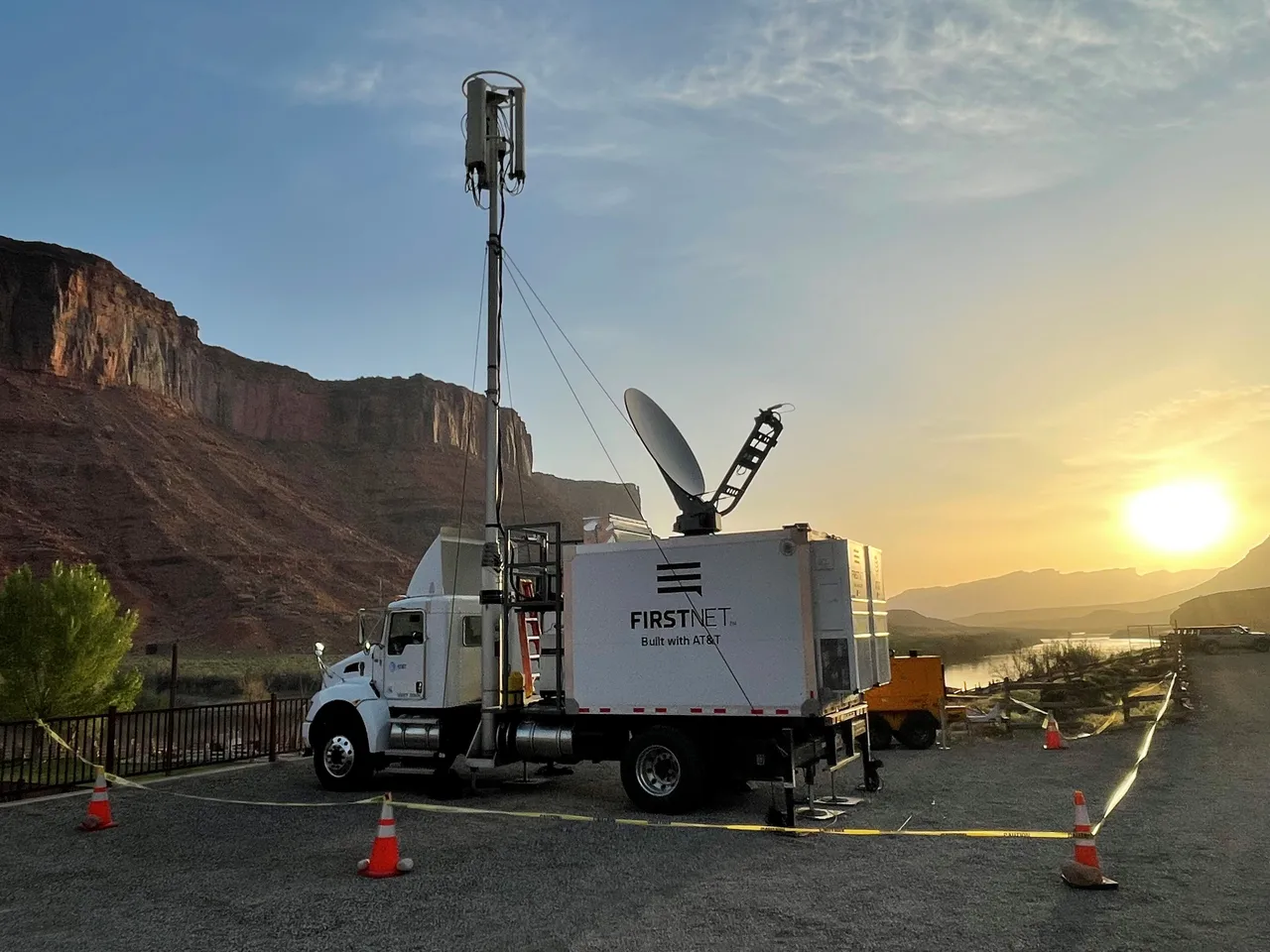
Of course, AT&T already uses low-Earth orbit (LEO) and geostationary satellites (GEO) for backhaul to connect temporary units, such as a cell tower on wheels or compact rapid deployables. With D2D, first responders get satellite connectivity direct to their devices when the terrestrial network is not available.
Users just need it to work
The PSBTA's role is to educate first responders, public safety organizations and government about FirstNet's broadband technology. Along with satellite connectivity, other developments discussed at the event included the relatively new Fusion offering and features enabled by the 5G SA core network.
Fusion meets public safety's need for interoperability, according to Walsh. The push-to-talk platform "brings together multiple communication types" including cellular and land mobile radio (LMR) so that different agencies can "communicate and operate as one."
The 5G SA core is enabling 15% faster uplink speeds and public safety is "using more uplink than anybody else on our network" to share "situational awareness," he said. "With Fusion, first responders can hit a button and share live with their talk group whatever they're looking at so they get a live video feed of the situation."
But whether it's satellite D2D, Fusion or the 5G SA core network functionality, public safety users are tough customers who just need the technology to work because lives depend on it.
As an experienced first responder himself, Carrizzo said there will always be early adopters, but most public safety users won't use a new product until they can be sure it works "100% of the time, 24 hours a day, 365 days a year."
That's a high bar for public safety service providers – not only for FirstNet, but also for T-Priority and Verizon's Frontline.
Update: The article was updated to correct that PSBTA plans to share the user input with AT&T and FirstNet Authority. It originally stated the information would also be shared with T-Mobile and Verizon.

-
 C114 Communication Network
 -
 Communication Home
