
 Search

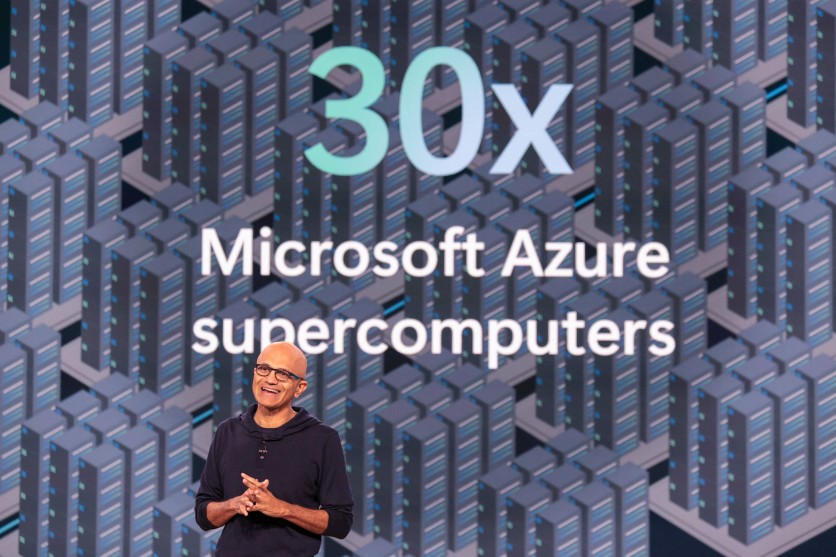
Microsoft Chairman and Chief Executive Officer Satya Nadella speaks speaks about Microsoft Azure during the Microsoft Build opening keynote at the Seattle Convention Center Summit Building in Seattle, Washington on May 21, 2024. JASON REDMOND/AFP via Getty Images
Microsoft reported its fiscal fourth-quarter 2026 results Wednesday evening, posting $90 billion in quarterly revenue and completing the first fiscal year in which its Azure cloud platform crossed $100 billion in annual sales — while Microsoft 365 Copilot added roughly 10 million paid seats in a single quarter, bringing the total to over 30 million and directly answering the paid-adoption alarm TechTimes documented just three weeks ago.
The results, released after market close, beat analyst forecasts on virtually every major metric and offer the clearest confirmation to date that the company's multiyear, multibillion-dollar bet on artificial intelligence infrastructure is generating real commercial traction — even as the capital spending required to sustain it now exceeds the free cash flow the company produces in a single quarter.
Copilot Paid Seats Surge From 20M to 30M — One Quarter After "Must Earn Right to Exist" Warning
The 30 million paid-seat milestone for Microsoft 365 Copilot is the single most consequential data point in Wednesday's report for anyone who has tracked the product's fraught commercial history, according to CNBC's earnings coverage.
As recently as April, Copilot counted 20 million paid seats — itself a marked step up from prior quarters, with seat additions running 250% higher year-over-year. The jump to 30 million in the April-through-June quarter means Microsoft added paid Copilot users at the fastest quarterly pace in the product's history. CEO Satya Nadella said on the post-earnings analyst call that hundreds of enterprise customers had purchased millions of seats for Microsoft's high-end E7 productivity software bundles.
That number lands three weeks after a leaked internal memo — first reported by The Decoder on July 3 and covered by TechTimes on July 4 — revealed that fewer than 4.5% of Microsoft's 450 million commercial Microsoft 365 customers then paid for Copilot, and that of those, only 20 to 30% used it on a weekly basis. Executive Vice President Jacob Andreou's memo described the product as needing to "earn the right to exist." Wednesday's seat count suggests the product may have taken its first large step toward doing so.
Read more: Microsoft Copilot Merges Into One App in August as Feature Cuts Reveal a Paid-Adoption Crisis
One note of caution: seat count is not the same as recognized revenue. Enterprise Copilot deals have involved significant discounts in competitive displacement scenarios, according to available market data. The 30 million figure represents paid licenses contracted, not necessarily full-price licenses, and the conversion rate from seat deployment to active weekly use remains a live question. Until Microsoft discloses average revenue per seat and weekly active use rates alongside its seat count, the headline figure captures the top of the commercial funnel without confirming what is flowing through it.
GitHub Copilot, the AI coding assistant, reached 50 million total users, and Microsoft said the tool now appears in one of every three pull requests on the GitHub platform. Microsoft Purview, its compliance product, audited more than 15 billion Copilot interactions during the quarter — up nearly 360% year-over-year — a figure that tracks both the scale of enterprise adoption and the monitoring infrastructure being built around it.
Azure Crosses $100B: What the Milestone Actually Means
Azure's growth rate of 43% year-over-year in the fiscal fourth quarter — accelerating from 40% in the prior quarter — cleared the analyst consensus of approximately 40% and comfortably exceeded the informal floor of around 36% that analysts had identified as the level below which a sell-off would be near-certain.
More significantly, Azure's full-year fiscal 2026 revenue surpassed $100 billion for the first time, growing 41% over the year. The Intelligent Cloud segment that houses Azure generated $39.31 billion in revenue for the quarter, up 31.6%, ahead of the $38.16 billion StreetAccount consensus. AI workloads have become an increasingly significant driver of this growth: Microsoft's AI business had reached an annual revenue run rate of $37 billion — up 123% year-over-year as of Q3 — making it one of the fastest-growing segments in any enterprise software company at this scale.
For Q1 fiscal 2027, CFO Amy Hood projected 45% Azure growth at constant currency — above StreetAccount's 41.4% consensus and above even Q4's 43% result — signaling that management believes the acceleration is continuing rather than peaking.
How Has In-House AI Changed Microsoft's Cost Structure?
The question Wall Street has been watching since May — whether Microsoft's investment in proprietary MAI models would begin to show up in margins — is partially answered by Wednesday's quarter, as TechTimes previously documented.
The technical mechanism behind the MAI cost story is worth understanding. Microsoft's flagship reasoning model, MAI-Thinking-1, uses a sparse Mixture of Experts architecture: it has approximately 1 trillion total parameters but activates only around 35 billion per inference call, routing each incoming request through a gating network to the specific sub-networks best suited for it. A model with 1 trillion total parameters running at the compute cost of a 35-billion-parameter model is the architectural explanation behind the company's cost-reduction claims.
Those claims are now in production: MAI-Image-2.5-Pro powers Bing Image Creator end-to-end and reduces GPU costs by up to 84% compared with OpenAI's GPT-Image-2 in PowerPoint. MAI-Voice-2-Flash, deployed in Dynamics 365 Contact Center, delivers GPU cost reductions of up to 89% versus the OpenAI model it replaced. OneDrive has reported a 26% increase in save rates and approximately 25% lower P95 latency since the MAI switch.
Whether and how much of these savings flowed through Q4's gross margin line is not yet precisely calculable from the available disclosures. Microsoft's gross margin percentage came in at 67% for the quarter, down year-over-year because of mix shift and AI infrastructure spending — so the savings from MAI model substitution did not fully offset the margin pressure from capex. What the Q4 quarter provides is the first evidence that the in-house model strategy is not merely a roadmap item — it is a deployed production system generating measurable cost differences.
How Does Azure Growth Compare to Amazon and Google?
Microsoft's Azure grew 43% in Q4, accelerating from 40% in Q3. Google Cloud posted 82% revenue growth in its most recent quarter. Amazon Web Services grew 28% in Q1 2026. Market share and growth rate reflect different things.
AWS leads global cloud infrastructure spending at roughly 30% market share, with the broadest service catalog in the industry. Azure holds approximately 24%, bolstered by Microsoft 365 and enterprise software integration. Google Cloud holds approximately 11 to 13%, but has been the fastest-growing hyperscaler for consecutive quarters, driven by TPU-based AI infrastructure and Gemini model integrations.
Azure's 43% growth rate reflects the specific structural advantage of Microsoft's enterprise software lock-in: when an organization already runs Exchange, SharePoint, Teams, and GitHub through Microsoft, adding Azure AI workloads has lower switching friction than migrating to a competing cloud. The commercial remaining performance obligations figure — $678 billion, up 84% year-over-year — is the most quantitative expression of that stickiness: that is contracted but not yet recognized revenue, and it now exceeds Microsoft's entire annual revenue ($331.8 billion) by approximately two-to-one.
Read more: Big Tech Earnings Week: One Memory Crisis, Four Different Balance Sheets
Capital Spending Exceeded Free Cash Flow for the First Time
Investors entering Wednesday's print were arguably as focused on capital expenditure as on revenue. And they have reason to be: in Q4, Microsoft spent $35.8 billion on property and equipment — more than double the $17.08 billion spent in the same quarter one year earlier — while generating approximately $19.6 billion in free cash flow after subtracting those additions from operating cash flow of $55.4 billion.
That is the first time since well before the AI buildout began that quarterly capital expenditure exceeded free cash flow. For the full fiscal year 2026, capital expenditures totaled approximately $115.95 billion — nearly double the $64.55 billion spent in fiscal 2025. Morgan Stanley analysts projected in a May note that 2027 capital expenditure could reach $262 billion if the current investment trajectory continues.
Amy Hood told analysts that capital spending plans for calendar year 2026 remain in line with prior guidance, adjusted to approximately $175 billion after reclassifying certain finance leases as operating leases, and that the company expects to remain cash-flow positive in fiscal 2027. The commercial RPO of $678 billion is Hood's most direct rebuttal to the FCF concern: that figure represents contracted future revenue, and if it converts at historical rates, the cash generation catches up to the infrastructure investment over time.
Stifel analyst Brad Reback, who downgraded MSFT to Hold in February citing "too optimistic" fiscal 2027 consensus expectations and Azure gross margin compression, will find some comfort and some challenge in Wednesday's numbers. Azure growth accelerated — that's comfort. Gross margin compressed — that's the challenge.
Segment Breakdown
Productivity and Business Processes — encompassing Microsoft 365, LinkedIn, and Dynamics 365 — generated $37.85 billion in revenue, up 14.3% and ahead of the $37.19 billion consensus. Microsoft 365 Commercial revenue grew 14% on a reported basis. LinkedIn revenue increased 12%. Dynamics 365 grew 13%, a deceleration from the 22% posted in Q3.
Intelligent Cloud — Azure's home — produced $39.31 billion, up 31.6%, comfortably ahead of the $38.16 billion StreetAccount consensus.
More Personal Computing — covering Windows, Xbox, Surface, and Bing — contributed $12.85 billion, down 4.4% year-over-year, but above the $12.17 billion StreetAccount consensus. Windows OEM and Devices revenue fell 7%. Xbox content and services revenue declined 10%. Search advertising revenue from Bing and Edge grew 10%, excluding traffic acquisition costs, as Bing gained search market share for the fifth consecutive year.
Full-Year Scorecard
For fiscal year 2026, Microsoft recorded:
- Revenue: $331.8 billion, up 18% (16% constant currency)
- Operating income: $155.2 billion, up 21%
- Net income: $133.7 billion, up 31% on a GAAP basis
- Diluted EPS: $17.95 (GAAP), up 32%
- Microsoft Cloud total revenue: $59.3 billion in Q4 alone, up 27%
How Microsoft Stock Reacted
Shares of Microsoft rose approximately 7 to 8% in extended trading following the release — a meaningful move for a company with a market capitalization of roughly $2.9 trillion. The stock had given up about 19% year-to-date through the regular session on Wednesday, reflecting investor anxiety over whether unprecedented AI infrastructure investment would generate returns commensurate with its scale.
Wednesday's results address that question directly, though not completely. The $100 billion Azure milestone, the acceleration in Azure growth despite an already-large base, the Copilot seat surge, and the $678 billion commercial backlog together argue that the AI transformation has moved into mass commercialization. But the capex-to-FCF inversion in Q4 is a real financial reality that investors monitoring returns on $190 billion of annual spending will not dismiss on the strength of one quarter.
Nadella said in the earnings release: "We are advancing the frontier on the cost-to-outcome curve, ensuring every customer can turn tokens into business results. This year, Azure revenue surpassed $100 billion for the first time, and Microsoft 365 Copilot reached over 30 million paid seats, reflecting the confidence customers are placing in us to power their AI transformation."
Microsoft's results set the tone for the rest of Big Tech earnings week, with Alphabet and Meta having already reported, and Amazon and Apple expected Thursday. The question all four prints together will answer — whether the broader industry's AI infrastructure buildout is generating returns that justify the collective hundreds of billions being spent — is one Microsoft has now answered more convincingly than it has in any prior quarter.
Microsoft's full earnings materials, including segment disclosures and management commentary, are available at Microsoft's investor relations page.
Frequently Asked Questions
How much did Azure grow in Q4 2026, and what does the $100 billion annual milestone mean?
Azure grew 43% year-over-year in Microsoft's fiscal fourth quarter, accelerating from 40% in the prior quarter and beating analyst estimates of approximately 40%. For the full fiscal year 2026, Azure revenue crossed $100 billion for the first time — up 41% for the year. The $100 billion figure places Azure behind only Amazon Web Services among cloud infrastructure platforms globally, and ahead of Alphabet's Google Cloud. For Q1 fiscal 2027, CFO Amy Hood guided for 45% Azure growth, above StreetAccount's 41.4% consensus.
Microsoft 365 Copilot now has 30 million paid seats — does that mean the adoption crisis is over?
The jump from 20 million to 30 million paid seats in a single quarter is the largest quarterly seat gain in Copilot's history and directly contradicts the "fewer than 4.5% conversion" alarm documented in internal Microsoft memos three weeks ago. But seat count and revenue recognized are not the same thing. Enterprise Copilot deals have involved significant discounts in competitive displacement scenarios, and Microsoft does not yet disclose average revenue per seat or weekly active use rates alongside its seat count. The 30 million figure shows top-of-funnel demand has accelerated; whether the revenue flowing through that funnel has caught up to the seat count is the question still pending disclosure.
Why is Microsoft's capital spending now exceeding free cash flow?
In the fiscal fourth quarter, Microsoft spent $35.8 billion on property and equipment — more than double the same quarter a year earlier — while generating approximately $19.6 billion in free cash flow after capital expenditure. The company is building AI data center infrastructure at a pace that currently exceeds its cash generation. Microsoft's CFO Amy Hood says the company expects to remain cash-flow positive in fiscal 2027 and points to $678 billion in commercial remaining performance obligations — contracted but not yet recognized revenue — as evidence that the infrastructure investment is tied to real future demand. Whether that backlog converts fast enough to restore FCF growth is the central investment thesis question for fiscal 2027.
How does the MAI in-house AI architecture reduce Microsoft's costs?
Microsoft's MAI models use a sparse Mixture of Experts architecture: MAI-Thinking-1, the flagship reasoning model, has approximately 1 trillion total parameters but activates only around 35 billion per inference call. A gating network routes each request to the relevant specialist sub-networks. This means the model delivers the output quality of a trillion-parameter system at the compute cost of a 35-billion-parameter system — which is the mechanism behind Microsoft's disclosed savings of 84% on GPU costs for image generation in PowerPoint and 89% on GPU costs in Dynamics 365 Contact Center voice AI. These savings partially offset the cost pressure from building the underlying infrastructure, though Q4 gross margins still compressed year-over-year due to the scale of AI spending overall.

-
 C114 Communication Network
 -
 Communication Home
