
 Search

Gigs
Most large organizations still manage employee mobile connectivity as they did twenty years ago. Phone plans tied to physical SIM cards, carrier contracts spread across regions, roaming packages that were never designed for a workforce that moves constantly, and every line change handled through a manual process that depends on someone remembering to follow through. While other categories got centralized, automated, and integrated, the phone plan stayed relatively stuck.
Gigs exists to fix that. Its enterprise mobility management platform, Gigs for Work, brings employee phone plan management into the same policy-driven, automated model that IT already uses for everything else.
Gigs
Why have employee mobile plans been left behind by IT standardization?
The last decade of enterprise IT investment followed a consistent pattern. Email came under Microsoft or Google Workspace. Identity came under Okta or Microsoft Entra. Devices came under MDM platforms like Jamf or Intune. Each of these categories moved from fragmented and difficult to audit into a unified platform that gave IT teams visibility, control, and the ability to enforce policy at scale.
The business phone plan did not follow that path. The root cause is structural. Companies are locked into legacy processes built around physical SIM card provisioning and bound by rigid carrier agreements across multiple markets that must be renegotiated annually with poor visibility and no central control. When a new office opens, a regional carrier contract gets signed. When headcount grows, a spreadsheet gets created to track it. Each decision makes sense in the moment, but over time, they compound into a patchwork of network providers, manual SIM logistics, fragmented invoices, and renegotiation cycles that consume IT and finance bandwidth year after year.
The impact of this isn't simply a loss in efficiency. Globally, businesses waste an estimated $65 billion annually on telecom inefficiencies, from unused services to opaque multi-carrier contracts. In the United States alone, companies spend an average of $1,200 per employee per year simply to keep staff connected.
That gap was tolerable when business phones were primarily communication tools. It is considerably less tolerable now that those same devices are authentication endpoints, VPN clients, and the primary access point for corporate email and internal systems. Research suggests that 84% of firms worldwide contend with employee-owned devices at work, but only 52% have formally approved the practice, meaning a significant share of organizations are already operating an unmanaged mobile program without a clear policy framework to govern it.
What are the biggest security and cost risks of unmanaged corporate mobile plans?
The problems created by unmanaged enterprise mobile lines are specific and recurring. Most IT professionals working in large organizations will recognize at least one of them from direct experience. Four failure modes show up consistently:
- Carrier fragmentation: Large organizations frequently manage employee mobile lines across multiple carrier contracts negotiated at different times by different procurement teams in different regions and sometimes different languages. The result is a cost structure that nobody has a complete view of, and basic questions about how many lines are active or what the organization is paying per line often can't be answered in real time.
- Unmanaged personal devices: BYOD arrangements that give employees access to corporate email, authentication apps, and internal systems from personal phones sit entirely outside the organization's security perimeter. Those devices are not enrolled in MDM, not governed by IT policy, and not subject to the same offboarding workflow as every other corporate access credential. According to the Zimperium 2025 Global Mobile Threat Report, Trojan-based attacks on mobile devices increased 50% year over year, spyware ranked as the top mobile malware category, and 70% of organizations now support BYOD, making mobile one of the fastest-growing attack surfaces in enterprise security.
- Roaming exposure: Travel roaming fees can reach thousands of dollars per trip, unpredictable enough that many employees default to unsecured public WiFi instead. That workaround carries its own cost: dropped calls, slow connections, and time spent reconnecting have been estimated to cost businesses more than $6,000 in lost revenue per employee annually. A corporate mobile program with built-in global roaming coverage removes the conditions that produce this problem.
- The offboarding gap: An employee whose system access is deactivated on their last day but whose corporate SIM remains active on a carrier plan nobody remembered to cancel has a continued window of network access that represents a real and auditable security exposure. Carrier portals do not talk to HR systems, and manual offboarding checklists can get missed.
These are not edge cases. They are often the default state of enterprise mobile plan management at many large organizations, and they persist largely because no purpose-built solution existed to address them at the infrastructure level. Gigs for Work was built specifically to close each gap.
How does the centralized mobile management model work?
The model that solves enterprise mobile's fragmentation, visibility, and security problems is not new to IT. It is the same centralized provisioning, policy enforcement, and automated lifecycle management already applied to email, identity, and devices. What is new is that this model has never before been available for global phone plan management. Gigs is the first platform to bring it there.
Email provisioning is the clearest reference point. A new employee receives a corporate email address on their first day, configured to organizational policy, accessible through managed clients, and deactivated through an automated offboarding workflow the moment employment ends. The process is so standardized it's invisible to both the employee and the IT team managing it.
Gigs extends that same logic to the phone plan, and created the first platform to make centralized, automated phone plan management available at the scale modern enterprises actually operate at.
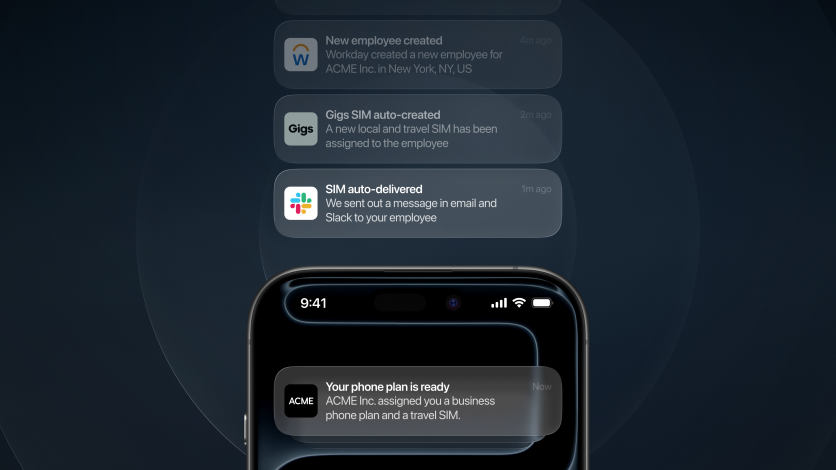
When a new employee joins, their corporate eSIM is provisioned through the same onboarding workflow that creates their email address and is delivered to the employee instantly via Slack, Teams, WhatsApp, or email with no IT involvement required.
Unlike physical SIMs, eSIMs can't be stolen or swapped, which closes a security gap that most organizations do not even realize they have. As headcount changes, SCIM-based workflows automatically activate and terminate lines as employees join or change roles. When someone's last day comes, their eSIM is deactivated through the same workflow that handles every other access credential, with no carrier portal login, no checklist item, and no window of continued access.
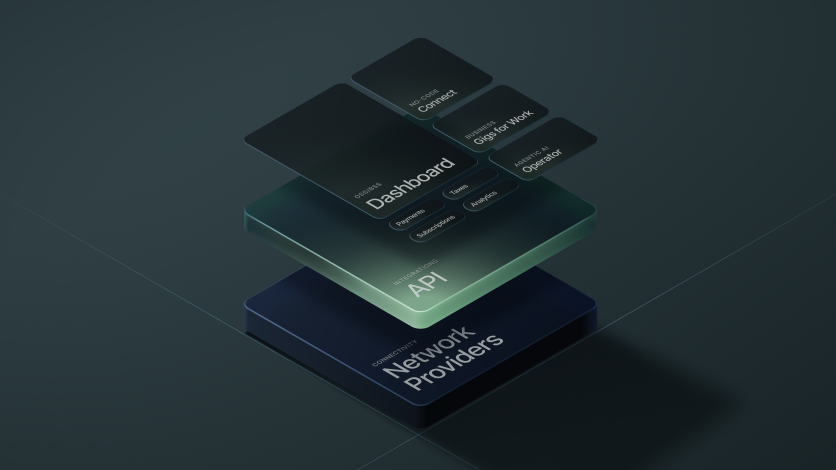
The visibility and cost picture changes just as dramatically. Every active line, usage pattern, and spend figure is visible in a single dashboard, and teams that want that data in their own systems can pull it directly via the Gigs API. Carrier contracts across all markets consolidate into a single agreement, a single invoice, and a single renewal cycle, replacing the fragmented renegotiation cycles that consume IT and finance bandwidth every year. It also comes with global roaming options so employees have a plan that works wherever they are, removing the conditions that push people onto unsecured public WiFi in the first place. And finally, SSO powered by WorkOS and SOC 2 Type II certification round out the security and compliance posture.
As a result of this, research shows that organizations that automate endpoint provisioning workflows reduce IT support costs by an average of 30 to 40%, which is precisely the kind of return Gigs is built to deliver.
Gigs
What should enterprises look for in a corporate mobile platform?
Not all enterprise mobile plan providers are equal. Many hide costs that only surface at invoice time. Many route traffic through lower-tier networks to cut wholesale costs, resulting in dropped calls and lost productivity. Once those fundamentals are right, the deeper question is which platform brings mobile plan provisioning into the managed IT model the organization already uses everywhere else. That is where purpose-built platforms separate themselves from carrier-direct relationships that were never designed for enterprise automation or security integration.
A traditional carrier relationship gives an enterprise access to network coverage and plan options, but provides no native integration with the identity, HR, and device management systems that govern every other access credential in the organization. Provisioning and deprovisioning remain manual processes that sit outside the managed IT perimeter. The carrier's incentives are oriented around contract renewal and upsell, not around helping IT maintain a clean and auditable mobile program.
Gigs meets every one of those criteria. For IT leaders who have spent years closing every other gap in the enterprise stack, it's the platform that closes the last one.
Gigs

-
 C114 Communication Network
 -
 Communication Home
