
 Search

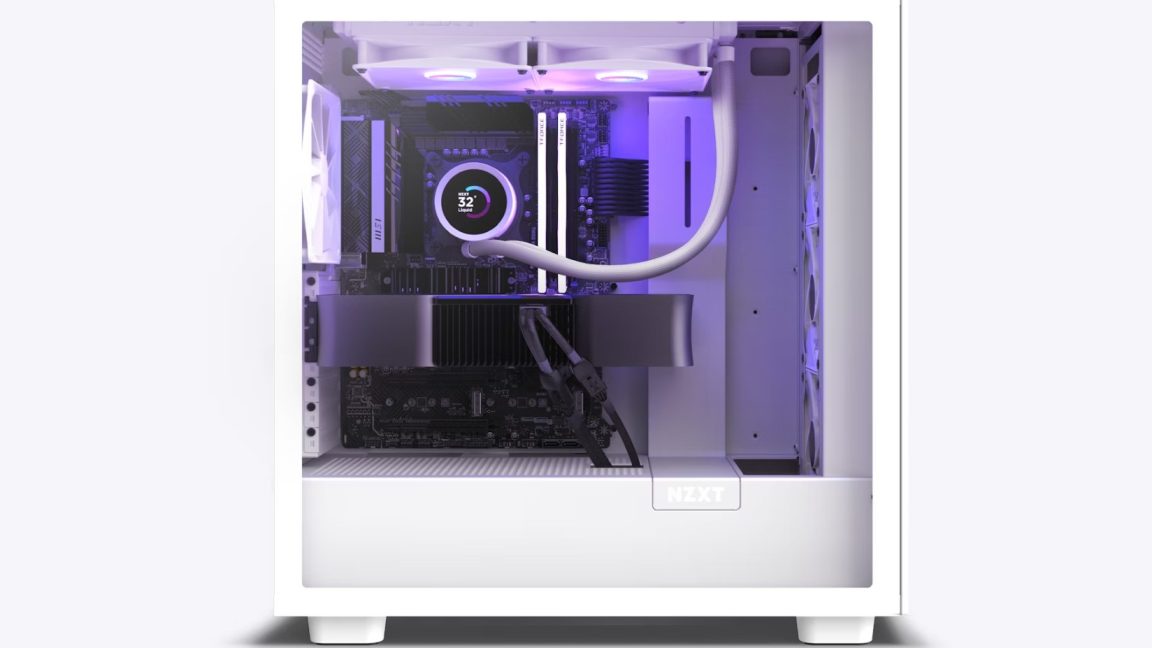
Credit: NZXT
PC hardware company NZXT and its billing partner, Fragile, have agreed to a $3,450,000 settlement in response to a class-action complaint regarding NZXT’s Flex PC rental program.
NZXT announced Flex in August 2024, saying that it would charge customers $59 to $169 a month to rent an NZXT gaming desktop (as of this writing, Flex prices are $79 to $279 per month. At the time, NZXT said that the PCs would be “new or like new.” Subscribers had the option to receive an upgraded rental PC every two years.
The program was met with criticism. Renting a PC can quickly become more costly than buying one, depending on the rental, and YouTube channel Gamers Nexus claimed in November 2024 that customers received less powerful components than expected and that NZXT advertised the rental PCs with inaccurate benchmark results. There was also concern about what NZXT did with customer data left on returned computers.
By December 2024, NZXT apologized to disgruntled customers and said that it sometimes had to change the specs of its rental PCs in “real-time” due to availability. At the time, CEO Johnny Hou said that the company would address concerns about Flex, and that NZXT is “not in the business of selling your data.” NZXT released a blog post outlining changes to Flex and its advertising, including removing “unclear messaging” from its website and bringing more “clarity” to product names so that customers know that Flex isn’t a rent-to-own program.
Fraud claims
In August 2025, three customers filed a complaint [PDF] seeking class-action certification in the US District Court for the Northern District of California against NZXT and Fragile, which handles payment and debt collection for Flex.
The lawsuit accused the companies of conspiring to “defraud consumers through gross misrepresentations and illegal business practices.” The filing further alleged:
Defendants accomplished their PC rental scheme through a bait-and-switch where Defendants (1) advertised PCs with specific components and attributes but provided consumers with lower quality components PCs and (2) misrepresented the nature of the Program including that there were no contracts, no cancellation fees, that consumers would own the PC, and leading customers to reasonably believe the Program was a rent-to-own agreement. Defendants misleading sales and advertising practices, along with bifurcating sales and marketing against the operation of the rental Program and debt enforcement, allowed Defendants to offload their supply of aging and stagnant inventory at an unlawful premium.
The complaint also cited NZXT’s 2024 blog post that admitted that Flex advertising conducted through “several” social media influencers included statements that “did not accurately reflect the details” of Flex. The complaint included screenshots from influencers, alleging that they advertised Flex as a rent-to-own program.
The complaint also claimed that the plaintiff received a desktop with an RTX 4090 instead of the expected RTX 4080 Super. Further, it alleged that a Fragile representative told a plaintiff that he could buy the PC after renting. This is despite a NZXT representative previously confirming via Reddit that Flex isn’t a rent-to-own program.
Settlement agreement
In lieu of a trial, on April 7, NZXT and Fragile reached a settlement agreement [PDF] for a class of 19,322 customers [PDF], as first spotted by Gamers Nexus. The terms of the agreement are pending approval from a judge.
The agreement would allow some customers to own the PCs that they rented if they meet certain requirements, including having signed up for Flex on or before 2024 and never received an upgraded PC, or if “their accounts are more than 90 days delinquent as of March 30, 2026 and they signed up for the NZXT Flex Program between October 29, 2024, and June 1, 2025.” The value of the PCs that users may keep is “approximately” $1,216,129.02, the agreement says.
The rest of the proposed settlement consists of a $923,117.92 debt forgiveness pool that will provide up to $5,000 to members who are 90 days past due on payments, plus a $1,450,000 settlement cash fund.
Finally, NZXT agreed to change its business practices by trying to “prohibit social media influencer advertisement campaigns from making statements that customers have an ownership interest in NZXT Flex PCs,” using different brand names for its rental PCs and PCs that can be owned (something that NZXT has done since December 2024).
The PC company also committed to providing “accurate specifications and performance statistics” for its rental PCs and requiring customers to confirm that they know Flex isn’t a rent-to-own program before subscribing.
Finally, NZXT will update Flex’s website to “prominently” inform customers that they can use software to transfer their data from one rental PC to another rental PC for free.
NZXT agreed to maintain these practices until December 31, 2027.
Ars Technica reached out to NZXT for comment, but did not hear back before publication. We’ll update the story if we receive a response.

-
 C114 Communication Network
 -
 Communication Home
