
 Search

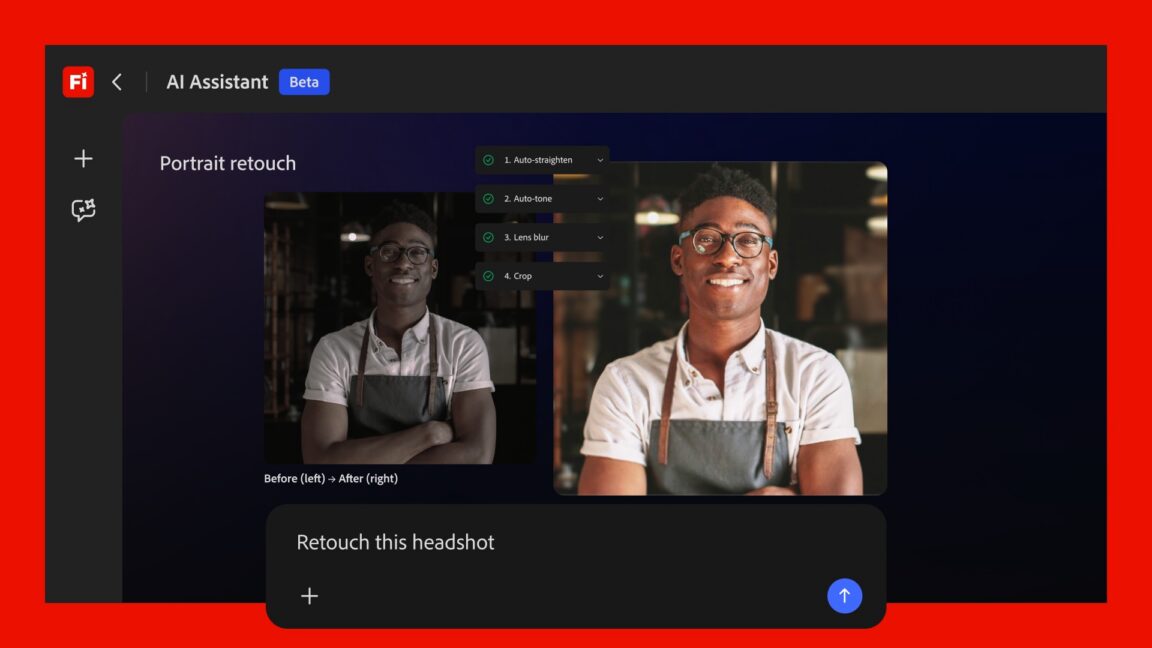
Credit: Adobe
Adobe has been putting task-specific AI tools and features into its creative productivity applications like Photoshop, Illustrator, and Premiere at a breakneck pace, but the latest product from the company—a chat-based interface that can handle complex, multi-modal projects across several applications—marks a significant shift in how users can think about its suite of tools.
You could imprecisely but defensibly call it a sort of “Claude Code for creative apps.” On one hand, it’s meant to provide experienced creatives with an efficient way to offload mundane tasks across multiple apps. On the other, it’s meant to reduce the “barrier to entry” for inexperienced or casual users, in the wake of tool complexity that the company says has previously “widened the gap between idea and output.”
Adobe has offered chat-based prompts within individual apps before and in other Firefly interfaces. It has also offered access to generative models under the Firefly brand before. What’s different here is that Firefly AI Assistant (as they call this new interface) promises to work across numerous Adobe Creative Cloud apps and to actually orchestrate workflows across them, checking in regularly with the user for suggestions and questions. As with similar tools we’ve already seen for programming and the like, users can interject mid-task with clarifications or additional information.
While it’s primarily a chat interface, it dynamically surfaces contextually relevant controls, such as sliders, based on the task at hand.
Adobe also says it can learn from users over time about their favorite tools or even stylistic preferences. That could be useful, but as with the memory features for LLMs, it could become frustrating if it pigeonholes a user. Here’s hoping you can customize that or disable that feature as needed.
In addition, there will be “skills,” which work pretty much like the skills you may have seen in similar tools for other disciplines, like OpenAI’s Codex or Anthropic’s Claude Code. Skills are essentially prepackaged integrations and workflows tailored to specific tasks. Users can tap a library of these, or they can build or configure their own.
Firefly AI Assistant was actually first previewed last October, when it had the moniker “Project Moonlight”—this is just the actual public release of that concept.
This development marks a notable shift in Adobe’s AI strategy. Think of it like this: Adobe’s approach up to this point has been somewhat similar to Apple’s, with an emphasis on leveraging models for very specific features and capabilities built into existing apps and workflows.
By contrast, this is an entirely different paradigm, where users may work significantly less within specialized applications, and the technology is used to facilitate a new approach to working rather than just giving new functionality to people who already know how to use the apps.
Adobe says Firefly AI Assistant will enter a public beta within a few weeks, but it hasn’t yet offered specifics about pricing, limits, or which users or plans it will be available to.

-
 C114 Communication Network
 -
 Communication Home
