
 Search


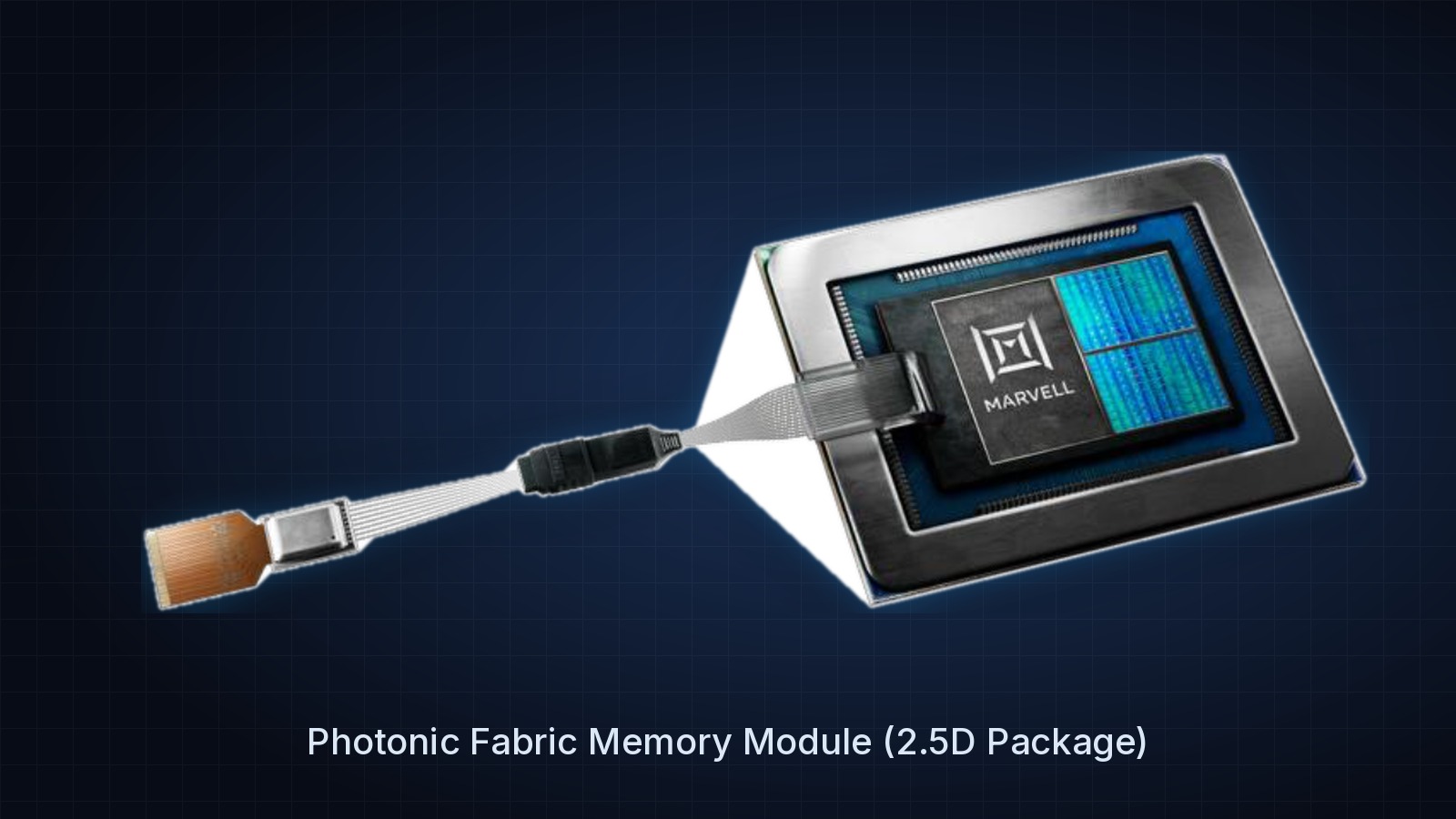
Marvell Technology and Penguin Solutions are joining forces to expand memory capacity for AI inference systems, combining CXL-based server memory expansion with optical interconnect technology designed to share memory across multiple racks. The collaboration has two distinct development tracks: integrating Marvell’s Structera X memory-expansion controllers into Penguin Solutions’ SMART CXL add-in cards, and incorporating Marvell’s Photonic Fabric technology into Penguin’s MemoryAI appliances and ComputeAI systems. The companies are targeting a progression from server-level memory expansion using existing DDR4 modules to multi-rack, petabyte-scale memory pools intended to support increasingly memory-intensive inference and agentic AI workloads.
The first phase focuses on repurposing high-density DDR4 memory recovered from decommissioned servers. Penguin Solutions plans to incorporate Marvell Structera X controllers into its SMART CXL add-in cards, enabling servers to access additional memory over PCIe 5.0 and CXL 2.0. The approach is intended to extend memory capacity without requiring wholesale replacement of existing infrastructure or reliance exclusively on new DDR5 modules. The standard add-in card form factor also supports deployment in dedicated CXL memory appliances, potentially allowing operators to aggregate recycled DDR4 capacity and allocate it across multiple hosts. Penguin expects the Structera X-powered cards to become available for qualification and enterprise customer deployment by the end of 2026.
The second phase extends memory expansion beyond individual servers through Marvell’s Photonic Fabric optical interconnect architecture. The companies plan to integrate Photonic Fabric-based memory modules and network interface cards into Penguin’s MemoryAI memory appliances and ComputeAI platforms, enabling high-bandwidth, low-latency memory sharing across racks. The architecture is intended to support petabyte-scale disaggregated memory pools for AI workloads requiring large context windows and substantial key-value (KV) cache capacity. Jointly developed Photonic Fabric-integrated memory expansion servers are expected to begin sampling in the second half of 2027. Neither company disclosed commercial pricing, production deployment commitments, or measured end-to-end performance results for the joint systems.
“By combining CXL-based memory expansion with a roadmap to optical memory sharing, Marvell and Penguin Solutions are giving CIOs and AI data center leaders a practical path to improve accelerator utilization,” said Preet Virk, senior vice president and general manager of Marvell’s Photonic Fabric Business Unit.
| AI Memory Expansion | Two-Phase Roadmap | |
| Server-level | • Marvell Structera X controllers in Penguin SMART CXL add-in cards • Reuses DDR4 from decommissioned servers • PCIe 5.0 and CXL 2.0 |
| Near-term target | • Qualification and enterprise deployments expected by end of 2026 |
| Multi-rack optical | • Photonic Fabric memory modules and NICs for MemoryAI and ComputeAI • Petabyte-scale memory pools targeted for agentic AI inference |
| Long-term target | • Joint optical-memory servers expected to sample in H2 2027 |
| Status | • Future product integration and sampling milestones; measured joint-system latency, throughput and token economics not disclosed |
Analysis
The collaboration addresses two different constraints in AI inference infrastructure: the amount of memory available to an individual server and the ability to share memory efficiently across a larger compute cluster. CXL expansion offers a standardized mechanism for extending server-accessible memory over PCIe, while optical memory fabrics target the distance, bandwidth and power constraints that arise when memory resources are distributed across racks. These approaches are complementary rather than interchangeable. CXL-based DDR4 expansion adds a capacity tier, while Photonic Fabric is designed to provide a shared-memory architecture spanning multiple systems.
The growing importance of KV cache provides an architectural rationale for both approaches. During transformer inference, previously computed attention keys and values can be retained to avoid unnecessary recomputation. KV cache requirements increase with context length, concurrency and model characteristics, potentially consuming substantial accelerator HBM capacity. Additional DDR memory can provide a larger, lower-cost capacity tier, while optical memory pooling could allow inference systems to share capacity beyond the physical boundaries of individual servers. However, remote memory does not automatically provide the bandwidth or latency characteristics of local HBM. Application performance will depend on access patterns, caching, contention, memory management software and the realized characteristics of the interconnect.
The roadmap also builds on technologies that both companies have discussed independently. Penguin previously demonstrated MemoryAI KV cache systems with up to 11 TB of CXL-based memory, while Marvell has outlined a Photonic Fabric Memory Appliance architecture supporting up to 32 TB of DDR5 and approximately 1 TB of HBM across 16 hosts. Marvell acquired Photonic Fabric through its February 2026 acquisition of Celestial AI. The new partnership introduces a joint system-integration and commercialization roadmap; previously described architecture specifications should not be interpreted as independently validated performance figures for the forthcoming Penguin systems.
The immediate opportunity is to extend the useful life of existing DDR4 inventory while adding memory capacity to AI servers. The longer-term objective is to decouple memory provisioning from individual compute nodes, allowing capacity to be allocated across larger AI deployments. The key milestones will be enterprise qualification of the CXL add-in cards during 2026 and initial sampling of the optical memory systems in the second half of 2027.
| Company Profile | Marvell Technology | |
| Company | Marvell Technology | NASDAQ: MRVL |
| Leadership | Matt Murphy, Chairman and CEO |
| Headquarters | Wilmington, Delaware (SEC principal executive office); Santa Clara, California operations |
| Technology | Custom AI silicon • Ethernet switching • Optical interconnects • CXL memory controllers • Storage connectivity |
| Memory portfolio | Structera X • Structera A • Photonic Fabric |
| Milestone | Celestial AI acquisition completed February 2, 2026 |
| Website | www.marvell.com |
| Company Profile | Penguin Solutions | |
| Company | Penguin Solutions | NASDAQ: PENG |
| Leadership | Kash Shaikh, President and CEO |
| Headquarters | Fremont, California |
| Platforms | MemoryAI • ComputeAI • ClusterWareAI • OriginAI • SMART Modular memory products |
| Markets | Enterprise AI • Neocloud infrastructure • Sovereign AI • HPC |
| Memory strategy | CXL expansion • Memory pooling • KV cache appliances • Photonic memory integration roadmap |
| Website | www.penguinsolutions.com |
We’re tracking developments in AI memory architectures, CXL expansion and optical interconnects for data centers. Follow our coverage at Converge Digest Data Centers.

-
 C114 Communication Network
-
 Communication Home
